Now, about those specifics: The HELP plan achieves near-universal coverage through a combination of regulation and subsidies. Insurance companies would be required to offer the same coverage to everyone, regardless of medical history; on the other side, everyone except the poor and near-poor would be obliged to buy insurance, with the aid of subsidies that would limit premiums as a share of income.C'mon, Congress! You really can do this thing, become true statesmen and actually help your constituents! Or... you can go with the huge insurance corporations, go with the flow, which means you are a dead fish (to quote a recently exxed governor...)Employers would also have to chip in, with all firms employing more than 25 people required to offer their workers insurance or pay a penalty. By the way, the absence of such an “employer mandate” was the big problem with the earlier, incomplete version of the plan.
And those who prefer not to buy insurance from the private sector would be able to choose a public plan instead. This would, among other things, bring some real competition to the health insurance market, which is currently a collection of local monopolies and cartels.
The budget office says that all this would cost $597 billion over the next decade. But that doesn’t include the cost of insuring the poor and near-poor, whom HELP suggests covering via an expansion of Medicaid (which is outside the committee’s jurisdiction). Add in the cost of this expansion, and we’re probably looking at between $1 trillion and $1.3 trillion.
There are a number of ways to look at this number, but maybe the best is to point out that it’s less than 4 percent of the $33 trillion the U.S. government predicts we’ll spend on health care over the next decade. And that in turn means that much of the expense can be offset with straightforward cost-saving measures, like ending Medicare overpayments to private health insurers and reining in spending on medical procedures with no demonstrated health benefits.
So fundamental health reform — reform that would eliminate the insecurity about health coverage that looms so large for many Americans — is now within reach. The “centrist” senators, most of them Democrats, who have been holding up reform can no longer claim either that universal coverage is unaffordable or that it won’t work.
Showing posts with label Universal Health Care. Show all posts
Showing posts with label Universal Health Care. Show all posts
Tuesday, July 07, 2009
It will take more than a sternly worded letter to Congress
To get them to move on health care reform, but Krugman helps shove them along:

Wednesday, June 10, 2009
THAT'S what we're talking about!!
Hitting the Republicans with the truth!
Thank you Senator Jeff Merkley!!
It's not every day that a sitting senator takes to the floor to call out a GOP strategist. But on Wednesday, Oregon Democrat Jeff Merkley did just that, whacking messaging guru Frank Luntz for writing a blueprint for demonizing health care reform and Republican officials for dutifully following his lead.
Thank you Senator Jeff Merkley!!
Sunday, May 10, 2009
Thursday, March 26, 2009
Stand with Dr. Dean
Sign the petition
Give America a choice. We support healthcare reform that allows individual Americans to choose either a universally available public healthcare option like Medicare or for-profit private insurance. A public option is the only way to guarantee healthcare for all Americans and its inclusion is non- negotiable.
Any legislation without the choice of a public option is only insurance reform and not the healthcare reform America needs.
Saturday, March 07, 2009
Republicans think your family doesn't 'need' health care coverage
Because it is apparently a 'want' not a 'need'.
Gee. Thanks. Let me just cough into your food as I prepare your order...
Gee. Thanks. Let me just cough into your food as I prepare your order...
Wednesday, July 23, 2008
Monday, June 23, 2008
Friday, June 20, 2008
Monday, June 09, 2008
Evil socialized medicine
Southern Beale gets to see it function on a trip (in more ways than one) to Norway.
Clearly, our health care system in the US is much much... ah... more .. uh.. differenter!
Clearly, our health care system in the US is much much... ah... more .. uh.. differenter!
Tuesday, July 10, 2007
What next for the health care movement?
Charley Blandy of Firedoglake:
And here is more from the article on Dr. Prem Reddy and his methods:
Go read the article here.
Update: Dr. Prem Reddy quoted in the article: (my bold)
...Real transformation, real health care justice, real humanity, will capture the public’s imagination. We’ve got to advocate for something we understand, something we can relate to, something we’d actually want. As citizens, it’s not our job to make excuses for our dysfunctional politics, or our dysfunctional health care. It’s not our job to parrot policy buzzwords: “Quality, affordable, accessible blah blah blah”. At this point, we should unapologetically advocate for a principle, not a policy: People should not be denied the medical care they need. Ever. Pretty simple, huh? How can anyone of good conscience deny that?Charley asks for comments.We must decide our true north, and make our policymakers follow it. Yeah, we’ve got to know enough about policy to know when someone’s trying to put one over on us, and we need to be wary of gauzy rhetoric backed up by slender substance. But if we lead with a statement of our core principles now, we’ll have a standard by which to evaluate the process as it continues — and indeed, participate and shape it according to our values.
What are the next steps for the health care movement?
And here is more from the article on Dr. Prem Reddy and his methods:
Critics say Reddy-owned hospitals routinely turn away uninsured patients, an allegation the company denies.Compare and contrast to the comments by two doctors in reaction to the Los Angeles article about Prime Healthcare.
On four occasions since 2002, inspectors have found that Prime Healthcare facilities failed to meet minimum federal safety standards, placing their Medicare funding at risk.
Records show that in one two-hour period during 2003, three uninsured patients left the emergency room at Desert Valley Hospital in Victorville after waiting up to four hours without being treated. Two of them were under 2 years old, including a 16-month-old girl who arrived with burns on her left hand.
The same year, Reddy discharged an uninsured patient he was personally treating who was in kidney failure, suggesting that the patient go to a nearby county facility where he could sign up for free care. The patient waited until the following day to visit another emergency room, records show.
State regulators found that the medical staff failed to make sure that discharging the patient "would not create a medical hazard."
In an interview, Reddy said the problems found by regulators in recent years were "insignificant" for a hospital chain of its size and that state data show Prime Healthcare hospitals have increased charity care to the uninsured. He said the company had taken corrective measures.
Reddy confirmed that he discharged the kidney patient, but said he did so after another doctor verified that the patient was stable. He added that the patient could apply for state Medi-Cal insurance at the county hospital more quickly.
More than a dozen current and former medical staffers and administrators interviewed by The Times said they were concerned that the company's business practices were putting patients in jeopardy. Many declined to talk on the record for fear of losing their job or being sued.
Experts say Prime Healthcare's unusual business model reduces patient access to services, significantly raises costs and, as the company grows, could destabilize California's healthcare system.
"Once you really take a look at what he's doing, it's hard to say the community benefits under his system," said Stan Otake, an Orange County healthcare consultant and former chief executive of Bellflower Medical Center.
Go read the article here.
Update: Dr. Prem Reddy quoted in the article: (my bold)
Reddy said his company's approach allowed it to be more efficient than its rivals, and he remained unapologetic to those who said the company was too focused on the bottom line. Patients, he said, may simply deserve only the amount of care they can afford.
Friday, July 06, 2007
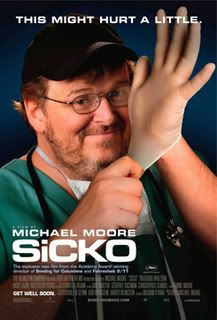
Wednesday, July 04, 2007
Doing the math
For a better health care system. It wouldn't cost that much, says R. Neal of Looking South. Check the link for his comparisons of American, Canadian, French and British taxes and expenses. Neal concludes:
So, yes, providing universal insurance coverage or universal health care for everyone would cost a little more in taxes, but not that much more. And think of the savings, not to mention peace of mind and security. It seems pretty clear that it would be better than the $2 trillion we spend now that leaves nearly 50 million people behind and gives false hope to the other 250 million who think they are insured until they file a claim.Thank you. Another blockade destroyed, another hurdle removed. Watch Big Pharma and the Insurance companies build another one...
Subscribe to:
Posts (Atom)