Meteor shower incoming.
Arizona allows open carry in airports... which gets you this idiocy. And this reaction.
Sen. Sheldon Whitehouse (D-RI) debunks the anti-climate change Republicans, on video.
America's most hated banks.
Garbage men know all.
More methane sinkholes?
Showing posts with label Garbage. Show all posts
Showing posts with label Garbage. Show all posts
Tuesday, July 29, 2014

Friday, June 22, 2012
Imagine the world without plastic
No, I can't either. Will we ever be able to clean up what we have done? Can we stop?
Thursday, June 14, 2012
Why am I in this handbasket and why is it getting so warm?
Drowning in our own garbage.
Let the United States Holy Wars begin! Lo, the Lord sayeth, smite them, smite them, smite them!!
Surviving the flesh eating virus, lightning, and boobs.
The dangers of for-profit schools and prisons, and why the Republicans are embracing them wholeheartedly: More bodies, more money to wring out of them, and no oversight! Such a deal! Quality of schooling and dedication to returning prisoners to society are not involved:
Let the United States Holy Wars begin! Lo, the Lord sayeth, smite them, smite them, smite them!!
Surviving the flesh eating virus, lightning, and boobs.
The dangers of for-profit schools and prisons, and why the Republicans are embracing them wholeheartedly: More bodies, more money to wring out of them, and no oversight! Such a deal! Quality of schooling and dedication to returning prisoners to society are not involved:
Leonard invokes the “numerous lawsuits” against a company called Corinthian Colleges, including one in which a former admissions officer described high-pressure, even bullying recruitment tactics at one of the company’s schools, Everest: “The ultimate goal was to essentially make [potential students] wallow in their grief,” the admission officer’s affidavit says, feel that pain of having accomplished nothing in life, and then use that pain as their “reasons” to compel the leads to schedule an in-person meeting with an Everest admissions representative. A spokesman for Corinthian denied this account of its recruiting, but, as Leonard writes, “there’s little question that an obsessive focus on constantly boosting enrollment is crucial to survival in the for-profit college world. Sky-high withdrawal rates plague the industry.”Further down in the same article:
Chang’s series in the Times-Picayune, meanwhile, took a close look at how it is that Louisiana nearly doubled its prison population in the past twenty years, to become the state with the highest per-capita incarceration rate in the country—the highest in the world, in fact. (Adam Gopnik has written for The New Yorker about our mass-incarceration culture.) What Chang finds is a system under which the state began housing the majority of its inmates in for-profit facilities, many of them run by cash-strapped local sheriffs and some by private prison companies. Both have a financial incentive to keep the prisons full— like hotels, prisons in Louisiana don’t want any vacancies. “If the inmate count drops, sheriffs bleed money,” writes Chang. “Their constituents lose jobs. The prison lobby ensures this does not happen by thwarting nearly every reform that could result in fewer people behind bars.”
Thursday, August 06, 2009
Blog sprinkles

US Drought meter.
Tengrain: The day Bush got the memo titled Bin Laden Determined to Attack US. We will never forget.
Bryan warns us about the crow/squirrel cabal.
Go Rick Sanchez!
A CNN anchor today tore down Rick Scott, the founder of an organization that's been funding anti-health care reform protests and the former CEO of a hospital company that, as Sanchez pointed out, paid $1.7 billion to settle charges of overcharging Medicare and Medicaid.Brutal but delicious!
It was brutal.
Camping with vampires...
Eli posts the map that proves only 4 states are now solidly Republican. Maybe if we can get the birthers and the screechers calling for lynchings to keep it up, we may even get those states....
Garbage, the next frontier!
Biomass is a word that’s new to most people, and you aren’t likely to hear it tossed around over Sunday dinner at Auntie Myrtle’s. But you can bet you will be exposed to it plenty in coming years.KBR poisoned our troops and doesn't give a shit.
Although the term has several definitions, here it is used to mean piles or containers of organic matter that can be tapped for energy. The list of biomass materials is long—agricultural and food waste, wood chips, yard clippings, microorganisms, animal byproducts and many other things.
Among the prime fodder of biomass scientists are hundreds of substances that aren’t bashful about giving off sinus-clearing scents. Yes, many of today’s biomass pioneers just love castoffs that reek. These men and women dance through a universe of aromas that are not welcome in the better parts of town. The stink from cow pies. From chicken dirt. From festering mountains of garbage. And, hold on to your tear glands, even rivers of onion juice.
At the hearing, the Senators heard about an incident at a facility in Qarmat Ali where several hundred troops from the Oregon National Guard (and some from Indiana and West Virginia) were exposed to a chemical called sodium dichromate. (Seen the movie Erin Brockovich? That's the stuff that got all those folks so sick.)Buddhist treasures found again in Gobi desert.
Mudflats of Alaska cringes at the teabagging over the stimulus.
Murdock demands payment for news....
... and people go elsewhere. Bye!News Corp is set to start charging online customers for news content across all its websites.
The media giant is looking for additional revenue streams after announcing big losses.
The company lost $3.4bn (£2bn) in the year to the end of June, which chief executive Rupert Murdoch said had been "the most difficult in recent history".
News Corp owns the Times and Sun newspapers in the UK and the New York Post and Wall Street Journal in the US.
Update insert: Newsy is an interesting new media site offering many different viewpoints for the same news story. Excellent idea!
Avendon celebrates a fiery liberal.
Cookie Jill posts the list: Top 20 Largest Cases of Companies Caught For Committing Fraud Against the Government
Distributorcap NY notes the theme of old bags on airplanes.
Athenae: Just how many kids have faced the wrong end of a gun?
Friday, June 05, 2009
If we don't bomb ourselves to death
We will die buried in the garbage we create. Take a look at these 17 photos. Here is one:
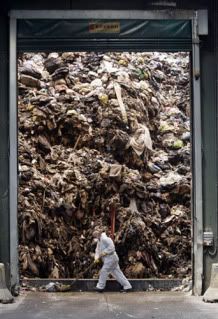

An employee works inside the Caivano dump, near Naples, southern Italy, where rubbish is turned into bales. Neapolitans took the law into their own hands after the city ran out of space to dump rubbishIt will make you want to never have to throw anything out again...
Photograph: Salvatore Laporta/AP
Friday, January 09, 2009
Maybe this will keep the islands from disappearing under water
Garbage!
Update: The recycling business is collapsing! Buy more! How else can we keep this world economy afloat?
Remember, folks, we're creating a new floating continent entirely made out of plastics as well! This is the wave of the future!It may be known as a tropical paradise, an archipelago of 1,200 coral islands in the Indian Ocean. But the traditional image of the Maldives hides a dirty secret: the world's biggest rubbish island.
A few miles and a short boat ride from the Maldivian capital, Malé, Thilafushi began life as a reclamation project in 1992. The artificial island was built to solve Malé's refuse problem. But today, with more than 10,000 tourists a week in the Maldives adding their waste, the rubbish island now covers 50 hectares (124 acres).
So much is being deposited that the island is growing at a square metre a day. There are more than three dozen factories, a mosque and homes for 150 Bangladeshi migrants who sift through the mounds of refuse beneath palm-fringed streets.
Update: The recycling business is collapsing! Buy more! How else can we keep this world economy afloat?
Monday, September 01, 2008
Plastic is forever
This post deserves repeating:Honolulu, HI (AHN) -- Two men have successfully sailed from California to Hawaii in a raft made of plastic bottles and Cessna airplane parts.
Dr. Marcus Eriksen and Joel Paschal built their raft, which they named "Junk," out of 15,000 plastic bottles and a Cessna 310 fuselage. The purpose of their journey was to bring attention to the massive amount of plastic floating at sea.
The Northern Pacific Gyre, which has been getting some alternative media attention this year, is an area twice the size of Britain that swirls with tons of plastics used for water bottles, food containers, and various other one-time purposes.
Eriksen and Paschal described to reporters instances during their 2,600 mile journey when they caught a fish to eat, only to find plastic in its stomach when they cut it open.
During the 87 day journey, the two men saw first hand that "plastic is forever, and it's everywhere," as yahctpals.com reported Eriksen wrote in his journal at the end of the trip.
He went on to say that he plans to use the voyage as a starting point to create a dialogue about how to deal with the problem of disposable plastics.
Making a new continentBefore you despair too much, another post mentions the teenage boy who discovered how to decompose plastic bags.
One plastic bag at a time: In the broad expanse of the northern Pacific Ocean, there exists the North Pacific Subtropical Gyre, a slowly moving, clockwise spiral of currents created by a high-pressure system of air currents. The area is an oceanic desert, filled with tiny phytoplankton but few big fish or mammals. Due to its lack of large fish and gentle breezes, fishermen and sailors rarely travel through the gyre. But the area is filled with something besides plankton: trash, millions of pounds of it, most of it plastic. It's the largest landfill in the world, and it floats in the middle of the ocean.It's the world's biggest landfill and it's in the Pacific Ocean
The gyre has actually given birth to two large masses of ever-accumulating trash, known as the Western and Eastern Pacific Garbage Patches, sometimes collectively called the Great Pacific Garbage Patch. The Eastern Garbage Patch floats between Hawaii and California; scientists estimate its size as two times bigger than Texas [source: LA Times]. The Western Garbage Patch forms east of Japan and west of Hawaii. Each swirling mass of refuse is massive and collects trash from all over the world. The patches are connected by a thin 6,000-mile long current called the Subtropical Convergence Zone. Research flights showed that significant amounts of trash also accumulate in the Convergence Zone.
Tuesday, July 08, 2008
Make your own fuel from your garbage!
Sounds efficient until you begin to think about how many incompetent neighbors would blow up their houses during the process...
Floyd Butterfield was ahead of today's need for alternative energy sources when he built a small Paso Robles plant that would produce fuel from alcohol — in 1981.
But not until recently, as gasoline prices started creeping up, has Butterfield’s contest-winning design for a small-scale ethanol production plant garnered worldwide attention.
Now he's designing and consulting for two innovative ethanol-based businesses. One includes production of four small-scale gas-from-trash plants in the Midwest, and another could bring ethanol production into your own backyard.
Thursday, June 26, 2008
Awash
Early estimates suggest that the extent of the cleanup will be unlike anything some of the flooded cities have experienced. And some of what the water left behind is toxic, experts said, possibly tinged with raw sewage or chemical runoff from agriculture.Lives destroyed by flooding occurs in the ocean as well:
In Cedar Rapids alone, it is estimated that the 4,200 flooded houses are producing about a ton of debris each, mostly heavy appliances, electronics and furniture. Beyond that, businesses, schools, hospitals, churches and government offices are flooded, bringing the city’s total flood-related garbage load to about 300,000 tons, officials estimated.
A typical garbage truck can handle about four tons of trash.
“We’re looking at 10 to 15 times as much garbage as we’ve ever dealt with, so this is huge,” said Mark Jones, the superintendent of the city’s solid waste and recycling division. Backup trucks are arriving from across the state. “As you could see, it would take us forever to do this,” he said.
Des Moines, IA (AHN) - The marine dead zone resulting from the Midwest flooding is expected to expand to over 10,000 square miles, according to researchers from the Louisiana State University and the Louisiana Universities Marine Consortium.
The water in the dead zone, approximately the size of Massachusetts, does not have sufficient oxygen at depth to support marine life. Since 1990, the zone, located off the coasts of Louisiana and Texas, usually covers 6,000 square miles, varying according to the flow of the Mississippi River.
Wednesday, June 04, 2008
What would we do without science?
Stealing this pic from perspicio of Today We Choose Faces:
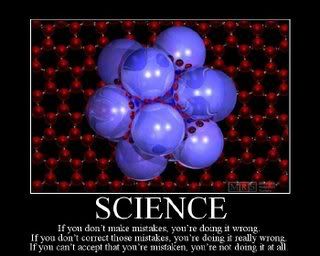
(click the pic to read it)
To remind us what those who love the scientific process can do:
(click the pic to read it)
To remind us what those who love the scientific process can do:
This month heralds a world-changing scientific breakthrough as a teenage prodigy has developed a new way to decompose plastic bags in just three months! A 16 year old named Daniel Burd conducted his experiment as a science fair project, and ended up with a revolutionary solution to the plastic plague that has laid waste to ecosystems around the world. By isolating the microorganisms that break down plastic, Burd’s research has yielded an industrially scalable way to cinch closed the material’s millennium-spanning life-cycle.I posted this in November of '07 and deserves a reprint:
Plastic bags, once icons of customer convenience, cost more than 1.6 billion barrels of oil per year and leave the environment to foot the bill. The statistics are scary - each year the world produces 500 billion bags, and Earth Resource Foundation states that “all the plastic that has been made is still around in smaller and smaller pieces.” Meanwhile the UN Environment Program estimates that there are 46,000 pieces of plastic litter in every square mile of ocean, and a swirling vortex of trash twice the size of Texas has spawned in the North Pacific.
Making a new continent: One plastic bag at a time In the broad expanse of the northern Pacific Ocean, there exists the North Pacific Subtropical Gyre, a slowly moving, clockwise spiral of currents created by a high-pressure system of air currents. The area is an oceanic desert, filled with tiny phytoplankton but few big fish or mammals. Due to its lack of large fish and gentle breezes, fishermen and sailors rarely travel through the gyre. But the area is filled with something besides plankton: trash, millions of pounds of it, most of it plastic. It's the largest landfill in the world, and it floats in the middle of the ocean.It's the world's biggest landfill and it's in the Pacific Ocean.
The gyre has actually given birth to two large masses of ever-accumulating trash, known as the Western and Eastern Pacific Garbage Patches, sometimes collectively called the Great Pacific Garbage Patch. The Eastern Garbage Patch floats between Hawaii and California; scientists estimate its size as two times bigger than Texas [source: LA Times]. The Western Garbage Patch forms east of Japan and west of Hawaii. Each swirling mass of refuse is massive and collects trash from all over the world. The patches are connected by a thin 6,000-mile long current called the Subtropical Convergence Zone. Research flights showed that significant amounts of trash also accumulate in the Convergence Zone.
Thursday, November 01, 2007
Making a new continent
One plastic bag at a time:
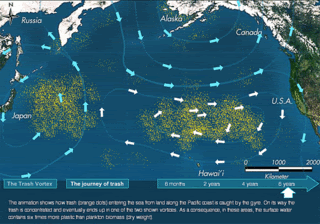
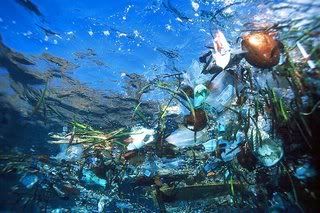
In the broad expanse of the northern Pacific Ocean, there exists the North Pacific Subtropical Gyre, a slowly moving, clockwise spiral of currents created by a high-pressure system of air currents. The area is an oceanic desert, filled with tiny phytoplankton but few big fish or mammals. Due to its lack of large fish and gentle breezes, fishermen and sailors rarely travel through the gyre. But the area is filled with something besides plankton: trash, millions of pounds of it, most of it plastic. It's the largest landfill in the world, and it floats in the middle of the ocean.It's the world's biggest landfill and it's in the Pacific Ocean.
The gyre has actually given birth to two large masses of ever-accumulating trash, known as the Western and Eastern Pacific Garbage Patches, sometimes collectively called the Great Pacific Garbage Patch. The Eastern Garbage Patch floats between Hawaii and California; scientists estimate its size as two times bigger than Texas [source: LA Times]. The Western Garbage Patch forms east of Japan and west of Hawaii. Each swirling mass of refuse is massive and collects trash from all over the world. The patches are connected by a thin 6,000-mile long current called the Subtropical Convergence Zone. Research flights showed that significant amounts of trash also accumulate in the Convergence Zone.
Subscribe to:
Posts (Atom)