
Showing posts with label Great Pacific Garbage Patch. Show all posts
Showing posts with label Great Pacific Garbage Patch. Show all posts
Thursday, June 14, 2018

Friday, June 07, 2013
Friday froth
6 Baffling Discoveries That Science Can’t Explain
Healthy tips for surviving our chemicalized world
Fixing the climate.
Learning a new language is good for your brain.
Monsanto's unapproved wheat found in Oregon is affecting the export of wheat to those countries who have said no to GMOs. Too late.... so the farmers are suing Monsanto.
One girl in a village.
Everything you ever wanted to know about ticks.
19-Year-Old Develops Ocean Cleanup Array That Could Remove 7,250,000 Tons Of Plastic From Oceans
Roman Seawater Concrete Holds the Secret to Cutting Carbon Emissions
High Fructose Corn Syrup is addictive....
Healthy tips for surviving our chemicalized world
Fixing the climate.
Learning a new language is good for your brain.
Monsanto's unapproved wheat found in Oregon is affecting the export of wheat to those countries who have said no to GMOs. Too late.... so the farmers are suing Monsanto.
One girl in a village.
Everything you ever wanted to know about ticks.
19-Year-Old Develops Ocean Cleanup Array That Could Remove 7,250,000 Tons Of Plastic From Oceans
Roman Seawater Concrete Holds the Secret to Cutting Carbon Emissions
High Fructose Corn Syrup is addictive....
Thursday, August 09, 2012
The perils of plastic pellets
Following the aftermath of Typhoon Vincent this week, the worst typhoon to hit Hong Kong in 15 years, hundreds of 25kg plastic sacks filled with pre-production plastic pellets (aka Nurdles) produced by SINOPEC Petroleum Hainan are now washing up on the beaches of Hong Kong.
[snip]
So far we have discovered 250 plus sacks, of which approximately 50% have spilled their deadly contents into the ecosystem. This is the equivalent of a SOLIDIFIED OIL SPILL. Each sack contains approximately 1 million pellets. The 250 sacks were all on our local beach, we have put out a call to action asking ocean lovers all over Hong Kong to visit their local beaches and check them for these "white plastic sacks of death," and if found to report them to Sea Shepherd Hong Kong who are working with local authorities on the cleanup operation. The biggest problem is that this material absorbs toxins and pollutants, turning it a yellowish brown color. The darker the pellet becomes the more toxic it is. Small fish, birds, and even large filter feeding species such as whales, whale sharks, and manta rays eat these pellets, mistaking them for fish eggs. Once eaten, the animals become toxic and often die. Bigger fish eat the small fish and this continues up the food chain, spreading the toxicity into seafood that will end up on our tables for human consumption.Just finished reading The World Without Us by Alan Weisman. One of the book's chapters addresses the horror of the many plastic gyres in the oceans... and the small toxic glop that is poisoning the marine life. Can we possibly fix this problem before we kill off everything? We can only wait and see.... Update: It is suggested that plastics could be linked to diabetes and obesity.
Wednesday, July 11, 2012
Stuff. Because it's still hot at 11 o'clock at night.
The facts about the Great Pacific Plastic Garbage Gyre.
Your chair is trying to kill you.
Florida... *cough*.. *cough*
An evil plot to create more stupid voters who vote against their own interests.
A Lego bridge in Germany.
Star Trek?! NO.... ALIENS!!
Contraception saves 250,000 lives each year: study
Odds of record U.S. heat being a random event: 1 in 1.6 million and U.S. Sees Hottest 12 Months And Hottest Half Year On Record and so Climate scientists are finally coming forth and making the connection between human activity and the wild weather.
Woman photographs her own abortion to educate women and fight the ugly fear-mongering anti-choice protesters use.
Rush Limbaugh's phony empire.
Bees are smarter than supercomputers.
Monsanto gets an F.
Your chair is trying to kill you.
Florida... *cough*.. *cough*
An evil plot to create more stupid voters who vote against their own interests.
A Lego bridge in Germany.
Star Trek?! NO.... ALIENS!!
Contraception saves 250,000 lives each year: study
Odds of record U.S. heat being a random event: 1 in 1.6 million and U.S. Sees Hottest 12 Months And Hottest Half Year On Record and so Climate scientists are finally coming forth and making the connection between human activity and the wild weather.
Woman photographs her own abortion to educate women and fight the ugly fear-mongering anti-choice protesters use.
Rush Limbaugh's phony empire.
Bees are smarter than supercomputers.
Monsanto gets an F.
Friday, June 22, 2012
Imagine the world without plastic
No, I can't either. Will we ever be able to clean up what we have done? Can we stop?
Wednesday, May 09, 2012
Can we stop ourselves from poisoning the earth?
We use our oceans both as a pantry and as a toilet. We drill without knowing how to plug the holes. We genetically modify without testing. Will we die before we learn we are poisoning ourselves and future generations? ... don't answer that.
Following Garbage's Long Journey Around The Earth
Study: Plastic in 'Great Pacific Garbage Patch' increases 100-fold
The lesson of the Gulf of Mexico is forgotten...
Following Garbage's Long Journey Around The Earth
Study: Plastic in 'Great Pacific Garbage Patch' increases 100-fold
The lesson of the Gulf of Mexico is forgotten...
Rules relaxed for reporting offshore oil and gas accidents:
The North Sea safety regulator has lightened up the rules for reporting accidents offshore even as one operator in the field, Total, struggles to halt a gas leak that has been going on for over a month. The Health and Safety Executive (HSE) has introduced a new regulation that says injuries need only be reported if workers are out of action for over seven days. The former level was three days.Exclusive: Shale causes rise in waste gas pollution
(Reuters) - The shale energy boom is fuelling a rise in the burning of waste gas after years of decline, a World Bank source told Reuters ahead of the release of new data, giving environmentalists more ammunition against the industry.Monsanto's attempts to stifle reporters:
Wednesday, February 22, 2012
Stuff I read today....
Radiation detected 400 miles off Japanese coast
Netherlands Closing 8 Prisons Due To Plummeting Crime Rates
DEAR ENTREPRENEURS, ATHLETES AND LOTTERY WINNERS: Here's How To Keep All That Money You Made
SwedishMealTime chef
The great escape: the bath toys that swam the Pacific
Opus Dei: Neofascism Within the Catholic Church
Teaching science and evolution to religious rural kids.
Radioactive contamination from the Fukushima power plant disaster has been detected as far as almost 400 miles off Japan in the Pacific Ocean, with water showing readings of up to 1,000 times more than prior levels, scientists reported Tuesday.300 million year old forest
Netherlands Closing 8 Prisons Due To Plummeting Crime Rates
DEAR ENTREPRENEURS, ATHLETES AND LOTTERY WINNERS: Here's How To Keep All That Money You Made
SwedishMealTime chef
The great escape: the bath toys that swam the Pacific
When 28,800 bath toys fell off a cargo ship in the Pacific 20 years ago, they began an incredible journey. While some washed up in British Columbia and Hawaii, countless others circumnavigated the globe.Tiny 'Soccer Ball' Space Molecules Could Equal 10,000 Mount Everests
Opus Dei: Neofascism Within the Catholic Church
Teaching science and evolution to religious rural kids.
Friday, October 28, 2011
Monday, September 01, 2008
Plastic is forever
This post deserves repeating:Honolulu, HI (AHN) -- Two men have successfully sailed from California to Hawaii in a raft made of plastic bottles and Cessna airplane parts.
Dr. Marcus Eriksen and Joel Paschal built their raft, which they named "Junk," out of 15,000 plastic bottles and a Cessna 310 fuselage. The purpose of their journey was to bring attention to the massive amount of plastic floating at sea.
The Northern Pacific Gyre, which has been getting some alternative media attention this year, is an area twice the size of Britain that swirls with tons of plastics used for water bottles, food containers, and various other one-time purposes.
Eriksen and Paschal described to reporters instances during their 2,600 mile journey when they caught a fish to eat, only to find plastic in its stomach when they cut it open.
During the 87 day journey, the two men saw first hand that "plastic is forever, and it's everywhere," as yahctpals.com reported Eriksen wrote in his journal at the end of the trip.
He went on to say that he plans to use the voyage as a starting point to create a dialogue about how to deal with the problem of disposable plastics.
Making a new continentBefore you despair too much, another post mentions the teenage boy who discovered how to decompose plastic bags.
One plastic bag at a time: In the broad expanse of the northern Pacific Ocean, there exists the North Pacific Subtropical Gyre, a slowly moving, clockwise spiral of currents created by a high-pressure system of air currents. The area is an oceanic desert, filled with tiny phytoplankton but few big fish or mammals. Due to its lack of large fish and gentle breezes, fishermen and sailors rarely travel through the gyre. But the area is filled with something besides plankton: trash, millions of pounds of it, most of it plastic. It's the largest landfill in the world, and it floats in the middle of the ocean.It's the world's biggest landfill and it's in the Pacific Ocean
The gyre has actually given birth to two large masses of ever-accumulating trash, known as the Western and Eastern Pacific Garbage Patches, sometimes collectively called the Great Pacific Garbage Patch. The Eastern Garbage Patch floats between Hawaii and California; scientists estimate its size as two times bigger than Texas [source: LA Times]. The Western Garbage Patch forms east of Japan and west of Hawaii. Each swirling mass of refuse is massive and collects trash from all over the world. The patches are connected by a thin 6,000-mile long current called the Subtropical Convergence Zone. Research flights showed that significant amounts of trash also accumulate in the Convergence Zone.
Wednesday, June 04, 2008
What would we do without science?
Stealing this pic from perspicio of Today We Choose Faces:
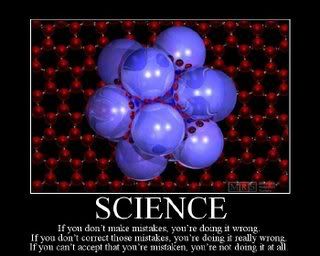
(click the pic to read it)
To remind us what those who love the scientific process can do:
(click the pic to read it)
To remind us what those who love the scientific process can do:
This month heralds a world-changing scientific breakthrough as a teenage prodigy has developed a new way to decompose plastic bags in just three months! A 16 year old named Daniel Burd conducted his experiment as a science fair project, and ended up with a revolutionary solution to the plastic plague that has laid waste to ecosystems around the world. By isolating the microorganisms that break down plastic, Burd’s research has yielded an industrially scalable way to cinch closed the material’s millennium-spanning life-cycle.I posted this in November of '07 and deserves a reprint:
Plastic bags, once icons of customer convenience, cost more than 1.6 billion barrels of oil per year and leave the environment to foot the bill. The statistics are scary - each year the world produces 500 billion bags, and Earth Resource Foundation states that “all the plastic that has been made is still around in smaller and smaller pieces.” Meanwhile the UN Environment Program estimates that there are 46,000 pieces of plastic litter in every square mile of ocean, and a swirling vortex of trash twice the size of Texas has spawned in the North Pacific.
Making a new continent: One plastic bag at a time In the broad expanse of the northern Pacific Ocean, there exists the North Pacific Subtropical Gyre, a slowly moving, clockwise spiral of currents created by a high-pressure system of air currents. The area is an oceanic desert, filled with tiny phytoplankton but few big fish or mammals. Due to its lack of large fish and gentle breezes, fishermen and sailors rarely travel through the gyre. But the area is filled with something besides plankton: trash, millions of pounds of it, most of it plastic. It's the largest landfill in the world, and it floats in the middle of the ocean.It's the world's biggest landfill and it's in the Pacific Ocean.
The gyre has actually given birth to two large masses of ever-accumulating trash, known as the Western and Eastern Pacific Garbage Patches, sometimes collectively called the Great Pacific Garbage Patch. The Eastern Garbage Patch floats between Hawaii and California; scientists estimate its size as two times bigger than Texas [source: LA Times]. The Western Garbage Patch forms east of Japan and west of Hawaii. Each swirling mass of refuse is massive and collects trash from all over the world. The patches are connected by a thin 6,000-mile long current called the Subtropical Convergence Zone. Research flights showed that significant amounts of trash also accumulate in the Convergence Zone.
Thursday, November 01, 2007
Making a new continent
One plastic bag at a time:
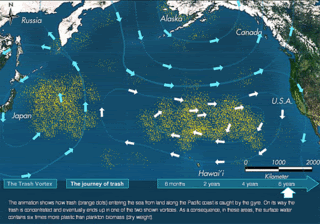
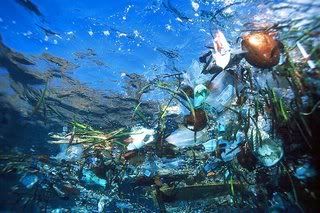
In the broad expanse of the northern Pacific Ocean, there exists the North Pacific Subtropical Gyre, a slowly moving, clockwise spiral of currents created by a high-pressure system of air currents. The area is an oceanic desert, filled with tiny phytoplankton but few big fish or mammals. Due to its lack of large fish and gentle breezes, fishermen and sailors rarely travel through the gyre. But the area is filled with something besides plankton: trash, millions of pounds of it, most of it plastic. It's the largest landfill in the world, and it floats in the middle of the ocean.It's the world's biggest landfill and it's in the Pacific Ocean.
The gyre has actually given birth to two large masses of ever-accumulating trash, known as the Western and Eastern Pacific Garbage Patches, sometimes collectively called the Great Pacific Garbage Patch. The Eastern Garbage Patch floats between Hawaii and California; scientists estimate its size as two times bigger than Texas [source: LA Times]. The Western Garbage Patch forms east of Japan and west of Hawaii. Each swirling mass of refuse is massive and collects trash from all over the world. The patches are connected by a thin 6,000-mile long current called the Subtropical Convergence Zone. Research flights showed that significant amounts of trash also accumulate in the Convergence Zone.
Subscribe to:
Posts (Atom)