Showing posts with label South Pacific Gyre. Show all posts
Showing posts with label South Pacific Gyre. Show all posts
Friday, June 22, 2012
Imagine the world without plastic
No, I can't either. Will we ever be able to clean up what we have done? Can we stop?

Wednesday, May 09, 2012
Can we stop ourselves from poisoning the earth?
We use our oceans both as a pantry and as a toilet. We drill without knowing how to plug the holes. We genetically modify without testing. Will we die before we learn we are poisoning ourselves and future generations? ... don't answer that.
Following Garbage's Long Journey Around The Earth
Study: Plastic in 'Great Pacific Garbage Patch' increases 100-fold
The lesson of the Gulf of Mexico is forgotten...
Following Garbage's Long Journey Around The Earth
Study: Plastic in 'Great Pacific Garbage Patch' increases 100-fold
The lesson of the Gulf of Mexico is forgotten...
Rules relaxed for reporting offshore oil and gas accidents:
The North Sea safety regulator has lightened up the rules for reporting accidents offshore even as one operator in the field, Total, struggles to halt a gas leak that has been going on for over a month. The Health and Safety Executive (HSE) has introduced a new regulation that says injuries need only be reported if workers are out of action for over seven days. The former level was three days.Exclusive: Shale causes rise in waste gas pollution
(Reuters) - The shale energy boom is fuelling a rise in the burning of waste gas after years of decline, a World Bank source told Reuters ahead of the release of new data, giving environmentalists more ammunition against the industry.Monsanto's attempts to stifle reporters:
Tuesday, April 20, 2010
Plastic islands
Are growing apace in all of our oceans!
More excellent graphics and links here.
And the articles I've been collecting since I learned about our plastic continents and dead zones.
Update: Sadly, plastic kills.
Maximenko's Plastic Pollution Growth Model from 5 Gyres on Vimeo.
More excellent graphics and links here.
And the articles I've been collecting since I learned about our plastic continents and dead zones.
Update: Sadly, plastic kills.
SEATTLE -- Researchers said a dead gray whale discovered on West Seattle’s Arroyo Beach last Wednesday was filled with a variety of debris, reported KIRO 7 Eyewitness News.
Cascadia Research Collective, which has performed hundreds of whale necropsies, said it has never seen so much debris in the stomach of a gray whale.
Saturday, January 16, 2010
Just one word.... Plastics
Plastic Plastic Everywhere: The 5 Gyres Project posted by Dave Chameides
....you’ve most certainly heard about the plastic mass that is floating out in the North Pacific Gyre. The gyre, one of several in the world, is a vortex of currents swirling inwards that lies between California and Japan. Like a toilet bowl that never flushes, it’s filled with plastic debris from man made items. So much so that from the first time it was studied until now, it has grown from the size of the state of Texas to twice the size of the continental United States!I've been fascinated by the gyres ever since I heard about them a few years ago. That and the growing Dead Zones that occur in the Gulf of Mexico and around major coastal cities.How do I know this? Simple, my friends, Dr. Marcus Erikson and Anna Cummins, along with a bevy of other scientists, have traversed it, not once, but several times, in order to study what is actually happening out there. And what they found is truly disturbing. While the plastic soup is not concentrated, meaning you wouldn’t be able to see it from the air, once you get in the water, it can’t be missed. Thousands of tiny confetti-like pieces of plastic, filling otherwise pristine waters, waiting to be ingested.
Is Plastic Making Us Fat?
Hormone-mimicking chemicals that already have a bad rap for their role as endocrine disruptors in the body (including the notorious bisphenol A (BPA)), are now thought to also screw with the body’s metabolism and, depending on the amount and timing of exposure, predispose individuals to obesity.Just one word... Plastics!
We’re surrounded by these chemicals: BPA and pthalates are everywhere, from water bottles to dryer sheets to the PVC pipes that deliver your shower water, and they’re taking their toll. Call them obesogens–a term coined by Bruce Blumberg, a leading researcher on the issue. A recent Newsweek story illustrates the increasing body of evidence that links these chemicals to the body’s metabolism.
Friday, February 15, 2008
We've been assuming the oceans could handle anything we've done to them
But they haven't:
What with continent-sized plastic-filled gyres and dead zones, I'd say we're doing a heck of a job!
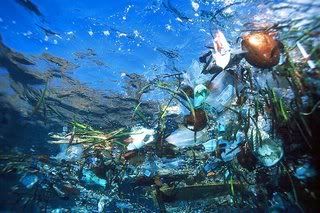
Santa Barbara, CA (AHN) - A recent study revealed that there are very few ocean areas, if any, that remain untouched by human influence and activities.
Upon mapping out the areas influenced by humans in some way, scientists discovered that every ocean in the world had been tampered with or affected in some way by human activities, such as fishing, pollution or global warming.
The findings were determined by a global map created by a University of California team. The map indicated the level and nature of damage to marine ecosystems, revealing the parts of the world's oceans that might have managed to remain pure and pristine.
A range of scores of 17 kinds of human influence was assigned, and then tallied for every ocean, eventually showing the extent of human impact on the world's waters.
[snip]
The map showed that 40 percent of the marine ecosystems garnered either a "medium high" or "high" human impact, taking in factors such as shipping lanes, oil and gas exploration and invasive species, according to Bloomberg. The analysis looked into the effects on reefs, continental shelves and mangroves.
The study revealed that the areas of the Mediterranean, east Caribbean, Persian Gulf, Norwegian Sea, Bering Sea, North America's east coast and the Sri Lanka waters were the ones most affected by human activity.
What with continent-sized plastic-filled gyres and dead zones, I'd say we're doing a heck of a job!

Sunday, January 27, 2008
The ocean gyres are getting bigger

The Sahara, the Gobi, the Chihuahuan--all are great deserts. But what about the South Pacific's subtropical gyre? This "biological desert" within a swirling expanse of nutrient-starved saltwater is the largest, and least productive, ecosystem of the South Pacific. Together with the subtropical gyres in other oceans, biological deserts cover 40% of Earth's surface. But their relative obscurity may be about to change. Researchers are reporting that the ocean's biological deserts have been expanding, and they are growing much faster than global warming models predict.The Bush Era will also mark of the death of the oceans, the destruction of the environment, the speeding up of Global Warming, the spread of theocracy wars, the spike in terrorism, Peak Oil, and the collapse of world economies.The evidence comes from the Sea-viewing Wide Field-of-view Sensor (SeaWiFS) onboard the orbiting SeaStar spacecraft. Launched in 1997, SeaWiFS maps ocean color around the globe. The green of the photosynthetic pigment chlorophyll a is a measure of the abundance of plant life, which supports the base of the food chain. In an upcoming Geophysical Research Letters paper, biological oceanographer Jeffrey Polovina of the U.S. National Marine Fisheries Service in Honolulu, Hawaii, and his colleagues describe how they charted the changing size of the central region of faintest green in the subtropical gyres of the North and South Pacific, North and South Atlantic, and South Indian oceans from SeaWiFS's launch through 2006.
All of the biological deserts had grown, except the South Indian Ocean's. The total expansion was 6.6 million square kilometers or 15%, and it happened as the shallow waters of the gyres were warming. "We're seeing this pattern in each of the four ocean basins," says Polovina. That suggests to him that global warming could be the ultimate cause of the observed desert expansion.
Gyre waters are already strongly layered, so stirring by the wind brings little of the nutrients stored in deep waters to the surface to fuel plant and ultimately animal growth. Warming further strengthens this stratification, making such nourishing mixing all the more difficult. Climate-ecosystem models predict that global warming will exacerbate ocean desert expansion, but not this quickly, Polovina notes. During the past 9 years, gyre deserts expanded 10 to 25 times faster than modeled.
Did I forget anything?
Subscribe to:
Posts (Atom)