How DARE Obama get the prisoners out of Iran using diplomacy!11!!1 We need a WAR to prove how manly we are!1!!1
The oceans are warming at a faster rate than we calculated. They are also filling up with plastic.
Nuclear gypsies: those who are attempting to clean up Fukushima.
George Washington was right.
Actually, there hasn't been a mass shooting every day in 2015.
Now they are not allowed to tell us where our meat has been raised or processed. That makes me feel so safe.
The Onion actually has a good take on the idiots in Oregon.
Quantum knots.
Monsanto Files Lawsuit to Stop California From Listing Glyphosate as Known Carcinogen
Showing posts with label Diplomacy. Show all posts
Showing posts with label Diplomacy. Show all posts
Saturday, January 23, 2016

Thursday, June 26, 2014
Moon dust and cereal...
Moon dust and its dangers.
Negotiating with terrorists.
An Iraq War Veteran says what he thinks about war and warmongers.
Why ignorance is being embraced as a virtue in the GOP.
Life in the most religious states.
Tom Tomorrow gets it right.
Plastics, even non-BPA, can affect your hormones. And pesticides may give your child autism.
10 invasive species
Women listening to men in Western Art History. And speaking in a sexist language.
Cereal killers...
Negotiating with terrorists.
An Iraq War Veteran says what he thinks about war and warmongers.
Why ignorance is being embraced as a virtue in the GOP.
Life in the most religious states.
Tom Tomorrow gets it right.
Plastics, even non-BPA, can affect your hormones. And pesticides may give your child autism.
10 invasive species
Women listening to men in Western Art History. And speaking in a sexist language.
Cereal killers...
Monday, December 23, 2013
Tidbits
How you guys talk gives away where you are from....
Diplomacy is better than genocide, oddly.
Cats and engineers.
A cube. That can stand on a point. And jump. And I need to beat it to death...
Pharmacies deliberately misinforming teenagers about emergency contraception.
Parenting done right.
Voices from prison.
Diplomacy is better than genocide, oddly.
Cats and engineers.
A cube. That can stand on a point. And jump. And I need to beat it to death...
Pharmacies deliberately misinforming teenagers about emergency contraception.
Parenting done right.
Voices from prison.
Friday, February 11, 2011
Tuesday, February 02, 2010
One way out of Bush's war
POLITICS: Behind Cautious Signal, a Decision for Afghan Peace Talks
By Gareth Porter*
KABUL, Jan 26, 2010 (IPS) - Gen. Stanley A. McChrystal's very cautiously-worded support for a negotiated settlement with the Taliban leadership in an interview published Monday is only the first public signal of a policy decision by the Barack Obama administration to support a political settlement between the Hamid Karzai regime and the Taliban, an official of McChrystal's International Security Assistance Force (ISAF) command has revealed in an interview with IPS.
Speaking to the Financial Times, McChrystal couched his position on negotiations in terms of an abstract support for negotiated settlements of wars, saying, "I believe that a political solution to all conflicts is the inevitable outcome." The ISAF commander avoided a direct answer to the question of whether the Taliban could play a role in a future Afghan government.
When pressed by the interviewer on the issue, McChrystal would only say that "any Afghan can play a role if they focus on the future and not the past."
The ISAF official, who spoke with IPS on condition that he would not be named, was much more candid about the centrality of peace negotiations with the Taliban leadership in the Obama administration's strategy in Afghanistan and about the understanding of the ISAF command that the Taliban leadership is independent of al Qaeda and is already positioning itself for a political settlement.
Monday, November 16, 2009
Friday, October 02, 2009
Diplomacy! What an amazing new invention!
Actually talking to people!
Glenn Greenwald's headline:
Glenn Greenwald's headline:
Iran: More accomplished in one day of negotiations than in 8 years of threatsIn some undisclosed secure location, Cheney is twirling his mustaches in frustration. The war with Iran is getting further and further from his grasp....

Tuesday, July 07, 2009
Doing more for world safety and stability
In one diplomatic act than Bush and Cheney did with seven years of bombing:
MOSCOW — President Obama signed an agreement on Monday to cut American and Russian strategic nuclear arsenals by at least one-quarter, a first step in a broader effort intended to reduce the threat of such weapons drastically and to prevent their further spread to unstable regions.And he didn't even have to peer into Putin's soul...
Tuesday, April 21, 2009
Wednesday, April 15, 2009

Monday, April 13, 2009
Blog sprinkles

Chemicals in your food, First Lady Michelle?:
First Lady Michelle Obama received widespread praise for her decision to plant a White House garden that will provide food for the residence. Obama has been receiving help with the project from Bancroft Elementary School children, who are learning the importance of healthy living. “You can carry a message back to your school about the importance of eating healthy meals,” Agriculture Secretary Tom Vilsack said yesterday. “You have a partner at the Department of Agriculture to make meals better tasting and better for you.” However, the Mid America CropLife Association (MACA) — which represents agribusinesses like Monsanto, Dow AgroSciences, and DuPont Crop Protection — are unhappy that no chemicals are being used on the food....The President at play.

Phila of Bouphonia's Friday hope post.
Clutch those pearls! We're gonna talk to Iran!:
Taking teabagging to a whole new level.TEHRAN (Reuters) - Iran said on Monday it would welcome constructive dialogue with six world powers, including the United States, in its clearest signal yet it will accept an invitation for talks on its disputed nuclear work.
State television quoted Iran's chief nuclear negotiator Saeed Jalili as making the comment in a telephone conversation with European Union foreign policy chief Javier Solana.
The United States, Russia, China, France, Germany and Britain said on Wednesday they would ask Solana to invite Iran to a meeting to find "a diplomatic solution to this critical issue," referring to the long-running nuclear row.
That marked a major shift in U.S. policy under new President Barack Obama, whose predecessor George W. Bush's administration shunned direct talks with Tehran as long as it pressed ahead with nuclear activity the West fears has military aims
The glory of giving.
2009's most ethical companies.
Mr. President, we are getting a little worried you are expanding the horrors that Bush left. So as a reminder, a depiction of what change is NOT.
Rove had a little list, but none of them'll be missed...
Buy more men's underwear and save the economy!
Hitchens and religion
Tuesday, March 24, 2009
President Barack Obama addresses the world
We are living through a time of global economic challenges that cannot be met by half-measures or the isolated efforts of any nation. Now, the leaders of the G-20 have a responsibility to take bold, comprehensive and coordinated action that not only jump-starts recovery but launches a new era of economic engagement to prevent a crisis like this from ever happening again.A worldwide message from the president:
No one can deny the urgency of action. A crisis in credit and confidence has swept across borders, with consequences for every corner of the world. For the first time in a generation, the global economy is contracting and trade is shrinking. Trillions of dollars have been lost, banks have stopped lending and tens of millions around the globe will lose their jobs. The prosperity of every nation has been endangered, along with the stability of governments and the survival of people in the most vulnerable parts of the world.
We have learned that the success of the American economy is inextricably linked to the global economy. There is no line between action that restores growth within our borders and action that supports it beyond. If people in other countries cannot spend, markets dry up; already we've seen the biggest drop in American exports in nearly four decades, which has led directly to American job losses. And if we continue to let financial institutions around the world act recklessly and irresponsibly, we will remain trapped in a cycle of bubble and bust. That is why the upcoming London summit of the world's 20 leading economies is directly relevant to our recovery at home.
My message is clear: The United States is ready to lead, and we call on our partners to join us with a sense of urgency and common purpose. Much good work has been done, but much more remains. Our leadership is grounded in a simple premise: We will act boldly to lift the American economy out of crisis and reform our regulatory structure, and these actions will be strengthened by complementary action abroad. Through our example, the United States can promote a global recovery and build confidence around the world; and if the London summit helps galvanize collective action, we can forge a secure recovery, and future crises can be averted.
Our efforts must begin with swift action to stimulate growth. Already, the United States has passed the American Recovery and Reinvestment Act -- the most dramatic effort to jump-start job creation and lay a foundation for growth in a generation. Other members of the G-20 have pursued fiscal stimulus as well, and these efforts should be robust and sustained until demand is restored. As we go forward, we should embrace a collective commitment to encourage open trade and investment, while resisting the protectionism that would deepen this crisis.
Second, we must restore the credit that businesses and consumers depend on. At home, we are working aggressively to stabilize our financial system. This includes an honest assessment of the balance sheets of our major banks, and will lead directly to lending that can help Americans purchase goods, stay in their homes and grow their businesses.
This must continue to be amplified by the actions of our G-20 partners. Together, we can embrace a common framework that insists on transparency, accountability and a focus on restoring the flow of credit that is the lifeblood of a growing global economy. And the G-20, together with multilateral institutions, can provide trade finance to help lift up exports and create jobs.
Third, we have an economic, security and moral obligation to extend a hand to countries and people who face the greatest risk. If we turn our backs on them, the suffering caused by this crisis will be enlarged and our own recovery will be delayed because markets for our goods will shrink further and more U.S. jobs will be lost. The G-20 should quickly deploy resources to stabilize emerging markets, substantially boost the emergency capacity of the International Monetary Fund and help regional development banks accelerate lending. Meanwhile, America will support new and meaningful investments in food security that can help the poorest weather the difficult days that will come.
While these actions can help get us out of crisis, we cannot settle for a return to the status quo. We must put an end to the reckless speculation and spending beyond our means; to the bad credit, over-leveraged banks and absence of oversight that condemns us to bubbles that inevitably bust. Only coordinated international action can prevent the irresponsible risk-taking that caused this crisis. That is why I am committed to seizing this opportunity to advance comprehensive reforms of our regulatory and supervisory framework.
All of our financial institutions -- on Wall Street and around the globe -- need strong oversight and common- sense rules. All markets should have standards for stability and a mechanism for disclosure. A strong framework of capital requirements should protect against future crises. We must crack down on offshore tax havens and money laundering. Rigorous transparency and accountability must check abuse, and the days of out-of-control compensation must end. Instead of patchwork efforts that enable a race to the bottom, we must provide the clear incentives for good behavior that foster a race to the top.
I know that America bears its share of responsibility for the mess that we all face. But I also know that we need not choose between a chaotic and unforgiving capitalism and an oppressive government-run economy. That is a false choice that will not serve our people or any people.
This G-20 meeting provides a forum for a new kind of global economic cooperation. Now is the time to work together to restore the sustained growth that can only come from open and stable markets that harness innovation, support entrepreneurship and advance opportunity.
The nations of the world have a stake in one another. The United States is ready to join a global effort on behalf of new jobs and sustainable growth. Together, we can learn the lessons of this crisis and forge a prosperity that is enduring and secure for the 21st century.
With the G20 meeting approaching on April 2nd, this morning the President published a rare "simultaneous op-ed" in thirty papers around the world, calling for a collective effort to address the economic peril found in all corners of the globe. "The United States is ready to lead, and we call upon our partners to join us with a sense of urgency and common purpose," he writes. His op-ed appeared in the following publications:Kinda cool, isn't it? Having a president who uses words rather than threats, diplomacy rather than bombs?Al Watan (Gulf States), Arab Times (Gulf States), Asharq Al Awsat (Arab-wide paper in Arabic), The Australian (Australia), Bangkok Post (Thailand), Chicago Tribune (United States), Clarin (Argentina), Corriere della Sera (Italy), Die Welt (Germany), El Pais (Madrid), El Mercurio (Chile), Eleftyropiea (Greece), Estado de Sao Paulo (Brazil), Gulf News (Gulf States), The Hindustan Times/ The Hindu (India), International Herald Tribune (London), Kristeligt Dagblad (Denmark), Le Monde (Paris), Lidove Noviny (Czech), Los Angeles Times (United States), The News (Pakistan), NRC Handelsblad (Netherlands), Saudi Gazette (Saudi Arabia), South China Morning Post (Hong Kong), Straits Times (Singapore), Sunday Times (South Africa), Svenska Dagbladet (Sweden), Syndey Morning Herald (Australia), WProst (Poland), Yomiuri Shimbun (Japan)
Monday, February 09, 2009
When Shock'n'Awe failed and diplomacy began
Via Steve Clemons of the Washington Note:
I agree with Ricks that Captain Samuel Cook and his Crazyhorse Troop showed remarkable sense in changing what were failing heavy-handed counterinsurgency methods into something far more effective. The opposite of this strategy can easily be seen in two award-winning films that benchmark what was going on before officers like Captain Cook and another favorite of mine, Captain Jon Powers (who recently ran and lost in a Democratic primary for a New York House seat), began changing the game on the front line of contact with Iraq's civilians. One of these was Michael Tucker's Gunner Palace and the other Alex Gibney's Taxi to the Dark Side.The Surge is still controversial, and I look forward to reading Tom Ricks' assessment of it -- and why the surge, per se, mattered so much. One of the questions I look forward to exploring is why a "change in tactics" (i.e., using any of the sensible tactics Captain Samuel Cook used in the video above) required a greater deployment of troops.
Repairing eight years of damage
Sounds wonderful:
What it's guaranteed to do is piss off Putin....
But then Biden acknowledged:"I come to Europe on behalf of a new administration determined to set a new tone in Washington, and in America's relations around the world," Mr Biden said.
"We will engage. We will listen. We will consult. America needs the world, just as I believe the world needs America," he said.
"Our administration has set ambitious goals... to advance democracy not through its imposition by force from the outside, but by working with moderates in government and civil society to build the institutions that will protect freedom."
On Russia, Mr Biden said: "It's time, to paraphrase President Obama, to press the reset button and to revisit the many areas where we can and should work together."
He added that the US would continue with its plans for a missile defence shield in Central Europe.WTF? We still have the useless Star Wars program being advanced? Is this because of the Iranian satellite that was just launched? Or is this more about a nuclear Pakistan becoming destabilized? Or is it the inability to peel off an entrenched defense contractor?
[snip]
On Iran, Mr Biden said: "We will continue to develop missile defences to counter a growing Iranian capability, provided the technology is proven to work and cost effective.
[snip]
He added: "We will do so in consultation with our Nato allies and Russia."
He reiterated President Barack Obama's pledge to communicate with Iran, saying the US offered a clear choice: "Continue down your current course and there will be pressure and isolation; abandon your illicit nuclear programme and support for terrorism and there will be meaningful incentives." "
What it's guaranteed to do is piss off Putin....
Wednesday, January 14, 2009
I always said you can't declare war on a noun
It was one of the most idiotic phrases to come out of the Bush administration.
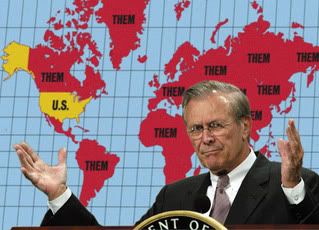
Bush's 'You're either for us or against us'; 'Bring it on'; and 'Wanted, dead or alive' quotes all reflect the bizarre simpleton thinking of the neocons. Sweeping up everybody who doesn't like us into a big pile and treating everyone the same loses the ability for using diplomacy, nuance, tolerance, and the capability of addressing wrongs. Wanting the world to be black or white, good or evil, wrong or right will not make it so. Acting like it is is even worse.The foreign secretary, David Miliband, today argues that the use of the "war on terror" as a western rallying cry since the September 11 attacks has been a mistake that may have caused "more harm than good".
In an article in today's Guardian, five days before the Bush administration leaves the White House, Miliband delivers a comprehensive critique of its defining mission, saying the war on terror was misconceived and that the west cannot "kill its way" out of the threats it faces.
British officials quietly stopped using the phrase "war on terror" in 2006, but this is the first time it has been comprehensively discarded in the most outspoken remarks on US counterterrorism strategy to date by a British minister.
In remarks that will also be made in a speech today in Mumbai, in one of the hotels that was a target of terrorist attacks in November, the foreign secretary says the concept of a war on terror is "misleading and mistaken".
"Historians will judge whether it has done more harm than good," Miliband says, adding that, in his opinion, the whole strategy has been dangerously counterproductive, helping otherwise disparate groups find common cause against the west.
"The more we lump terrorist groups together and draw the battle lines as a simple binary struggle between moderates and extremists or good and evil, the more we play into the hands of those seeking to unify groups with little in common," Miliband argues, in a clear reference to the signature rhetoric of the Bush era. "We should expose their claim to a compelling and overarching explanation and narrative as the lie that it is."
"Terrorism is a deadly tactic, not an institution or an ideology," he says.

Friday, December 26, 2008
Shouldn't this be a huge red alert?
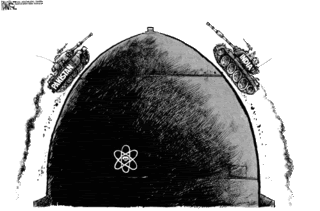
You know: Hair on fire, claxon alarms, shrieks, the clattering of hundreds of shoes as diplomats rush to planes to talk these two countries down?
Pakistan Moves Thousands Of Troops Toward Indian BorderBecause... you know... both countries have nukes? Hello Bush administration? The article continues:
The troops headed to the Indian border were being diverted away from tribal areas near Afghanistan, officials said, and the move was expected to frustrate the United States, which has been pushing Pakistan to step up its fight against al-Qaida and Taliban militants near the Afghan border.Wait ... surely Bush must be on it!
Two intelligence officials said the army's 14th Division was being redeployed to the towns of Kasur and Sialkot, close to the Indian border. They said some 20,000 troops were on the move. Earlier Friday, a security official said all troop leave had been canceled.
The officials spoke on condition of anonymity because of the sensitivity of the situation.
Both countries have said they want to avoid military conflict over the attacks. But India has not ruled out the use of force as it presses its neighbor to crack down on the Pakistani-based terrorist group it blames for the attack.
The United States has urged India and Pakistan to avoid unnecessarily raising tension amid reports of troop movements to the border.What? This standoff could start WWIII (or is it IV?). Do we have anyone going over there? Like... you know... Rice? Anybody? Did Bush fire the entire diplomatic corps? And what does it mean: the US is in close contact? What does that mean? On the phone? IMing? Email? Why do I think nobody's home .....?
[snip]Air strikes against militants in the restive Swat and Bajaur regions had been scaled down as some of the airpower had to be redeployed to the country's eastern border, a senior Pakistani military official told Asif Farooqi, the Islamabad-based correspondent of the BBC Urdu service.
There have been reports of possible forthcoming "surgical" strikes by India on the headquarters and camps of Lashkar-e-Taiba, the militant group India blames for the Mumbai attacks.
The group and Pakistan's government deny any involvement.
White House spokesman Gordon Johndroe said: "We hope that both sides will avoid taking steps that will unnecessarily raise tensions during these already tense times."
He said the US remained "in close contact with both countries to urge closer co-operation in investigating the Mumbai attacks and in fighting terrorism generally".
The BBC's Barbara Plett in Islamabad says the troop movements do not appear to be greatly significant and that both countries have said they want to avoid military conflict. However they warn they will act if provoked.
But our correspondent says any significant cut in the Pakistani military presence along the Afghan border would worry Washington, which relies on Islamabad to stem cross-border Taleban attacks on Nato forces.
President-elect Obama?
OoOoohhhhhhHHh boy.... January 20th can't come fast enough...Dec. 12, 2008 | A consensus is emerging among intelligence analysts and pundits that Pakistan may be President-elect Barack Obama's greatest policy challenge. A base for terrorist groups, the country has a fragile new civilian government and a long history of military coups. The dramatic attack on Mumbai by members of the Pakistan-based Lashkar-e Tayiba, the continued Taliban insurgency on the Pakistan-Afghanistan border, the frailty of the new civilian government, and the country's status as a nuclear-armed state have all put Islamabad on the incoming administration's front burner.
But does Obama understand what he's getting into? In his "Meet the Press" interview with Tom Brokaw on Sunday, Obama said, "We need a strategic partnership with all the parties in the region -- Pakistan and India and the Afghan government -- to stamp out the kind of militant, violent, terrorist extremists that have set up base camps and that are operating in ways that threaten the security of everybody in the international community." Obama's scenario assumes that the Pakistani government is a single, undifferentiated thing, and that all parts of the government would be willing to "stamp out" terrorists. Both of those assumptions are incorrect.
Pakistan's government has a profound internal division between the military and the civilian, which have alternated in power since the country was born from the partition of British India in 1947. It is this military insubordination that creates most of the country's serious political problems. Washington worries too much about other things in Pakistan and too little about the sheer power of the military. United States analysts often express fears about an internal fundamentalist challenge to the chiefs of staff. The main issue, however, is not that Pakistan's military is too weak, but that it is too strong. And that is complicated by the fact that elements within the military are at odds, not just with the civilian government, but also with each other.
[snip]
The United States, going back to the Cold War, has long viewed the Pakistani army as a geopolitical ally, and Washington tends to prefer that the military be in power. Since Gen. Musharraf was forced out, U.S. intelligence circles have been lamenting the country's "instability," as though it were less unstable under an unpopular dictatorship. If Pakistan -- and Pakistani-American relations -- are to have a chance, it will lie in the incoming Obama administration doing everything it can to strengthen the civilian political establishment and ensure that the military remains permanently in its barracks. The military needs to be excluded from political power, and it needs to learn to take orders from a civilian president. At the same time, Obama should follow through on his commitment to commit serious diplomatic resources to helping resolve the long-festering Kashmir issue.
Sunday, August 17, 2008
Diplomacy is hard werk

In the time since the summit, numerous foreign policy observers have concluded that Bush's resolute advocacy of promising Tbilisi NATO membership caused unnecessary tensions with the Kremlin. At the same time, if NATO now backs away from its pledge to Georgia, this could also be perceived by Moscow as a reward for its actions.Well... forget that. Bush will save the day by sending help!:
WASHINGTON — President Bush Wednesday promised that U.S. naval forces would deliver humanitarian aid to war-torn Georgia before his administration had received approval from Turkey, which controls naval access to the Black Sea, or the Pentagon had planned a seaborne operation, U.S. officials said Thursday.Whatever, let's build more missile shields and piss Russia off even more!:
As of late Thursday, Ankara, a NATO ally, hadn't cleared any U.S. naval vessels to steam to Georgia through the Bosporus and the Dardanelles, the narrow straits that connect the Mediterranean and the Black Seas, the officials said. Under the 1936 Montreaux Convention, countries must notify Turkey before sending warships through the straits.
Pentagon officials told McClatchy that they were increasingly dubious that any U.S. Navy vessels would join the aid operation, in large part because the U.S.-based hospital ships likely to go, the USNS Comfort and the USNS Mercy, would take weeks to arrive.
"The president was writing checks to the Georgians without knowing what he had in the bank," said a senior administration official.
WASHINGTON: The United States and Poland have reached a deal to place an American missile-defense base on Polish territory, in the strongest reaction so far to Russia's military operation in Georgia.Not to worry, Poland! Just look at how we've treated Georgia!
Russia reacted in anger, saying that the move would worsen relations with the United States, which had already been strained severely in the week since Russian troops entered separatist enclaves in Georgia, a close American ally.
At a news conference Friday, a senior Russian defense official, Colonel General Anatoli Nogovitsyn, suggested that Poland was making itself a target by agreeing to serve as host for the antimissile system. Such an action "cannot go unpunished," he said.
Thursday, July 17, 2008
Nazi appeasers!
The US plans to establish a diplomatic presence in Tehran for the first time in 30 years as part of a remarkable turnaround in policy by President George Bush.Ohhhh Nooooo! What would Grandpoppy Prescott think? What will Americans think? What will other nations think?
The Guardian has learned that an announcement will be made in the next month to establish a US interests section - a halfway house to setting up a full embassy. The move will see US diplomats stationed in the country.
The news of the shift by Bush who has pursued a hawkish approach to Iran throughout his tenure comes at a critical time in US-Iranian relations. After weeks that have seen tensions rise with Israel conducting war games and Tehran carrying out long-range missile tests, a thaw appears to be under way.
The White House announced yesterday that William Burns, a senior state department official, is to be sent to Switzerland on Saturday to hear Tehran's response to a European offer aimed at resolving the nuclear standoff.
Thursday, May 22, 2008
Omg, Bush's bestest buds are appeasers!
To refresh memories:
And, clutch those pearls, Mabel, Israel is an appeaser, too!:
I thought talking to the enemy was evil and bad?
crossposted at SteveAudio
Appeasement:So what do you call this?
to yield or concede to the belligerent demands of (a nation, group, person, etc.) in a conciliatory effort, sometimes at the expense of justice or other principles.
PESHAWAR, PAKISTAN -- Pakistani authorities announced Wednesday that they had struck a truce with a militant faction that moved last year to impose Taliban-style rule in a once-popular tourist area.Pakistan's last consession allowed the Taliban to reorganize and gain strength. What is this going to do?
The deal between government officials and Islamic militants in the scenic Swat valley could presage broader accords with militants in the tribal areas bordering Afghanistan.
The 15-point pact was signed despite explicit expressions of concern from the United States about such truces -- the latest warning delivered only a day earlier by Deputy Secretary of State John D. Negroponte in Washington.
Pakistan's new coalition government, which took office seven weeks ago after winning parliamentary elections in February, has said it is willing to talk with extremists who are prepared to renounce violence. But the Bush administration and the North Atlantic Treaty Organization say they believe that Islamic militants will use respites to strengthen and rearm themselves and resume attacks when it suits them. They also say cross-border strikes aimed at Western troops in Afghanistan have edged up since negotiations began.
[snip]
Under the pact, the government appeared to have made significant concessions. It agreed to begin pulling back troops, provided that attacks against the military cease. The government suggested that Fazlullah, previously one of the country's most wanted men, would not be actively pursued. It also agreed that the Swat valley would come under a system of Sharia, or Islamic law, with Islamic clerics and scholars advising civil judges.
In return, the militants softened some of the harsher measures they had taken to enforce their stringent form of Islam. They agreed to stop their campaign against polio vaccinations, which they have denounced as a Western plot, and girls' schooling. They also promised to stop terrorizing barbers who shaved men's beards and blowing up music and video stores.
As part of the agreement, Fazlullah's followers pledged not to display weapons in public, though they did not agree to disarm. The group's former heavily fortified headquarters is to be turned into a university, both sides said.
And, clutch those pearls, Mabel, Israel is an appeaser, too!:
JERUSALEM -- In February 2007, Israeli Prime Minister Ehud Olmert and his Turkish counterpart, Recep Tayyip Erdogan, met privately for more than two hours in Turkey.Georgie, you knew about these dangerous diplomatic appeasement-related program activities for a year? And didn't tell us?
The two leaders concluded that the time was ripe for Turkey to mediate indirect peace negotiations between longtime enemies Israel and Syria.
The existence and extent of those negotiations were acknowledged by all sides Wednesday, prompting speculation as to the timing, goals and prospects for success.
Syrian President Bashar Assad disclosed the negotiations last month, saying Turkish mediators had informed him that Israel was willing to return the disputed Golan Heights to Syria.
Israel declined to confirm the talks at the time, but an Israeli official said Wednesday's coordinated statements out of Jerusalem, Damascus and Ankara were a sign that "the discussions had advanced" to a more serious level.
The Israeli official, speaking on condition of anonymity, said the U.S. government had been "fully briefed" from the start on the initiative.
I thought talking to the enemy was evil and bad?
crossposted at SteveAudio
Wednesday, January 09, 2008
Silly diplomats!
Of course Iraq is safe! Hasn't the White House said this over and over again? So get your ass on out there to Baghdad!
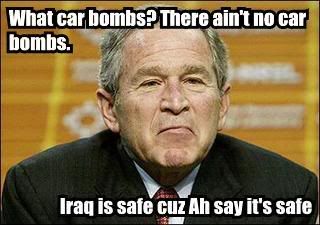
WASHINGTON - Nearly half of U.S. diplomats unwilling to volunteer to work in Iraq say one reason for their refusal is they don't agree with Bush administration's policies in the country, according to a survey released Tuesday.Security concerns and separation from family ranked as the top reasons for not wanting to serve in Iraq. But 48 percent cited "disagreement" with administration policy as a factor in their opposition, said the survey conducted by the American Foreign Service Association, the union that represents U.S. diplomats.
In addition, nearly 70 percent of U.S. diplomats oppose forced assignments to Iraq, a prospect that sparked a storm of controversy last year when the State Department announced it might have to require such tours under penalty of dismissal in the largest diplomatic call-up to a war zone since Vietnam.
The results suggest the State Department is facing a far more serious revolt over Iraq among its ranks than previously thought, and call into question its ability to fully staff diplomatic missions in Iraq, as well as those in Afghanistan and other dangerous posts deemed critical to the administration's foreign policy goals.
The survey was conducted late last year among the 11,500 members of the U.S. diplomatic corps and found deep frustration over Iraq, safety and security issues elsewhere, pay disparities and the leadership of Secretary of State Condoleezza Rice and her top deputies.
"The results of this survey raise serious questions about the long-term health of the Foreign Service and, with it, the future viability of U.S. diplomatic engagement," said union President John Naland. "This argues for immediate action to deal with the concerns highlighted in the survey."
Subscribe to:
Posts (Atom)