Showing posts with label Depression. Show all posts
Showing posts with label Depression. Show all posts
Tuesday, September 04, 2018

Friday, September 11, 2015
Friday to Friday creeps in its petty pace ....
Ways to avoid being eaten by mosquitoes.
What climate change means to polar bears. And to bring back to life ancient pathogens which may or may not be virulent.
Building a sailboat and the love of woodcraft.
The opposite of hoarding... being too clean?
A necessary and informative timeline from the New York Times (takes us only to April 2015) to show how long it took to get the Iran nuclear agreement and why it is a big effing deal. And why Cheney wants Iran to be all Obama's fault.
How to catch liars.
A designer for Silicon Valley. She's over 90.
A scientist's doubts over GMOs. French court finds Monsanto guilty of chemical poisoning.
Harvard linguist points out the 58 most commonly misused words and phrases
Dealing with depression.
9/11 conspiracies list.
What climate change means to polar bears. And to bring back to life ancient pathogens which may or may not be virulent.
Building a sailboat and the love of woodcraft.
The opposite of hoarding... being too clean?
A necessary and informative timeline from the New York Times (takes us only to April 2015) to show how long it took to get the Iran nuclear agreement and why it is a big effing deal. And why Cheney wants Iran to be all Obama's fault.
How to catch liars.
A designer for Silicon Valley. She's over 90.
A scientist's doubts over GMOs. French court finds Monsanto guilty of chemical poisoning.
Harvard linguist points out the 58 most commonly misused words and phrases
Dealing with depression.
9/11 conspiracies list.
Monday, August 18, 2014
Monday, April 29, 2013
Economics 101
Here is the situation:
1) There was a downward spiral, businesses were laying off so customers were not spending. This caused businesses to cut back more, which caused customers to cut back more, which caused businesses to cut back more.
2) Expectation were also in a downward spiral because everyone saw what was happening so they cut back too.
3) Deflation joined the party as businesses cut prices to try to get customers, so customers decided prices were going down and decided to wait before buying.
4) Unemoployment caused people to ask for lower wages when they took a job, which put downward pressure on wages, so cutomers were cutting back even more, (go to 1)
5) Etc., spiraling ever downward.
In the past, society learned that the way to fix this is for government to step in and “stimulate” the economy by investing in things like infrastructure project, hiring people to fix roads etc., which stopped the spiral. In fact the Obama stimulus reversed the downward spiral. We were losing 800,000 jobs a month until the stimulus kicked in, then after a while we were gaining jobs again
But then came the Wall Street-backed “austerians” demanding that government cut back instead of stimulate. Wall Street benefits from unemployment because the very wage drop means they pay less for the labor commodity. And they benefit from deflation because people with lots of money gain while people who owe money lose. And the “study” by Reinhart and Rogoff provided an intellectual justification for Wall Street’s demand.And Paul Krugman:
Let’s start with what may be the most crucial thing to understand: the economy is not like an individual family.
Families earn what they can, and spend as much as they think prudent; spending and earning opportunities are two different things. In the economy as a whole, however, income and spending are interdependent: my spending is your income, and your spending is my income. If both of us slash spending at the same time, both of our incomes will fall too.
And that’s what happened after the financial crisis of 2008. Many people suddenly cut spending, either because they chose to or because their creditors forced them to; meanwhile, not many people were able or willing to spend more. The result was a plunge in incomes that also caused a plunge in employment, creating the depression that persists to this day.
Why did spending plunge? Mainly because of a burst housing bubble and an overhang of private-sector debt — but if you ask me, people talk too much about what went wrong during the boom years and not enough about what we should be doing now. For no matter how lurid the excesses of the past, there’s no good reason that we should pay for them with year after year of mass unemployment.
So what could we do to reduce unemployment? The answer is, this is a time for above-normal government spending, to sustain the economy until the private sector is willing to spend again. The crucial point is that under current conditions, the government is not, repeat not, in competition with the private sector. Government spending doesn’t divert resources away from private uses; it puts unemployed resources to work. Government borrowing doesn’t crowd out private investment; it mobilizes funds that would otherwise go unused.
Update: Ezra Klein says: The era of austerity is over (for now)
Now, just to be clear, this is not a case for more government spending and larger budget deficits under all circumstances — and the claim that people like me always want bigger deficits is just false. For the economy isn’t always like this — in fact, situations like the one we’re in are fairly rare. By all means let’s try to reduce deficits and bring down government indebtedness once normal conditions return and the economy is no longer depressed. But right now we’re still dealing with the aftermath of a once-in-three-generations financial crisis. This is no time for austerity.
Monday, September 26, 2011
Wednesday, June 29, 2011
Saturday, July 31, 2010
Corporate greed
Is why we are in an economic recession.
Bob Herbert has the figures:
Bob Herbert has the figures:
The recession officially started in December 2007. From the fourth quarter of 2007 to the fourth quarter of 2009, real aggregate output in the U.S., as measured by the gross domestic product, fell by about 2.5 percent. But employers cut their payrolls by 6 percent.
In many cases, bosses told panicked workers who were still on the job that they had to take pay cuts or cuts in hours, or both. And raises were out of the question. The staggering job losses and stagnant wages are central reasons why any real recovery has been so difficult.
“They threw out far more workers and hours than they lost output,” said Professor Sum. “Here’s what happened: At the end of the fourth quarter in 2008, you see corporate profits begin to really take off, and they grow by the time you get to the first quarter of 2010 by $572 billion. And over that same time period, wage and salary payments go down by $122 billion.”
That kind of disconnect, said Mr. Sum, had never been seen before in all the decades since World War II.
In short, the corporations are making out like bandits. Now they’re sitting on mountains of cash and they still are not interested in hiring to any significant degree, or strengthening workers’ paychecks.
Productivity tells the story. Increases in the productivity of American workers are supposed to go hand in hand with improvements in their standard of living. That’s how capitalism is supposed to work. That’s how the economic pie expands, and we’re all supposed to have a fair share of that expansion.
Corporations have now said the hell with that. Economists believe the nation may have emerged, technically, from the recession early in the summer of 2009. As Professor Sum writes in a new study for the labor market center, this period of economic recovery “has seen the most lopsided gains in corporate profits relative to real wages and salaries in our history.”
Worker productivity has increased dramatically, but the workers themselves have seen no gains from their increased production. It has all gone to corporate profits. This is unprecedented in the postwar years, and it is wrong.
Wednesday, January 27, 2010
Work to be done
Bob Herbert of the New York Times:
Update: Steven Colbert has the final word: Colbert on filibuster rules: ‘Democrats are pussies’
Joseph Stiglitz: Why we have to change capitalism:While the nation was suffering through the worst economy since the Depression, the Democrats wasted a year squabbling like unruly toddlers over health insurance legislation. No one in his or her right mind could have believed that a workable, efficient, cost-effective system could come out of the monstrously ugly plan that finally emerged from the Senate after long months of shady alliances, disgraceful back-room deals, outlandish payoffs and abject capitulation to the insurance companies and giant pharmaceutical outfits.
The public interest? Forget about it.
With the power elite consumed with its incessant, discordant fiddling over health care, the economic plight of ordinary Americans, from the middle class to the very poor, got pathetically short shrift. And there is no evidence, even now, that leaders of either party fully grasp the depth of the crisis, which began long before the official start of the Great Recession in December 2007.
Even now, many deny the magnitude of the problems facing our market economy. Once we are over our current travails – and every recession does come to an end – they look forward to a resumption of robust growth. But a closer look at the US economy suggests that there are some deeper problems: a society where even those in the middle have seen incomes stagnate for a decade, a society marked by increasing inequality; a country where, though there are dramatic exceptions, the statistical chances of a poor American making it to the top are lower than in "Old Europe".Dennis Kucinich:
It is said that a near-death experience forces one to re-evaluate priorities and values. The global economy has just had a near-death experience. The crisis exposed not only flaws in the prevailing economic model but also flaws in our society. Too many people had taken advantage of others. Almost every day has brought stories of bad behaviour by those in the financial sector – Ponzi schemes, insider trading, predatory lending, and a host of credit card schemes to extract as much from the hapless user as possible.
WASHINGTON -- Rep. Dennis Kucinich (D-OH) on Wednesday said the Massachusetts election was a "wake up call" for Democrats and that his party had better change course or it could suffer devastating losses come November.Can we do it?
"People elected Democrats in 2008 to change the country's direction," he told Raw Story in a nearly hour-long interview.
"And the same entrenched interests that George Bush could not shake, this current White House is having great difficulty in shaking. One could suggest they might be more entrenched than ever."
Kucinich staunchly defended liberalism but alleged that Democrats are not behaving like liberals.
[snip]
Kucinich lamented Democrats' growing camaraderie with big moneyed interests, claiming it's hurting the party.
"You ask the banks to reform banking?" he said. "Put the insurance companies to reform insurance. Call in nuclear to reform energy policies? Are you kidding me?"
"These problems, lest we forget, did not start with Barack Obama," Kucinich said. "It was George Bush drove the economy over the cliff with a trillion dollar tax cut and a war based on lies, and an expanding trade deficit."
"And we can't do that by playing patty-cake with Wall Street, by caving into the demands of big banks, by playing footsie with insurance companies and by jumping in bed with the pharmaceutical industry.
"Americans are really skittish about the economy, and they have every right to be," he said. "This isn't a left-right argument; this isn't a liberal-conservative argument. This is about down or up."
"We have a really deep recession, and the only way to bring it back up is to have a massive jobs program," he said. "I don't see any evidence" that Obama's economic team is standing behind that.
Update: Steven Colbert has the final word: Colbert on filibuster rules: ‘Democrats are pussies’
Friday, December 18, 2009
Wednesday, September 02, 2009
Why are the Republicans all plugging their ears
And singing 'La la la I can't hear you la la la'?
Update: .... but then again...Atrios reminds us
WASHINGTON -- Government efforts to funnel hundreds of billions of dollars into the U.S. economy appear to be helping the U.S. climb out of the worst recession in decades.Ah. Never mind.
Update: .... but then again...Atrios reminds us
Sunday, June 14, 2009
Paul Krugman singlehandedly makes everyone start buying sacks of rice and beans
And deciding where to dig the bunker....
Will Hutton: You are warning that what happened to Japan could happen to the whole world. Japan's GDP at the end of this year will be no higher than it was in 1992 - 17 lost years. You are saying that this is an ongoing risk, certainly for the North Atlantic economy - maybe the world economy.
Paul Krugman: Yes. It's not that the risk of the Japan syndrome has receded very much. The risk of a full, all-out Great Depression - utter collapse of everything - has receded a lot in the past few months. But this first year of crisis has been far worse than anything that happened in Japan during the last decade, so in some sense we already have much worse than anything the Japanese went through. The risk for long stagnation is really high.
Wednesday, April 01, 2009
Blog sprinkles

The best April Fool's pranks this year.
The top ten conservative idiots.
The GOP is the party of Beavis and Butthead:
I’d really like to see some genuine bipartisanship in America. But that can’t happen until we start having at least somewhat sane partisans.Obama's polling:
For the third Friday in a row, Gallup's polling shows 62% of those surveyed saying they approve of the job the president is doing. Also for the third week in a row, 27% say they don't approve.Joe the Plumber stumped about Employee Free Choice Act.
Moles:
“Are you saying that you think Vice President Cheney is still having a chilling effect on people who might otherwise be coming forward,” asked Gross. “I’ll make it worse,” answered Hersh, adding that he believes Cheney “put people back” in government to “stay behind” in order to “tell him what’s going on” and perhaps even “do sabotage”...When you are foreclosed, you may not take the built-in bathtub with you.
Politifact truth-o-meter site.
So never refer to someone as looking tasty:
The death of Tom Hurndall:There are already too many people living on Planet Earth, according to one of most influential science advisors in the US government.
Nina Fedoroff told the BBC One Planet programme that humans had exceeded the Earth's "limits of sustainability".
Hurndall was trying to save Palestinian homes and infrastructure but frequently came under Israeli fire and seemed to have lost his fear of death. “While approaching the area, they (the Israelis) continually fired one- to two-second bursts from what I could see was a Bradley fighting vehicle… It was strange that as we approached and the guns were firing, it sent shivers down my spine, but nothing more than that. We walked down the middle of the street, wearing bright orange, and one of us shouted through a loudspeaker, ‘We are International volunteers. Don’t shoot!’ That was followed by another volley of fire, though I can’t be sure where from…”Tips on how to survive the depression.
Tom Hurndall had stayed in Rafah. He was only 21 where – in his mother’s words – he lost his life through a single, selfless, human act. “Tom was shot in the head as he carried a single Palestinian child out of the range of an Israeli army sniper.” Mrs Hurndall asked me to write a preface to Tom’s book and this article is his preface, for a brave man who stood alone and showed more courage than most if us dreamed of. Forget tree huggers. Hurndall was one good man and true.
Wingnuts eating their own.
Is this a dogwhistle to fundamentalists who think a one world currency is another omen of the incoming END of DAYS?
Controversial British MP George Galloway has been denied entry into Canada by a federal court judge.
And now it's Chinese and Vietnamese pepper.
Defrocking a priest:
Oh, and by the way:The Episcopal Church has defrocked Ann Holmes Redding, the Seattle Episcopal priest who announced in 2007 that she is both Christian and Muslim.
Bishop Geralyn Wolf of Rhode Island, who has disciplinary authority over Redding, informed the priest of her decision in a letter today.
Wolf found Redding to be "a woman of utmost integrity and their conversations over the past two years have been open, honest and respectful," according to a press release from the Diocese of Rhode Island.
"However, Bishop Wolf believes that a priest of the Church cannot be both a Christian and a Muslim."
The top U.S. commander in the Middle East, General David Petraeus, warned today that Israel might attack Iran to prevent it from developing nuclear weapons, Bloomberg reports.
Tuesday, March 31, 2009
Monday, March 23, 2009
With all the reported hand wringing and declarations of failure
About the Obama administration, you can't retort better than David Corn:
Give the man some space to do his work and some time to get it rolling.

It's not my job to do White House press secretary Robert GIbbs' job. But, jeez, in less than two months, Obama has passed one of the biggest spending packages in history (yeah, it has pork in it, as well as billions for progressive programs) and has crafted a budget loaded with various innovations (and hundreds of billions of dollars for expanding health care). He's signed a bunch of executive orders implementing fundamental change on assorted matters of significance,: Gitmo, torture, FOIA, ethics, family planning funds, stem cells research and more. He's signed into law an equal pay bill and a measure expanding the state children's health insurance program. He's brought science back into federal agency decision-making. He's begun a withdrawal in Iraq. He's ordered a review of policy in Afghanistan. He's seeking fresh starts in US relations with Russia and Iran. He's rolled out plans--detailed or not--for dealing with the banking crisis, the mortgage crisis, toxic assets, and excessive corporate compensation. In the works is an additional plan for financial reregulation. And he's done all of this while staffing up the federal government and initiating the process of appointing federal judges.Bush had eight years to fuck up and he still found it convenient to blame Clinton. Obama has been in office exactly HOW many weeks?
Give the man some space to do his work and some time to get it rolling.

Friday, March 13, 2009
18 percent

The wealth of American families plunged nearly 18% in 2008, erasing years of sharp gains on housing and stocks and marking the biggest loss since the Federal Reserve began keeping track after World War II.
The Fed said Thursday that U.S. households' net worth tumbled by $11 trillion -- a decline in a single year that equals the combined annual output of Germany, Japan and the U.K. The data signal the end of an epoch defined by first and second homes, rising retirement funds and ever-fatter portfolios.
Past downturns have been mere blips compared with the losses Americans faced last year, which set them back to below 2004 levels. "In the postwar period, we've never had anything other than very modest declines. That life experience led many people to think that houses were a one-way bet," says Douglas Cliggott, the chief investment officer of Dover Management LLC.
The decline in Americans' net worth, which was the first in six years, follows an extraordinary boom. Not accounting for inflation, household wealth more than doubled from 1990 to 2000, and then, after a pause, rose nearly 50% before the bust of 2008.
Monday, March 09, 2009
Because Obama isn't buying into their schemes...
He is obviously a commie fascist anti-capitalist Islamic saboteur.
Frank Rich explains:
Frank Rich explains:
Led by Cramer and Kudlow, the CNBC carnival barkers are now, without any irony whatsoever, assailing the president as a radical saboteur of capitalism. It’s particularly rich to hear Cramer tar Obama (or anyone else) for “wealth destruction” when he followed up his bum steer to viewers on Bear Stearns with oleaginous on-camera salesmanship for Wachovia and its brilliant chief executive, a Cramer friend and former boss, just two weeks before it, too, collapsed. What should really terrify the White House is that Cramer last month gave a big thumbs-up to Timothy Geithner’s bank-rescue plan.
In one way, though, the remaining vestiges of the past decade’s excesses, whether they live on in the shouted sophistry of CNBC or in the ashes of Stanford’s castle, are useful. Seen in the cold light of our long hangover, they remind us that it was the America of the bubble that was aberrant and perverse, creating a new normal that wasn’t normal at all.
The true American faith endures in “Our Town.” The key word in its title is the collective “our,” just as “united” is the resonant note hit by the new president when saying the full name of the country. The notion that Americans must all rise and fall together is the ideal we still yearn to reclaim, and that a majority voted for in November. But how we get there from this economic graveyard is a challenge rapidly rivaling the one that faced Wilder’s audience in that dark late winter of 1938.
Saturday, March 07, 2009
Coming around full circle
A homeless tent city by Sacramento, growing by 50 people a week. Then compare to the same area photos of a 1936 depression tent city.
Brother, can you spare a job?
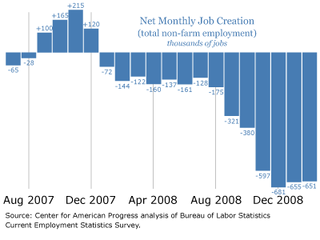
The labor market plunge continues. Employers shed 651,000 jobs in February—the largest one-month fall in employment since 1949—and total job losses have reached 4.4 million since the recession began in December 2007. More than half of these losses—2.6 million—occurred just since October after the trickle of jobs loss turned into a torrent.I think we've been here before....
The unemployment rate shot up to 8.1 percent in February, from 7.6 percent in January. There are 5 million more people unemployed compared to a year ago as the labor-market both loses jobs and fails to employ new entrants. This is the largest annual jump in the number of unemployed since the U.S. Bureau of Labor Statistics began tabulating this data just after World War II. Most of the unemployed—62.3 percent—are out of work because they lost their job, higher than any point since 1982.

Monday, February 23, 2009
Friday, February 13, 2009
Hoping that Obama fails

Thanks, Boehner. We will remember that.WASHINGTON – Democrats pushed a huge, $787 billion stimulus bill through the House and toward final approval on Friday, launching a costly attack on the worst economic crisis since the Great Depression and handing President Barack Obama a major victory early in his term. The House vote was 246-183, with Republicans unanimous in opposition to the bill, which includes tax cuts and an estimated $500 billion in federal spending.
Senate leaders set a confirming vote for several hours later, and in a show of urgency, the White House dispatched a government plane to Ohio to fly back a senator who was home for his mother's Saturday morning funeral.
Supporters said the bill would save or create 3.5 million jobs. House Majority Leader Steny Hoyer conceded there was no guarantee, but he said that "millions and millions and millions of people will be helped, as they have lost their jobs and can't put food on the table of their families."
Vigorously disagreeing, House Republican leader John Boehner of Ohio dumped a copy of the 1,071-page bill to the floor in a gesture of contempt. "The bill that was about jobs, jobs, jobs has turned into a bill that's about spending, spending, spending," he said.
Subscribe to:
Posts (Atom)