Showing posts with label Unemployment. Show all posts

Monday, April 29, 2013

Economics 101

Here is the situation:
1) There was a downward spiral, businesses were laying off so customers were not spending. This caused businesses to cut back more, which caused customers to cut back more, which caused businesses to cut back more. 
2) Expectation were also in a downward spiral because everyone saw what was happening so they cut back too. 
3) Deflation joined the party as businesses cut prices to try to get customers, so customers decided prices were going down and decided to wait before buying. 
4) Unemoployment caused people to ask for lower wages when they took a job, which put downward pressure on wages, so cutomers were cutting back even more, (go to 1) 

5) Etc., spiraling ever downward. 

In the past, society learned that the way to fix this is for government to step in and “stimulate” the economy by investing in things like infrastructure project, hiring people to fix roads etc., which stopped the spiral. In fact the Obama stimulus reversed the downward spiral. We were losing 800,000 jobs a month until the stimulus kicked in, then after a while we were gaining jobs again 
But then came the Wall Street-backed “austerians” demanding that government cut back instead of stimulate. Wall Street benefits from unemployment because the very wage drop means they pay less for the labor commodity. And they benefit from deflation because people with lots of money gain while people who owe money lose. And the “study” by Reinhart and Rogoff provided an intellectual justification for Wall Street’s demand.
And Paul Krugman:
Let’s start with what may be the most crucial thing to understand: the economy is not like an individual family. 

Families earn what they can, and spend as much as they think prudent; spending and earning opportunities are two different things. In the economy as a whole, however, income and spending are interdependent: my spending is your income, and your spending is my income. If both of us slash spending at the same time, both of our incomes will fall too. 
And that’s what happened after the financial crisis of 2008. Many people suddenly cut spending, either because they chose to or because their creditors forced them to; meanwhile, not many people were able or willing to spend more. The result was a plunge in incomes that also caused a plunge in employment, creating the depression that persists to this day. 

Why did spending plunge? Mainly because of a burst housing bubble and an overhang of private-sector debt — but if you ask me, people talk too much about what went wrong during the boom years and not enough about what we should be doing now. For no matter how lurid the excesses of the past, there’s no good reason that we should pay for them with year after year of mass unemployment. 

So what could we do to reduce unemployment? The answer is, this is a time for above-normal government spending, to sustain the economy until the private sector is willing to spend again. The crucial point is that under current conditions, the government is not, repeat not, in competition with the private sector. Government spending doesn’t divert resources away from private uses; it puts unemployed resources to work. Government borrowing doesn’t crowd out private investment; it mobilizes funds that would otherwise go unused. 

Now, just to be clear, this is not a case for more government spending and larger budget deficits under all circumstances — and the claim that people like me always want bigger deficits is just false. For the economy isn’t always like this — in fact, situations like the one we’re in are fairly rare. By all means let’s try to reduce deficits and bring down government indebtedness once normal conditions return and the economy is no longer depressed. But right now we’re still dealing with the aftermath of a once-in-three-generations financial crisis. This is no time for austerity.
Update: Ezra Klein says: The era of austerity is over (for now)

Sunday, March 07, 2010

Just so you know

You are unemployed because you like it. So says Tom DeLay, and he should know!
"You know," Delay said, "there is an argument to be made that these extensions, the unemployment benefits keeps people from going and finding jobs. In fact there are some studies that have been done that show people stay on unemployment compensation and they don't look for a job until two or three weeks before they know the benefits are going to run out.

Host Candy Crowley: Congressman, that's a hard sell, isn't it?

Delay: it's the truth.

No concept on what regular people go through, is there? Where did they get the concept that poor people are lazy, that bad things happen to bad people, that somehow being chosen by the people to serve in Congress is like being chosen by God to do whatever you want to because you are special and everybody else is not.... Is there something in the water in Washington D C that makes people go mad?

Is it power? Or lead?

Friday, December 11, 2009

More jobs, please

Paul Krugman of the New York Times:
But there’s also, I believe, a question of priorities. The Fed sprang into action when faced with the prospect of wrecked banks; it doesn’t seem equally concerned about the prospect of wrecked lives.

And that is what we’re talking about here. The kind of sustained high unemployment envisaged in the Fed’s own forecasts is a recipe for immense human suffering — millions of families losing their savings and their homes, millions of young Americans never getting their working lives properly started because there are no jobs available when they graduate. If we don’t get unemployment down soon, we’ll be paying the price for a generation.

So it’s time for the Fed to lose that complacency, shrug off that fatalism and start lending a hand to job creation.
Why do banksters get a hand and the economic engine of the country ... the middle class ... gets the finger?

Thursday, October 22, 2009

Compare and contrast

These headlines on the same day:


  • Losing their lifeline - 7,000 a day As the Senate debates whether to extend unemployment benefits, more than 200,000 jobless Americans are set to see their checks stop in October.
And how about this little gem?
  • Saudis redefine chutzpah: After decades of overpricing, and with trillions of dollars in future revenues, they want aid if world cuts oil use in climate deal
But look at what a little adroit diplomacy will get you:

Marc Ambinder asked, "Has Sen. John Kerry ever had as good a press cycle?"
Indeed, most of the stories devoted to Kerry have the exact same analysis: Kerry was reluctantly thrust into the role of negotiator. Kerry developed Karzai's trust. Kerry had the diplomatic skills that current ambassador Karl Eikenberry lacked. Kerry's importuning proved to be the turning point. Oh, and it compares favorably to Kerry's brokering of a dialog between the U.S. and Syria earlier in the year.

The Boston Globe called it a "triumph" for Kerry -- his biggest accomplishment since the presidential race. The Wall Street Journal, along with many other publications, noted that Kerry used his own experience in 2004 to establish a better bond with Karzai.

And in case there are any doubts, these developments do not point to tensions between Kerry and Secretary of State Hillary Clinton. Just the opposite -- David Rogers reported that the two worked together on this: "Clinton, as secretary of state, helped clear the way with a long call to Karzai but also gave Kerry the room to run. And the result -- Karzai's agreement to hold a runoff election next month -- was a joint triumph for the onetime rivals."

Have I mentioned lately how nice it is to have grown-ups in positions of governmental authority again?
Amen!

And President Obama does a good thing:
  • WASHINGTON – President Barack Obama on Thursday signed into law a measure designed to keep funding for veterans' medical care steady amid future budget negotiations.
While EX-Vice President Dick Cheney shoots his mouth off and gets a reaction:
  • Retired General Paul Eaton, senior adviser to the National Security Network, has hit back hard at Dick Cheney a day after the former vice president criticized the Obama administration again for "dithering while America's armed forces are in danger." In a speech Wednesday night, Cheney said, "President Obama now seems afraid to make a decision, and unable to provide his commander on the ground with the troops he needs to complete his mission." In an NSN press release, Eaton empties his chamber:
    The record is clear: Dick Cheney and the Bush administration were incompetent war fighters. They ignored Afghanistan for 7 years with a crude approach to counter-insurgency warfare best illustrated by: 1. Deny it. 2. Ignore it. 3. Bomb it. While our intelligence agencies called the region the greatest threat to America, the Bush White House under-resourced our military efforts, shifted attention to Iraq, and failed to bring to justice the masterminds of September 11.
Wow.

Monday, May 25, 2009

But I like bananas...

Krugman on what the economic collapse of California means to the US:
The recession has hit the Golden State hard. The housing bubble was bigger there than almost anywhere else, and the bust has been bigger too. California’s unemployment rate, at 11 percent, is the fifth-highest in the nation. And the state’s revenues have suffered accordingly.

What’s really alarming about California, however, is the political system’s inability to rise to the occasion.

[snip]

So will America follow California into ungovernability? Well, California has some special weaknesses that aren’t shared by the federal government. In particular, tax increases at the federal level don’t require a two-thirds majority, and can in some cases bypass the filibuster. So acting responsibly should be easier in Washington than in Sacramento.

But the California precedent still has me rattled. Who would have thought that America’s largest state, a state whose economy is larger than that of all but a few nations, could so easily become a banana republic?

On the other hand, the problems that plague California politics apply at the national level too.

Okay, then! Bananas for everybody!

And I'm digging my bunker deeper...

Saturday, October 25, 2008

Guess who's coming to dinner?

And breakfast and brunch and lunch and tea and snack and supper and dessert....

Photobucket

Paul Krugman:
While the manic-depressive stock market is dominating the headlines, the more important story is the grim news coming in about the real economy. It’s now clear that rescuing the banks is just the beginning: the nonfinancial economy is also in desperate need of help.

And to provide that help, we’re going to have to put some prejudices aside. It’s politically fashionable to rant against government spending and demand fiscal responsibility. But right now, increased government spending is just what the doctor ordered, and concerns about the budget deficit should be put on hold.

Before I get there, let’s talk about the economic situation.

Just this week, we learned that retail sales have fallen off a cliff, and so has industrial production. Unemployment claims are at steep-recession levels, and the Philadelphia Fed’s manufacturing index is falling at the fastest pace in almost 20 years. All signs point to an economic slump that will be nasty, brutish — and long.

How nasty? The unemployment rate is already above 6 percent (and broader measures of underemployment are in double digits). It’s now virtually certain that the unemployment rate will go above 7 percent, and quite possibly above 8 percent, making this the worst recession in a quarter-century.

And how long? It could be very long indeed.
Welcome to the new/old mantra to lead us into the 21st century and the wonderful neocon vision of the future!: Use it up, wear it out, make it do, or do without.

Photobucket

Sunday, June 22, 2008

Changing the landscape of Iraq

One blast wall at a time...

Photobucket

And, responding to the comments the Blackwater apologist made at this link:
Most contractors are locals and thus the costs are far, far cheaper than using Americans. Companies will always use locals if they have a choice, that's how they compete to win the contracts. Using locals contributes to the economy, to stability, to undermining the insurgents etc.. Two-thirds of our contractors in Iraq are Iraqis, the folks who should be doing their own security and reconstruction.
the local Iraqi economy is not being helped:
With unemployment as high as 67 percent, the imported products and foreign workers flooding across the borders have become a source of tremendous resentment in Iraq and yet another open tap fueling the insurgency. And Iraqis don't have to look far for reminders of this injustice; it's on display in the most ubiquitous symbol of the occupation: the blast wall. The ten-foot-high slabs of reinforced concrete are everywhere in Iraq, separating the protected—the people in upscale hotels, luxury homes, military bases, and, of course, the Green Zone—from the unprotected and exposed. If that wasn't injury enough, all the blast walls are imported, from Kurdistan, Turkey, or even farther afield, this despite the fact that Iraq was once a major manufacturer of cement, and could easily be again. There are seventeen state-owned cement factories across the country, but most are idle or working at only half capacity. According to the Ministry of Industry, not one of these factories has received a single contract to help with the reconstruction, even though they could produce the walls and meet other needs for cement at a greatly reduced cost. The CPA pays up to $1,000 per imported blast wall; local manufacturers say they could make them for $100. Minister Tofiq says there is a simple reason why the Americans refuse to help get Iraq's cement factories running again: among those making the decisions, “no one believes in the public sector.”
(link via dirk gently)

Friday, June 06, 2008

The center cannot hold

Jobs?
WASHINGTON - The nation's unemployment rate jumped to 5.5 percent in May — the biggest monthly rise since 1986 — as nervous employers cut 49,000 jobs.

The latest snapshot of business conditions showed a deeply troubled economy, with dwindling job opportunities in a time of continuing hardship in the housing, credit and financial sectors.

"It was ugly," said Richard Yamarone, economist at Argus Research.

With employers worried about a sharp slowdown and their own prospects, they clamped down on hiring in May, said Friday's report from the Labor Department. The unemployment rate soared from 5 percent in April to 5.5 percent in May. That was the biggest one-month jump in the rate since February 1986. The increase left the jobless rate at its highest since October 2004.
Financial institutions?

Federal regulators warned Thursday that banking-industry turmoil would continue as financial institutions come to terms with piles of bad loans they made to finance the construction of homes and condominiums.

Until now, most of the damage to banks from the housing crisis has come from homeowners defaulting on their mortgages. But amid a dismal spring sales season for new homes, loans to home and condo builders are looking increasingly shaky. Banks have begun to dump them at what will likely be steep discounts, setting the stage for billions of dollars in fresh losses.

"As long as the housing market is on a downward path, as long as those prices continue to fall, I think there's a risk that the losses could continue to mount on a variety of loans," Federal Reserve Vice Chairman Donald Kohn told the Senate Banking Committee Thursday.

And:
WASHINGTON (Reuters) - Future U.S. bank failures linked to the downturn in the real estate market may include "institutions of greater size" than in the recent past, Federal Deposit Insurance Corp Chairman Sheila Bair said on Thursday.

In testimony prepared for a Senate Banking Committee hearing on the state of the banking industry, Bair said an increasing number of problem banks face high exposure to commercial real estate and construction lending.

"There is also the possibility that future failures could include institutions of greater size than we have seen in the recent past," Bair said. "Uncertainties in today's economic environment continue to pose significant challenges for the banking industry, households, and bank regulators."

The FDIC, which has about $52.8 billion in its deposit insurance fund, has launched a review of its risk-assessment rates for larger banks to determine if they reflect current conditions, she said.

Oil?: (my bold)
NEW YORK - Oil prices shot up nearly $7 a barrel Friday, extending big gains from the previous day and racing toward an all-time high after a Morgan Stanley analyst predicted prices could hit $150 by the Fourth of July.

Light, sweet crude for July delivery jumped $6.27 to $134.06 on the New York Mercantile Exchange. Earlier, the contract rose as high as $134.68.

Friday's surge builds on a $5.49 gain Thursday, which was the biggest single-day price increase in the history of the Nymex crude contract. That spike came as the dollar fell in response to comments by the European Central Bank suggesting the bank could raise interest rates.

Prices pushed sharply higher Friday after Morgan Stanley analyst Ole Slorer said he expected strong demand in Asia that could drive prices to $150 by July 4.

Consumer confidence?:
WASHINGTON (Reuters) - U.S. consumers are socking more money into savings, as fears of a weakening economy may be making them reluctant to spend their tax rebate checks, according to analysts who say that may mean the economy faces a prolonged period of slower growth.

In fact, consumers have been slowly rebuilding savings since hitting a low point in November 2007, when they drew down savings in order to keep spending. Since November's negative 0.1
percent savings rate, it has slowly climbed to reach 0.7 percent of disposable income in April.

[snip]

As of last Friday, the U.S. Treasury had mailed out tax rebate checks of up to $600 for individuals and $1,200 for couples, worth a total of $50.041 billion. The rebates are part of a $152 billion stimulus program signed into law in February by President George W. Bush aimed at giving the flagging economy a quick lift.

CONSUMERS JITTERY

Economists, however, think much of the money will be directed by jittery consumers toward reducing existing debts, instead of more spending on goods and services.

"If people are looking ahead to next winter and thinking how much it is going to take to fill up the heating oil tank ... it is not going to help the economy in the short run," said Gary Thayer, senior economist for Wachovia Securities.

There is evidence people are shopping less. Last week's personal income report showed that spending rose a meager 0.2 percent in April after a 0.4 percent gain in March.

And a Reuters/University of Michigan Survey of Consumers data showed consumer confidence in May dropped to its lowest level in 28 years, a signal that consumers are not about to open their wallets easily.

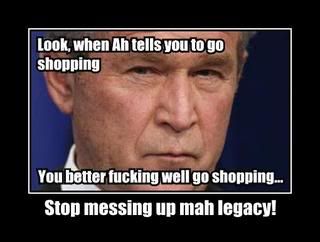
Bush's legacy. We didn't go shopping when he told us to.
Photobucket