Brave New Foundation Asks 1.3 Million Supporters to Urge Congress to Pass 'Helping Families Save Their Homes' Act
LOS ANGELES - Yesterday, Brave New Foundation asked its email list of 1.3 million people to call their Congressional Representatives and ask them to support H.R. 1106, Rep. John Conyers' new bill authorizing judges to modify home loans in bankruptcy proceedings.
As part of its "Fighting For Our Homes" campaign, Brave New Foundation has released a new online documentary video featuring a former subprime lender speaking anonymously about the mortgage sales industry, describing club promoters and drug dealers being hired and trained to deliberately mislead people into taking out loans they could not afford.
Watch the video: http://www.youtube.com/watch?v=KNBqP5j1FZQ
Over the last several weeks, Brave New Foundation's "Fighting For Our Homes" campaign has collected dozens of stories in text and video of people all over the country who are impacted by the housing meltdown. These stories are aggregated at FightingForOurHomes.com, a website that seeks to put a human face on the foreclosure crisis.
Now, the Fighting For Our Homes campaign is encouraging people to take action in support of struggling homeowners.
Congressman John Conyers, the author of the new bill, was recently interviewed by Brave New Foundation about his legislation in a state-of-the-art newscast that appeared exclusively online: http://www.youtube.com/watch?v=g9GTqpTKddk
Prior to that interview, Rep. Marcy Kaptur from Ohio also spoke to Brave New Foundation about the foreclosure crisis, stating that if not repaired soon, the housing crisis "will crush finance in this country for years to come." See video here: http://www.youtube.com/watch?v=JHl_tXvBmO4&feature=channel_page
Contact:
Nathan Havey
310-204-0448 x231
nhavey@bravenewfoundation.org
Showing posts with label Subprime Loans. Show all posts
Showing posts with label Subprime Loans. Show all posts
Monday, March 02, 2009
Why can't we bail out the homeowners
Who would then pay off the bank loans and everybody would be happy?

Thursday, October 23, 2008
What do you mean foxes can't guard the henhouse?
The inmates can't run the asylum? ... Corporations can't self-regulate?
I'm shocked, shocked, I tell you!!
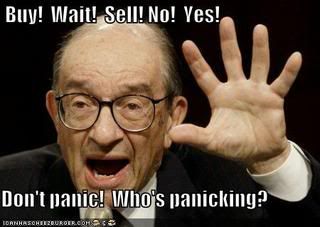
Will this lesson take? Nah, I give it ....oh... another twenty years or so before we hear the pleading for deregulation again... long enough for the next generation of neocons to spawn and for voters to forget.
crossposted at American Street
I'm shocked, shocked, I tell you!!

In opening statements, Rep. Henry Waxman, D-Calif., committee chairman, said the current economic crisis could have been prevented "if regulators had paid more attention and intervened with responsible legislation. The list of regulatory mistakes and misjudgments is long and the cost to taxpayers and the economy is staggering."Well... you see, Mr. Greenspan, it's like this.... human nature by default is self-obsessed and greedy. We must assume that those who know they won't be caught will do things that benefit themselves, ignoring the cost to others. We need checks and balances built into the system. When you take those away, you see the wreckage before you as an illustration of the end result.
Waxman put Greenspan on the spot, asking if he made any mistakes during his tenure as Federal Reserve chairman that may have contributed to the mortgage crisis.
Greenspan said he made a mistake in presuming that lenders themselves were more capable than regulators of protecting their finances. He said he was "shocked" when that system "broke down."
"I still do not understand exactly how it happened," said Greenspan.
Will this lesson take? Nah, I give it ....oh... another twenty years or so before we hear the pleading for deregulation again... long enough for the next generation of neocons to spawn and for voters to forget.
crossposted at American Street
Wednesday, October 15, 2008
Forrest Gump Explains Mortgage Backed Securities
An email making the rounds...


Mortgage Backed Securities are like boxes of chocolates. Criminals on Wall Street stole a few chocolates from the boxes and replaced them with turds. Their criminal buddies at Standard & Poor rated these boxes AAA Investment Grade chocolates. These boxes were then sold all over the world to investors. Eventually somebody bites into a turd and discovers the crime. Suddenly nobody trusts American chocolates anymore worldwide.
Hank Paulson now wants the American taxpayers to buy up and hold all these boxes of turd-infested chocolates for $700 billion dollars until the market for turds returns to normal. Meanwhile, Hank's buddies, the Wall Street criminals who stole all the good chocolates are not being investigated, arrested, or indicted. So far
nothing is back to normal.
Mama always said: "Sniff the chocolates first Forrest".
Tuesday, October 14, 2008
Monday, October 13, 2008
Fannie and Freddie found not guilty
WASHINGTON — As the economy worsens and Election Day approaches, a conservative campaign that blames the global financial crisis on a government push to make housing more affordable to lower-class Americans has taken off on talk radio and e-mail.Try pointing the finger somewhere else, like at yourselves, guys. Blaming the victim is not going to work.
Commentators say that's what triggered the stock market meltdown and the freeze on credit. They've specifically targeted the mortgage finance giants Fannie Mae and Freddie Mac, which the federal government seized on Sept. 6, contending that lending to poor and minority Americans caused Fannie's and Freddie's financial problems.
Federal housing data reveal that the charges aren't true, and that the private sector, not the government or government-backed companies, was behind the soaring subprime lending at the core of the crisis.
Thursday, September 25, 2008
Sunday, September 21, 2008
Monday, April 14, 2008
Volcker and Stiglitz speak
And tells the financial systems where they went wrong with this new crisis (more video at the Calculated Risk link):
I think he may actually know what he's talking about....
And
Stiglitz: Worst Recession Since the Great Depression
He also can see what is coming.
This is going to be .... interesting...
I think he may actually know what he's talking about....
And
Stiglitz: Worst Recession Since the Great Depression
He also can see what is coming.
This is going to be .... interesting...
Monday, April 07, 2008
Well... Cheney never did like California anyway
Filled as it is with dirty fucking hippies and stuff. The Enron thing exploded before California was taught its place, so how are we doing with the foreclosure/subprime disaster? Click the pic to enlarge.
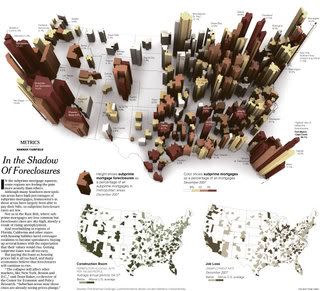
Ain't deregulation fun?
Ain't deregulation fun?
Friday, February 15, 2008
Dealing with the economic crisis
By hiding the facts.
Steve Benen of the Carpetbagger Report:
Steve Benen of the Carpetbagger Report:
After listing several examples of oddly convenient "budgetary constraints", Benen ends by saying:The Bush administration has a long and comical history of going to great lengths to hide bad news from the public. Today, Amanda at TP reports on the latest gem:
The U.S. economy is faltering. Family debt is on the rise, benefits are disappearing, the deficit is skyrocketing, and the mortgage crisis has worsened. Conservatives have attempted to deflect attention from the crisis, by blaming the media’s negative coverage and insisting the United States is not headed toward a recession, despite what economists are predicting.
The Bush administration’s latest move is to simply hide the data. Forbes has awarded EconomicIndicators.gov one of its “Best of the Web” awards. As Forbes explains, the government site provides an invaluable service to the public for accessing U.S. economic data:
“This site is maintained by the Economics and Statistics Administration and combines data collected by the Bureau of Economic Analysis, like GDP and net imports and exports, and the Census Bureau, like retail sales and durable goods shipments. The site simply links to the relevant department’s Web site. This might not seem like a big deal, but doing it yourself–say, trying to find retail sales data on the Census Bureau’s site — is such an exercise in futility that it will convince you why this portal is necessary.”
Alas, as the economic conditions worsen, the administration decided to shut down this “necessary” website, citing “budgetary constraints.”
When public information conflict with the White House’s agenda, the Bush gang has a choice — deal with the problem or hide the information. Guess which course they prefer?Well.. lessee... hmmm. Really do some hard work? Sit down and do some difficult math? Actually govern?

The Bush administration approved of making more poor
By supporting banks and predatory lending practices.
Eliot Spitzer, governor of New York for the Washington Post:

Eliot Spitzer, governor of New York for the Washington Post:
Predatory lending was widely understood to present a looming national crisis. This threat was so clear that as New York attorney general, I joined with colleagues in the other 49 states in attempting to fill the void left by the federal government. Individually, and together, state attorneys general of both parties brought litigation or entered into settlements with many subprime lenders that were engaged in predatory lending practices. Several state legislatures, including New York's, enacted laws aimed at curbing such practices.What did the Bush administration do in response? Did it reverse course and decide to take action to halt this burgeoning scourge? As Americans are now painfully aware, with hundreds of thousands of homeowners facing foreclosure and our markets reeling, the answer is a resounding no.
Not only did the Bush administration do nothing to protect consumers, it embarked on an aggressive and unprecedented campaign to prevent states from protecting their residents from the very problems to which the federal government was turning a blind eye.
Let me explain: The administration accomplished this feat through an obscure federal agency called the Office of the Comptroller of the Currency (OCC). The OCC has been in existence since the Civil War. Its mission is to ensure the fiscal soundness of national banks. For 140 years, the OCC examined the books of national banks to make sure they were balanced, an important but uncontroversial function. But a few years ago, for the first time in its history, the OCC was used as a tool against consumers.
In 2003, during the height of the predatory lending crisis, the OCC invoked a clause from the 1863 National Bank Act to issue formal opinions preempting all state predatory lending laws, thereby rendering them inoperative. The OCC also promulgated new rules that prevented states from enforcing any of their own consumer protection laws against national banks. The federal government's actions were so egregious and so unprecedented that all 50 state attorneys general, and all 50 state banking superintendents, actively fought the new rules.
But the unanimous opposition of the 50 states did not deter, or even slow, the Bush administration in its goal of protecting the banks. In fact, when my office opened an investigation of possible discrimination in mortgage lending by a number of banks, the OCC filed a federal lawsuit to stop the investigation.
Throughout our battles with the OCC and the banks, the mantra of the banks and their defenders was that efforts to curb predatory lending would deny access to credit to the very consumers the states were trying to protect. But the curbs we sought on predatory and unfair lending would have in no way jeopardized access to the legitimate credit market for appropriately priced loans. Instead, they would have stopped the scourge of predatory lending practices that have resulted in countless thousands of consumers losing their homes and put our economy in a precarious position.
When history tells the story of the subprime lending crisis and recounts its devastating effects on the lives of so many innocent homeowners, the Bush administration will not be judged favorably. The tale is still unfolding, but when the dust settles, it will be judged as a willing accomplice to the lenders who went to any lengths in their quest for profits. So willing, in fact, that it used the power of the federal government in an unprecedented assault on state legislatures, as well as on state attorneys general and anyone else on the side of consumers.

Wednesday, January 30, 2008
The Deciderer has speechified!

But that doesn't matter! Consumers are confident!:
WASHINGTON (AP) -- The economy nearly stalled in the fourth quarter with a growth rate of just 0.6 percent, capping its worst year since 2002.
Wednesday's Commerce Department report showed that the economy that deteriorated considerably during the October-to-December quarter as worsening problems in the housing market and harder-to-get credit made individuals and businesses more cautious in their spending. Fears of a recession have grown, even as inflation remained elevated.
For all of 2007, the economy grew by just 2.2 percent, the weakest performance in five years, when the country was struggling to recover from the 2001 recession. The housing collapse was the biggest culprit; builders slashed spending on housing projects by 16.9 percent on an annualized basis, the most in 25 years.
Consumer spending, which is a key to economic activity, slowed to a two per cent annual pace in the fourth quarter, down from 2.8 per cent in the previous quarter.We're not panicking:
Businesses also responded by shaving their inventories of goods, which trimmed 1.25 percentage points from fourth-quarter gross domestic product.
"The U.S. economy fired on just two cylinders late last year (business investment and exports), both of which are likely to downshift just when the consumer faces brisk headwinds," said BMO Capital Markets economist Sal Guatieri in a commentary.
"Looking ahead, we expect consumer spending to slow further in the first quarter of 2008, reflecting softer labour markets, elevated energy prices and declining house prices," said RBC economist Rishi Sondhi.
"On the corporate side, we also expect some weakening in business investment, owing to the effects of the financial market deterioration," Sondhi added.
WASHINGTON (AP) -- The Federal Reserve on Wednesday cut a key interest rate for the second time in just over a week, reducing the federal funds rate by a half point. It signaled that further rate cuts were possible.Recalling an earlier post, remember the discussion of liquidity traps.
The Fed action pushed the funds rate to 3 percent. It followed a three-fourths of a percentage point cut on Jan. 22, a day after financial markets around the world had plummeted on fears that the U.S. economy was heading into a recession. That decrease had been the biggest one-day move in more than two decades.
The half-point cut Wednesday followed news that the economy had slowed significantly in the final three months of last year with the gross domestic product expanding at a barely discernible pace of 0.6 percent, less than half what had been expected. The report came amid increased concern from several quarters about a possible recession.
In a brief statement explaining their decision, Federal Reserve Chairman Ben Bernanke and his colleagues said that "financial markets remain under considerable stress."
But there's no need for panic. Not yet, anyway.
Tuesday, January 29, 2008
Lesson learned from the subprime mess
If you are going to make a cockup, be sure it's an enormous cockup and the government will bail you out.
And diplomacy:
Trust the British to explain things better than we can....
And diplomacy:
Trust the British to explain things better than we can....
Thursday, September 20, 2007
What is that whistling sound?
Via Sorghum Crow at Sorghum Crow's General Store, The Telegraph:
And also from The Telegraph, China gets in the act:Saudi Arabia has refused to cut interest rates in lockstep with the US Federal Reserve for the first time, signalling that the oil-rich Gulf kingdom is preparing to break the dollar currency peg in a move that risks setting off a stampede out of the dollar across the Middle East.
[snip]
"This is a very dangerous situation for the dollar," said Hans Redeker, currency chief at BNP Paribas.
"Saudi Arabia has $800bn (£400bn) in their future generation fund, and the entire region has $3,500bn under management. They face an inflationary threat and do not want to import an interest rate policy set for the recessionary conditions in the United States," he said.
The Saudi central bank said today that it would take "appropriate measures" to halt huge capital inflows into the country, but analysts say this policy is unsustainable and will inevitably lead to the collapse of the dollar peg.
As a close ally of the US, Riyadh has so far tried to stick to the peg, but the link is now destabilising its own economy.
[snip]
There is now a growing danger that global investors will start to shun the US bond markets. The latest US government data on foreign holdings released this week show a collapse in purchases of US bonds from $97bn to just $19bn in July, with outright net sales of US Treasuries.
The danger is that this could now accelerate as the yield gap between the United States and the rest of the world narrows rapidly, leaving America starved of foreign capital flows needed to cover its current account deficit - expected to reach $850bn this year, or 6.5pc of GDP.
Via JJ at Unrepentant Old Hippie, the Canadian 'loonie' dollar:The Chinese government has begun a concerted campaign of economic threats against the United States, hinting that it may liquidate its vast holding of US treasuries if Washington imposes trade sanctions to force a yuan revaluation.
[snip]
Two officials at leading Communist Party bodies have given interviews in recent days warning - for the first time - that Beijing may use its $1.33 trillion (£658bn) of foreign reserves as a political weapon to counter pressure from the US Congress.
Shifts in Chinese policy are often announced through key think tanks and academies.
Described as China's "nuclear option" in the state media, such action could trigger a dollar crash at a time when the US currency is already breaking down through historic support levels.
It would also cause a spike in US bond yields, hammering the US housing market and perhaps tipping the economy into recession. It is estimated that China holds over $900bn in a mix of US bonds.
TORONTO - Boosted by high commodity prices and a weakening U.S. dollar, the loonie reached parity with the greenback Thursday for the first time in nearly 31 years, promising to boost the energy and import sectors and give consumers cheaper vacations but spelling more trouble for Canada's industrial heartland.
The loonie, which has been gaining on its American counterpart since bottoming out below 62 cents in early 2002, has recently been on a spectacular run, up from 95 cents at the start of September and from under 90 cents last spring.
And via Atrios at Eschaton:
Losses from sub-prime mortgages have far exceeded "even the most pessimistic estimates", US Federal Reserve chairman Ben Bernanke has said.
His comments to a US finance committee come two days after the Fed cut base interest rates to 4.75% from 5.25%.
[snip]
Mr Bernanke told the committee that US mortgage woes were set to continue - especially with adjustable rate mortgages (ARMs).
Proceedings for about 320,000 foreclosures - or repossessions - were begun in each of the first two quarters of 2007 he said, against an average of 225,000 per quarter in the past six years.
"With house prices still soft and many borrowers of recent-vintage sub-prime ARMs still facing their first interest rate resets, delinquencies and foreclosure initiations in this class of mortgages are likely to rise further," he said.
Mr Bernanke added that it was difficult to be precise about how many repossessions would take place, but he said that in normal circumstances about half of homeowners who were given repossession notices ended up losing their homes.
"That ratio may turn out to be higher in coming quarters because the proportion of sub-prime borrowers, who have weaker financial conditions than prime borrowers, is higher," Mr Bernanke said.
Do we start stuffing our mattresses with Euros? Or do we start burying jars of gold coin about our backyards?
Can anyone tell us how much trouble we are in?
Friday, August 10, 2007
Gripping the rollercoaster handrails for all we're worth
Because this could be a hell of a drop.
Paul Krugman:
Paul Krugman:
Yesterday, President Bush, showing off his M.B.A. vocabulary, similarly tried to reassure the markets. But Mr. Bush is, let’s say, a bit lacking in credibility. On the other hand, it’s not clear that anyone could do the trick: right now we’re suffering from a serious shortage of saviors. And that’s too bad, because we might need one.A post I did on the housing bubble a while back, and this video illustrate the point:
What’s been happening in financial markets over the past few days is something that truly scares monetary economists: liquidity has dried up. That is, markets in stuff that is normally traded all the time — in particular, financial instruments backed by home mortgages — have shut down because there are no buyers.
This could turn out to be nothing more than a brief scare. At worst, however, it could cause a chain reaction of debt defaults.
The origins of the current crunch lie in the financial follies of the last few years, which in retrospect were as irrational as the dot-com mania. The housing bubble was only part of it; across the board, people began acting as if risk had disappeared.
Everyone knows now about the explosion in subprime loans, which allowed people without the usual financial qualifications to buy houses, and the eagerness with which investors bought securities backed by these loans. But investors also snapped up high-yield corporate debt, a k a junk bonds, driving the spread between junk bond yields and U.S. Treasuries down to record lows.
Then reality hit — not all at once, but in a series of blows. First, the housing bubble popped. Then subprime melted down. Then there was a surge in investor nervousness about junk bonds: two months ago the yield on corporate bonds rated B was only 2.45 percent higher than that on government bonds; now the spread is well over 4 percent.
Investors were rattled recently when the subprime meltdown caused the collapse of two hedge funds operated by Bear Stearns, the investment bank. Since then, markets have been manic-depressive, with triple-digit gains or losses in the Dow Jones industrial average — the rule rather than the exception for the past two weeks.
But yesterday’s announcement by BNP Paribas, a large French bank, that it was suspending the operations of three of its own funds was, if anything, the most ominous news yet. The suspension was necessary, the bank said, because of “the complete evaporation of liquidity in certain market segments” — that is, there are no buyers.
When liquidity dries up, as I said, it can produce a chain reaction of defaults. Financial institution A can’t sell its mortgage-backed securities, so it can’t raise enough cash to make the payment it owes to institution B, which then doesn’t have the cash to pay institution C — and those who do have cash sit on it, because they don’t trust anyone else to repay a loan, which makes things even worse.
And here’s the truly scary thing about liquidity crises: it’s very hard for policy makers to do anything about them.
Subscribe to:
Posts (Atom)