This isn't brain surgery. A reporter's privilege should not be used to help powerful people in government lie to the public about what it's doing or punish its enemies for speaking out against it. It exists to protect people who are risking their livlihoods by speaking out against those same powerful people. This is not hard for rational people to understand and yet in Washington they are so confused by their relationships with the powerful that they seem to be speaking in tongues on this issue.
The political press is not a monolith. There are incredible reporters like Priest who have done extraordinary work under very difficult circumstances. We can't do without them. But the insider culture of Washington that McEnroe describes in his piece above is a decadent and insular little circle of celebrity and power that has affirmatively harmed this country. The Libby trial opened up that fetid boil and did this country a favor. I'm not surprised that they are squealing as loudly as they can --- or that the rightwing freakshow is behaving as if they were born yesterday. After all, they all know they are compromised. They just didn't think we did.
Showing posts with label Perjury Trial. Show all posts
Showing posts with label Perjury Trial. Show all posts
Monday, March 12, 2007
What Scooter Libby's trial exposed
Besides the perjury was the incestuous relationship of the press and Capitol Hill. As Digby explains:

Thursday, March 08, 2007
Waxman opens up hearings on the White House's outing of Valerie Plame
Cheney, Rove, Bush? Raise your right hand please...
Chairman Henry A. Waxman announced a hearing on whether White House officials followed appropriate procedures for safeguarding the identity of CIA agent Valerie Plame Wilson. At the hearing, the Committee will receive testimony from Ms. Wilson and other experts regarding the disclosure and internal White House security procedures for protecting her identity from disclosure and responding to the leak after it occurred. The hearing is scheduled for Friday, March 16.
In addition, the Committee today sent a letter to Special Prosecutor Patrick Fitzgerald commending him for his investigation and requesting a meeting to discuss testimony by Mr. Fitzgerald before the Committee.
The flow chart of impeachable offenses
Via Bryan at Why Now? Juan Cole has the timeline and photos of the Bush administration as they furiously beat the drum for war.
Excellently well done.
Excellently well done.
Tuesday, March 06, 2007
Nine myths about Scooter Libby and the Plame case you should expect to see in Republican talking points
Incoming about.....now: (My parentheses)
On March 6, a federal jury found former vice presidential chief of staff I. Lewis "Scooter" Libby guilty on charges of perjury, obstruction of justice, and lying to federal investigators. In the wake of this decision, conservatives and other media figures can be expected to revive and advance numerous myths and falsehoods regarding the CIA leak case that have circulated throughout the media since Libby's indictment in October 2005.
In anticipation of this misinformation, Media Matters for America has listed those baseless and false claims likely to surface in the coming days and weeks:
(Here is a list, they explain in the post in great detail).
No underlying crime was committed. (False)
There was no concerted White House effort to smear Wilson. (False)
Libby was not responsible for the leak of Plame's identity. (False)
Libby merely "left out some facts." (False)
Libby's leak was an effort to set the record straight. (False)
There is no evidence that the Plame leak compromised national security. (False)
Fitzgerald is a partisan prosecutor. (False)
Fitzgerald exceeded his mandate in investigating violations beyond the IIPA. (False)
Plame's employment with the CIA was widely known. (False)
Scooter is found guilty
So anyone want to bet how soon he gets pardoned?
WASHINGTON (AP) - Former White House aide I. Lewis "Scooter" Libby was convicted Tuesday of obstruction, perjury and lying to the FBI in an investigation into the leak of a CIA operative's identity. Libby, the former chief of staff to Vice President Dick Cheney, was accused of lying and obstructing the investigation into the 2003 leak of CIA operative Valerie Plame's identity to reporters.
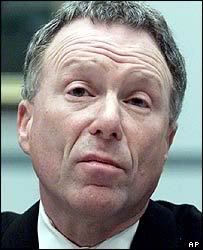
2.5 hours. The time it took after Scooter Libby’s verdict was announced for the National Review to publish its editorial: “Pardon Libby.”
Wednesday, February 21, 2007
Closing statements of the Scooter Libby trial
By emptywheel at The Next Hurrah. Breaks down the power plays and manuevers by the opposing lawyers, their statements, actions and reactions:
Fitzgerald took Wells' mock outrage and mocked it right back. Not only did his judicious (ha! like that word) use of emotion grab the attention of the jury in a way that Wells' sustained faux outrage no longer could. But with just a few words, Fitzgerald managed to belittle the entire argument the Defense had been making.
But Fitzgerald wasn't done with reappropriating Wells' schtick. After doing a number of things with his rebuttal--finally establishing Valerie Wilson as a person, getting weedier than I have ever been, countering Jeffress' "Perry Mason moment" with his own, accusing Cheney of obstructing justice--Fitzgerald returned to his explanation of why obstruction was so important. He wasn't yelling, like Wells had done. Rather, he used the same barely controlled outrage voice he used in the press conference where he announced charges against Libby. His voice cracked, as it had before.
And he flipped Wells' outrage on its head. Rather than Libby as the aggrieved party, he put the American people in the role of aggrieved party. He picked up Wells' language about what Scooter deserved, and asked, "Don't the American people deserve the truth?!?!?!" Then he picked up Wells' language about "giving Scooter back" and flipped that too.
If as a result his wife had a job, she worked at CPD, She gets dragged into newspapers. People want to find out was a law broken when people want to know, who did it. What role did Defendant play. What role did VP play? He told you he may have discussed this with VP. Don't you think FBI desesrves straight answers. When you go in [that] jury room, your commonsense will tell you that he made a gamble. He threw sand in the eyes of the FBI. He stole the truth of the judicial system. You return [a guilty verdict] you give truth back.
It perfectly mirrored Wells' argument: Faux outrage, Real outrage; Libby and his family, Valerie and her live; Give Libby back ... or give the truth back.
No better way to put this trial--you can give Libby back, or the American people can have the truth back. Wow.
But never forget--it was all set up when Zeidenberg, not on anyone's radar as the alpha male in this trial, forced Ted Wells to defend himself, rather than defend Scooter Libby.
Monday, February 19, 2007
Cheney, incompetent Prince of Darkness?
Hard to believe. After all, look at how well his PNAC plans are going...
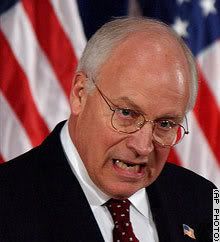
The trial against Mr. Libby has centered on a narrow case of perjury, with days of sparring between the defense and prosecution lawyers over the numbing details of three-year-old conversations between White House officials and journalists. But a close reading of the testimony and evidence in the case is more revelatory, bringing into bolder relief a portrait of a vice president with free rein to operate inside the White House as he saw fit in order to debunk the charges of a critic of the war in Iraq.
The evidence in the trial shows Vice President Dick Cheney and Mr. Libby, his former chief of staff, countermanding and even occasionally misleading colleagues at the highest levels of Mr. Bush’s inner circle as the two pursued their own goal of clearing the vice president’s name in connection with flawed intelligence used in the case for war.
The testimony in the trial, which is heading for final arguments as early as Tuesday, calls into question whether Mr. Cheney, known as a consummate inside player, operated as effectively as his reputation would hold. For all of his machinations, Mr. Cheney’s efforts sometimes faltered as he tried, with the help of Mr. Libby, to push back against critics during a crucial period in the early summer of 2003, when Mr. Bush’s initial case for war was beginning to fall apart. In some of their efforts, Mr. Cheney and his agent, Mr. Libby, appeared even maladroit in the art of news management.
Monday, February 12, 2007
Friday, February 09, 2007
Pardons?
John Aravosis at Americablog notes:
What I want to know is when the media is going to force George Bush to answer the question as to whether he's going to pardon Scooter, Cheney and Rumsfeld, among others, for their various offenses. Certainly, it's fair for the White House to postpone answering that question until Libby is convicted, if at all. But after that point, we need to demand answers, because you know they're all getting pardons.
Whig at Cannablog points out:
On the matter of the presidential pardon being used at any time to halt the investigation of this administration and its co-conspirators, such a pardon does not protect a person from giving future testimony to a grand jury, petit jury or the congress under the penalty of perjury for false statements. Moreover, a pardoned individual cannot raise a legitimate fifth amendment defense against self-incrimination with respect to the pardoned acts, but must testify truthfully to all that is known as one under a grant of prosecutorial immunity.
So either way ... If the courts and the Democrats persevere, we may finally hear the truth.
Tuesday, February 06, 2007
The Scooter Libby perjury trial
is about to drag in the bear in a cage and a bunch of sticks.
Jane Hamsher of Firedoglake:
Jane Hamsher of Firedoglake:
While tomorrow's release of the Scooter Libby grand jury tapes will no doubt be fodder for endless blog posts, they will be of no less interest to shrinks and dramatists. Over five and a half hours of the tapes played in court today, and although Libby's endless network of obfuscations at times became impenetrable, it was fascinating to watch his gradually dawning realization under Patrick Fitzgerald's relentless and dogged questioning that he was in fact screwed. Initially calm and self-assured, as Fitzgerald detailed one after another conversation in which Libby discussed Valerie Plame's identity with those who contradicted his claim of having heard the information first from Tim Russert, you could hear him start to slip. He grew foggy, his voice dropped, he became dour and tried to shift out from under Fitzgerald's painfully detailed questioning but there was no place to hide. Even hard core cynics in the media room were riveted.
The day started out with Judge Walton ruling that New York Times journalist David Sanger would be compelled to testify in Libby's defense. Somehow Sanger is supposed to say that he spoke with Libby during the time in question and since Libby didn't say anything to him about Valerie Plame this must be proof of…well, I don't quite know but Team Libby certainly seemed to think it was significant. Sanger's attorney was arguing against the appearance so an appeal is probably not unlikely, though one has to wonder how many New York Times reporters will go to jail, wallowing in melodrama in defense of Scooter Lilbby. I think we might already be at one too many.
Tuesday, January 30, 2007
The Great Undoing
The Bush administration, peopled as it is with ex-Nixon/Ford staffers, has done a wonderful play-by-play of Watergate. It isn't the crime, it's the cover-up that gets you.
Mustang Bobby:
Mustang Bobby:
For those of us who remember Watergate, it wasn't the "third-rate burglary" that brought down the presidency of Richard Nixon. It wasn't even the hush money paid to the burglars or the dirty tricks planned at the hands of G. Gordon Liddy in order to undermine the Democrats in the 1972 election. It was the cover-up that did them all in; the lying to the FBI, lying to Congress, and the obstruction of justice in the investigations that did it. The initial incident was nothing compared to the attempt to kill the result.For a front row seat at the Great Undoing of the Glorious Neocon Rule, go to Firedoglake for the liveblogging of the Libby Trial.
The same is true here. The leak of Valerie Plame's name, as odious and craven as it was in the attempt by the Bush administration to get back at someone for embarrassing the White House for calling them out on the infamous sixteen words, turns out to have been an inadvertant slip of the tongue by Richard Armitage, an innocuous public servant who, as far as anyone can tell, had no political motives when he did it. He just plain goofed. But given the paranoia and revenge-filled mindset of this White House, led by a president who can never make mistakes and enabled by willing toadys like Karl Rove within and the right-wing orcosphere without, it is not surprising that suspicion immediately fell on the higher-ups like Rove, Cheney, and even the president himself.
Sunday, January 28, 2007
Fleischer has immunity and Rove and Bartlett have been supoenaed
by Scooter Libby's lawyers:
Both Rove and Bartlett have already received trial subpoenas from Libby’s defense lawyers, according to lawyers close to the case who asked not to be identified talking about sensitive matters. While that is no guarantee they will be called, the odds increased this week after Libby’s lawyer, Ted Wells, laid out a defense resting on the idea that his client, Vice President Dick Cheney’s former chief of staff, had been made a “scapegoat” to protect Rove.
Cheney is expected to provide the most crucial testimony to back up Wells’s assertion, one of the lawyers close to the case said. The vice president personally penned an October 2003 note in which he wrote, “Not going to protect one staffer and sacrifice the other.” The note, read aloud in court by Wells, implied that Libby was the one being sacrificed in an effort to clear Rove of any role in leaking the identity of CIA operative Valerie Plame, wife of Iraq war critic Joe Wilson. “Wow, for all the talk about this being a White House that prides itself on loyalty and discipline, you’re not seeing much of it,” the lawyer said.
[snip]
An equally embarrassing conflict could emerge next week when former White House press secretary Ari Fleischer takes the stand. Fleischer has been one of the most mysterious figures in the case, making virtually no public comments about it since he left the White House in July 2003. In the past he has insisted he wasn’t even represented by a lawyer. But it emerged during court arguments this week that Fleischer originally invoked his Fifth Amendment privileges to avoid testifying and then only agreed to do so after he was given an immunity deal by Fitzgerald—an arrangement that normally requires extensive bargaining among attorneys. Fleischer’s testimony is critical to Fitzgerald’s case: as the prosecutor laid out this week in his opening statement, Fleischer has said that Libby told him over a White House lunch on July 7, 2003, that Wilson’s wife worked at the CIA and made a point of describing this information as “hush and hush.” Fitzgerald used that account to undercut Libby’s grand-jury assertion that he was surprised and “taken aback” just three or four days later when, he claims, Russert told him about Wilson’s wife. “You can’t learn something startling on Thursday that you’re giving out Monday and Tuesday of the same week,” Fitzgerald said. Fleischer has also testified that Bartlett also later told him about Wilson’s wife and, after hearing it from both Libby and Bartlett, the then-White House press secretary disclosed the information to NBC reporter David Gregory.On its face, Fleischer’s account seems to contradict the repeated public assertions of his immediate successor, Scott McClellan, in October 2003 that nobody at the White House was in any way involved in the leak of Plame’s identity. It also potentially puts Bartlett, one of the president’s senior and most trusted advisers, on the hot seat. If Bartlett backs up Fleischer, it suggests he himself played a role in passing along radioactive information that triggered a criminal investigation that has plagued the White House for more than four years. If he contradicts Fleischer, it raises questions about the credibility of a man who was President Bush’s chief spokesman for the first two and a half years of his presidency. His lawyer declined to comment on what Bartlett will say.
But either way, it’s not a scenario that anybody at the White House can be looking forward to.
The person everyone had to protect and lie for was Karl Rove.
Libby, it was widely thought by legal experts, was going to be the good soldier. He would play it safe at his trial in order to preserve his options; mainly, if convicted, to seek a presidential pardon before Bush leaves office.
But no sooner did he start his opening statement Tuesday morning than defense lawyer Ted Wells shocked the courtroom and all but tossed the “pardon strategy” out the window. Seeking to rebut Fitzgerald’s contention that Libby had lied about his knowledge of Plame’s CIA employment in order to save his job with Cheney, Wells shot back: “Mr. Libby was not concerned about losing his job in the Bush administration. He was concerned about being set up, he was concerned about being made the scapegoat.”
According to Wells, the chief culprit, or at least the beneficiary of the plot was Rove, described by the defense lawyer as “the president’s right hand man,” whose survival was essential for the president’s re-election. As related by Wells, his client was so worried that Rove’s fate was taking priority over his that Libby went to his boss, Cheney, in October 2003 and complained: “I think people in the White House are trying to set me up. People in the White House are trying to protect Karl Rove.”
Well’s argument was both brilliant and complex-and perhaps difficult for non-news hounds on the jury to follow. But it raised the prospect that the Libby trial will now turn into a horror show for the White House, forcing current and former top aides to testify against each other and revealing an administration that has been in turmoil over the Iraq war for more than three years.
Thursday, January 25, 2007
Tuesday, January 23, 2007
Being set up by Bush
To take the fall is a family pastime. If you are no longer protecting the boy king, you get thrown under the bus. After six years, there are a lot of bodies under there.
Attorney Wells for Libby:
Attorney Wells for Libby:
Attorneys for former White House aide ``Scooter'' Libby said Tuesday that Bush administration officials tried to blame him for the leak of a CIA operative's name to cover up for Bush political adviser Karl Rove's own disclosures.
Attorney Theodore Wells, in the opening statements of I. Lewis Libby's perjury trial, said Libby went to Vice President Dick Cheney in 2003 and complained that the White House was subtly blaming him for leaking Valerie Plame's identity to columnist Robert Novak.
``They're trying to set me up. They want me to be the sacrificial lamb,'' Wells said, recalling the conversation between Libby and Cheney. ``I will not be sacrificed so Karl Rove can be protected.''
Subscribe to:
Posts (Atom)