Showing posts with label Nixon. Show all posts

Monday, June 18, 2012

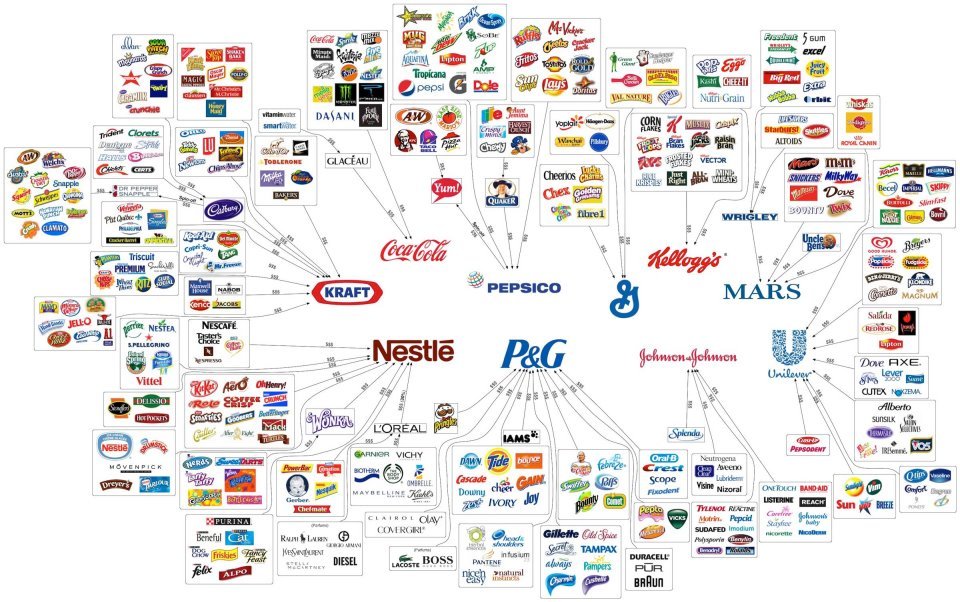
Only a few monolithic companies control our food

Does it make you wonder at all the health problems such as obesity, diabetes, high blood pressure, food allergies that are found in abundance in the United States and not as much elsewhere? Take a look at the diagram and ask yourself if these companies have your health in mind or only your money. And then notice that food stamps tie into to this as well...

Update 6/18: From the Guardian article about obesity:
The story begins in 1971. Richard Nixon was facing re-election. The Vietnam war was threatening his popularity at home, but just as big an issue with voters was the soaring cost of food. If Nixon was to survive, he needed food prices to go down, and that required getting a very powerful lobby on board – the farmers. Nixon appointed Earl Butz, an academic from the farming heartland of Indiana, to broker a compromise. Butz, an agriculture expert, had a radical plan that would transform the food we eat, and in doing so, the shape of the human race. Butz pushed farmers into a new, industrial scale of production, and into farming one crop in particular: corn. US cattle were fattened by the immense increases in corn production. Burgers became bigger. Fries, fried in corn oil, became fattier. Corn became the engine for the massive surge in the quantities of cheaper food being supplied to American supermarkets: everything from cereals, to biscuits and flour found new uses for corn. As a result of Butz's free-market reforms, American farmers, almost overnight, went from parochial small-holders to multimillionaire businessmen with a global market. One Indiana farmer believes that America could have won the cold war by simply starving the Russians of corn. But instead they chose to make money. By the mid-70s, there was a surplus of corn. Butz flew to Japan to look into a scientific innovation that would change everything: the mass development of high fructose corn syrup (HFCS), or glucose-fructose syrup as it's often referred to in the UK, a highly sweet, gloppy syrup, produced from surplus corn, that was also incredibly cheap. HFCS had been discovered in the 50s, but it was only in the 70s that a process had been found to harness it for mass production. HFCS was soon pumped into every conceivable food: pizzas, coleslaw, meat. It provided that "just baked" sheen on bread and cakes, made everything sweeter, and extended shelf life from days to years. A silent revolution of the amount of sugar that was going into our bodies was taking place. In Britain, the food on our plates became pure science – each processed milligram tweaked and sweetened for maximum palatability. And the general public were clueless that these changes were taking place.
Update 6/20:
The US long-term strategy was to dominate the global market in grain and agriculture commodities, as outlined in the early 1970s by Richard Nixon. This policy coincided with taking the dollar off the gold exchange standard in August 1971 to make US grain exports competitive in the rest of the world. However, in order for the US to become the world's most competitive agribusiness producer, it had to replace traditional American family-based farming with the now-widespread huge "factory-farm" production. In other words, traditional agriculture was systematically replaced with agribusiness production through changes in domestic policy. For example, domestic farm programs that had previously protected smaller farm incomes were phased out during Nixon's term in office. This policy was then exported to developing countries in a bid to make US agribusiness more competitive and to get a hold into foreign markets: The Nixon Administration began the process of destroying the domestic food production of developing countries as the opening shot in an undeclared war to create a vast new global market in "efficient" American food exports. Nixon also used the post-war trade regime known as the General Agreement on Tariffs and Trade (GATT) to advance this new global agribusiness export agenda.[2] In Henry Kissinger's 1974 report "National Security Study Memorandum 200" (NSSM 200), he directly targeted overseas food aid as an "instrument of national power."[3] The policy shifts during the 1970s were toward increased deregulation, which meant increased private regulation by the large and powerful global corporations. This led to an increase in corporate mergers and the rise of transnational corporations (which today often have larger gross domestic products than many nation states).[4] As large corporate agribusinesses were creating their food production, storage and distribution monopoly, smaller domestic farms were going bankrupt and closing. (Although this trend was predominantly occurring within the US, it later spread to other developed nations, which were forced to "modernize" their agricultural industry to compete with global trade.) For example, between 1979 and 1998, the number of US farmers dropped by 300,000 and by the end of the 1990s, the agriculture (in the US at least) was dominated by large commercial agribusiness interests. The US also operated a foreign policy of offering financial assistance "to developing countries via the World Bank in return for these countries to open their markets up to cheap US food imports and hybridized seeds."[5] By the beginning of the 21st century, world supplies of cereal were under the control of a few US-based monopolies. Four large agrochemical/seed companies - Monsanto, Novartis, Dow Chemical and DuPont - controlled more than 75 percent of the US's seed corn sales and 60 percent of soybean seed sales. By the merging of giant agrochemical and seed companies, livestock could be fed on a huge diet of drugs in order to stimulate increased growth. It has been estimated that in recent years the largest users of antibiotics and similar pharmaceutical products are not humans, but animals, which consumed 70 percent of all pharmaceutical antibiotics. Statistics show, quite shockingly, that the use of antibiotics by US agribusiness increased from 500,000 pounds to 40 million pounds (an 80-fold increase by weight) from 1954 to 2005. As a consequence, the Center for Disease Control in the US has reported an "epidemic" rise in food-related diseases in humans as a result of eating meat containing large quantities of antibiotics. One Harvard University researcher, Ray Goldberg, who set up a research group to examine the revolution in agribusiness (including genetically modified organisms), reported: "the genetic revolution is leading to an industrial convergence of food, health, medicine, fiber and energy business."[6]

Friday, September 05, 2008

The pure politics of resentment

Krugman:

One of the key insights in “Nixonland,” the new book by the historian Rick Perlstein, is that Nixon’s political strategy throughout his career was inspired by his college experience, in which he got himself elected student body president by exploiting his classmates’ resentment against the Franklins, the school’s elite social club. There’s a direct line from that student election to Spiro Agnew’s attacks on the “nattering nabobs of negativism” as “an effete corps of impudent snobs,” and from there to the peculiar cult of personality that not long ago surrounded George W. Bush — a cult that celebrated his anti-intellectualism and made much of the supposed fact that the “misunderestimated” C-average student had proved himself smarter than all the fancy-pants experts.

And when Mr. Bush turned out not to be that smart after all, and his presidency crashed and burned, the angry right — the raging rajas of resentment? — became, if anything, even angrier. Humiliation will do that.

Can Mr. McCain and Ms. Palin really ride Nixonian resentment into an upset election victory in what should be an overwhelmingly Democratic year? The answer is a definite maybe.

By selecting Barack Obama as their nominee, the Democrats may have given Republicans an opening: the very qualities that inspire many fervent Obama supporters — the candidate’s high-flown eloquence, his coolness factor — have also laid him open to a Nixonian backlash. Unlike many observers, I wasn’t surprised at the effectiveness of the McCain “celebrity” ad. It didn’t make much sense intellectually, but it skillfully exploited the resentment some voters feel toward Mr. Obama’s star quality.

I have a picture I'd like to share:

Photobucket

The preznitcee: Elect stupid people!

Monday, July 09, 2007

Nixon thought Fred Thompson was 'dumb as hell'

Crooks and Liars:

Nixon was disappointed with the selection of Thompson, whom he called “dumb as hell.” The president did not think Thompson was skilled enough to interrogate unfriendly witnesses and would be outsmarted by the committee’s Democratic counsel.

Oh s—, that kid,” Nixon said when told by his chief of staff, H.R. Haldeman, of Thompson’s appointment on Feb. 22, 1973.

“Well, we’re stuck with him,” Haldeman said.

Nixon expressed concern that Thompson was not “very smart.”

“Not extremely so,” Buzhardt agreed.

“But he’s friendly,” Nixon said.

“I found Thompson most cooperative, feeling more Republican every day,” Buzhardt said.

Thursday, July 05, 2007

Fred Thompson was a mole for Nixon

The Boston Globe:
WASHINGTON -- The day before Senate Watergate Committee minority counsel Fred Thompson made the inquiry that launched him into the national spotlight -- asking an aide to President Nixon whether there was a White House taping system -- he telephoned Nixon's lawyer.

Thompson tipped off the White House that the committee knew about the taping system and would be making the information public. In his all-but-forgotten Watergate memoir, "At That Point in Time," Thompson said he acted with "no authority" in divulging the committee's knowledge of the tapes, which provided the evidence that led to Nixon's resignation. It was one of many Thompson leaks to the Nixon team, according to a former investigator for Democrats on the committee, Scott Armstrong , who remains upset at Thompson's actions.

"Thompson was a mole for the White House," Armstrong said in an interview. "Fred was working hammer and tong to defeat the investigation of finding out what happened to authorize Watergate and find out what the role of the president was."

[snip]

John Dean , Nixon's former White House counsel, who was a central witness at the hearings, said he believed that Baker and Thompson were anything but impartial players. "I knew that Thompson would be Baker's man, trying to protect Nixon," Dean said in an interview.

Down With Tyranny and Crooks and Liars has more on the wonderfulness of Fred Thompson.

But remember, he's all manly and stuff!

Thursday, March 01, 2007

Shades of Watergate

Starting with a third-rate burglary:

The burglary over the weekend at the New Hampshire Democratic Party’s Concord headquarters came five weeks after a break-in at a Democratic Party office in Manchester.

The door to the Manchester Democratic Committee office was broken down sometime over the weekend of Jan. 20 to 21, according to party officials and the Manchester police. Raymond Buckley, chairman of the city Democrats and vice chairman of the state Democratic Party, said he doesn’t believe anything was taken from or vandalized in the Manchester office, and he dismissed any connection between that incident and the burglary of the party’s headquarters in Concord last weekend.

Several Democrats, speaking on condition of anonymity, said that laptops and other equipment had been taken from the [Concord] party headquarters, though they said it appears that any sensitive information was protected by passwords or stored on servers that were not taken from the building.

The Bush administration really does have old Nixon staff members, don't they?

Tuesday, January 30, 2007

The Great Undoing

The Bush administration, peopled as it is with ex-Nixon/Ford staffers, has done a wonderful play-by-play of Watergate. It isn't the crime, it's the cover-up that gets you.
Mustang Bobby:
For those of us who remember Watergate, it wasn't the "third-rate burglary" that brought down the presidency of Richard Nixon. It wasn't even the hush money paid to the burglars or the dirty tricks planned at the hands of G. Gordon Liddy in order to undermine the Democrats in the 1972 election. It was the cover-up that did them all in; the lying to the FBI, lying to Congress, and the obstruction of justice in the investigations that did it. The initial incident was nothing compared to the attempt to kill the result.

The same is true here. The leak of Valerie Plame's name, as odious and craven as it was in the attempt by the Bush administration to get back at someone for embarrassing the White House for calling them out on the infamous sixteen words, turns out to have been an inadvertant slip of the tongue by Richard Armitage, an innocuous public servant who, as far as anyone can tell, had no political motives when he did it. He just plain goofed. But given the paranoia and revenge-filled mindset of this White House, led by a president who can never make mistakes and enabled by willing toadys like Karl Rove within and the right-wing orcosphere without, it is not surprising that suspicion immediately fell on the higher-ups like Rove, Cheney, and even the president himself.
For a front row seat at the Great Undoing of the Glorious Neocon Rule, go to Firedoglake for the liveblogging of the Libby Trial.

Sunday, January 14, 2007

Calling for a leader among the Republicans

Who can do the heroic Goldwater-like thing and bring down the curtain on Georgie's Excellent Adventure in Iraq.

Via NTodd, Frank Rich:
"The question now is how to minimize the damage before countless more Americans and Iraqis are slaughtered to serve the president’s endgame of passing his defeat on to the next president. The Democrats can have all the hearings they want, but they are unlikely to take draconian action (cutting off funding) that would make them, rather than Mr. Bush, politically vulnerable to blame for losing Iraq.

I have long felt that it will be up to Mr. Bush’s own party to ring down the curtain on his failed policy, and after the 2006 midterms, that is more true than ever. The lame-duck president, having lost both houses of Congress and at least one war (Afghanistan awaits), has nothing left to lose. That is far from true of his party.

Even conservatives like Sam Brownback of Kansas and Norm Coleman of Minnesota started backing away from Iraq last week. Mr. Brownback is running for president in 2008, and Mr. Coleman faces a tough re-election fight. But Republicans not in direct electoral jeopardy (George Voinovich of Ohio, Lisa Murkowski of Alaska) are also starting to waver. It’s another Vietnam-Watergate era flashback. It wasn’t Democrats or the press that forced Richard Nixon’s abdication in 1974; it was dwindling Republican support. Though he had vowed to fight his way through a Senate trial, Nixon folded once he lost the patriarchal leader of his party’s right wing.

Photobucket - Video and Image Hosting

That leader was Barry Goldwater , who had been one of Nixon’s most loyal and aggressive defenders until he finally realized he’d been lied to once too often. If John McCain won’t play the role his Arizona predecessor once did, we must hope that John Warner or some patriot like him will, for the good of the country, answer the call of conscience. A dangerous president must be saved from himself, so that the American kids he’s about to hurl into the hell of Baghdad can be saved along with him."

Photobucket - Video and Image Hosting


Update Gene Lyons:
"Although polls show slight majorities favoring impeachment, the votes just aren’t there. Even so, it’s not hard to imagine how it could happen. Because to allow an arrogant, arguably delusional president and his shrinking band of ideologically driven aides to double-down in Iraq, gambling the “lives and sacred honor” of American soldiers to save face in a misbegotten war also would do incalculable harm to the idea of self-government.

To remove Bush, however, Republicans would have to take the lead. As Bush is currently wrecking the GOP everywhere but the Deep South, chances may not be as remote as they seem.

The cult of personality surrounding the White House has broken down. Last November, American voters delivered as clear a verdict on Iraq as an offyear electorate can possibly render. No Democratic incumbent lost anywhere. Yet Bush acts as if it never happened."