Showing posts with label Cloning. Show all posts

Saturday, May 31, 2008

South Korea doesn't want our beef...

I wonder why that is?:
SEOUL, South Korea - Tens of thousands of South Koreans rallied Saturday night against a government decision to import U.S. beef in the largest demonstration in a month of almost daily protests.

A crowd estimated by police at 38,000 people filled a plaza in front of city hall. Protesters lit candles, waved placards and chanted slogans criticizing President Lee Myung-bak.

South Korea agreed in April to reopen what was formerly the third-largest overseas market for U.S. beef. It had been shut for most of the past 4 1/2 years following the first U.S. case of mad cow disease in a Canadian-born cow in Washington state in 2003.

That deal, coupled with some sensational media reports, sparked fears of mad cow disease and triggered protests calling for scrapping or renegotiating the agreement.
Oh, c'mon! Our beef is totally safe! Totally! Tot.. ah ...
WASHINGTON (AP) -- The Bush administration on Friday urged a federal appeals court to stop meatpackers from testing all their animals for mad cow disease, but a skeptical judge questioned whether the government has that authority.
Ah... hmm: (my bold)
TUESDAY May 13, 2008 (foodconsumer.org) -- The Bush administration on Friday asked a federal appeals court to stop meatpackers from testing all their animals for mad cow disease, USA Today reports.

A low court ruled early that Kansas-based Creekstone Farms Premium Beef can conduct mad cow disease testing in all animals. The company pursues the testing to meet the demand from foreign markets like Japan, which requires the testing for every domestic cow.

But the United States Department of Agriculture strongly opposed such a testing saying meatpackers have no right to such a testing. And it also said such a testing would undermine consumers’ confidence in domestic beef safety.

Creekstone Farms sued the government and won the first round in a low court.

In May 2007, Consumer Unions wrote to the USDA asking the agency not to appeal the March 29, 2007 low court ruling. Regardless, the government appealed to a federal appeals court to block the low court’s ruling that allows the meatpacker to conduct the test.

In the United States, less than 1 % of slaughtered cows are tested for mad cow disease under the USDA guidelines, according to USA Today. USDA argued that widespread testing does not guarantee food safety and could cause false positive results that scare consumers.
HhhhooooOOokaaayyy... my confidence is a bit shaken but maybe there's not that many mad cows out there. There shouldn't be any other concerns, right?: (my bold)
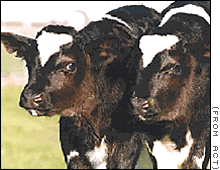
Milk and meat from cloned cows could hit grocery shelves in a few years if the FDA approves the process soon, as is expected.

But would the products be safe? Scientists and consumer advocates disagree on the answer.

The Food and Drug Administration has been wrestling for more than five years with the question of whether or not to allow the use of milk or meat from cloned cows, swine and sheep, with a voluntary ban on such products in place for now. Cloning companies and many scientists say the products are safe to eat, while consumer advocacy groups argue there are unaddressed concerns.

Several researchers told LiveScience that the FDA approval is inevitable. The Wall Street Journal reported last week that it could come as soon as this week.

But milk and meat from cloned animals is unlikely to hit grocery store shelves for a few years. Clones must grow up before products from them can be used. And since creating them is expensive, they will likely be used for breeding, not for direct consumption, experts say.

Cloning concerns

Reports of abnormalities, higher disease susceptibility and early deaths of clones have prompted many of the concerns about using their milk and meat. (Dolly, the sheep that was the first animal cloned by this process, was euthanized at the early age of six, though scientists at the institute that created her stated the disease she was suffering from was unrelated to her being a clone.)
Riot, South Koreans!! Go! Go!

Photobucket

crossposted at American Street

Tuesday, January 15, 2008

Try them, try them and you may, I say

Green cloned eggs and ham....
Meat and milk from cloned animals is generally safe to eat, the US Food and Drug Administration (FDA) has declared.

[snip]

The FDA does not expect to see a lot of products from cloned animals being sold, because of cost. It says clones would be used mainly for breeding.
The agency released almost identical draft conclusions in December 2006. Since then, new scientific information has strengthened its central view.

"After reviewing additional data and the public comments in the intervening year since the release of our draft documents on cloning, we conclude that meat and milk from cattle, swine, and goat clones are as safe as the food we eat every day," said Stephen Sundlof, director of the FDA's Center for Food Safety and Applied Nutrition.

The finding also confirms the conclusions of an investigation released in 2002 by the US National Academy of Sciences. The FDA will not require food from cloned animals to be labelled as such.


Less variety, less ability to withstand mutant viruses, more danger of losing large herds, more danger of losing our sources of meat. And if there is a problem found with cloning, how will it be reined in and controlled?

One response is to eat less meat, consume more vegetables. But even that may have problems....
Scientists in the US say they have created a genetically-engineered carrot that provides extra calcium.

They hope that adding the vegetable to a normal diet could help ward off conditions such as brittle bone disease and osteoporosis.

Someone eating the new carrot absorbs 41% more calcium than if they ate the old, the Proceedings of the National Academy of Sciences study suggests.

The calcium-charged vegetable still needs to go through many safety trials.

"These carrots were grown in carefully monitored and controlled environments," said Professor Kendal Hirschi, part of the team at the Baylor College of Medicine in Texas.
Just wait until the Terminator Gene gets released into the wild...

Update: Uh... about those calcium carrots:

Auckland, New Zealand (AHN) - A study revealed that prescribed calcium supplements taken by older women actually increase the possibility of the patients suffering from heart problems and stroke.

Researchers from New Zealand's University of Auckland observed medical data of 1,500 women, with the focus being their bone density. The volunteers were divided into two groups, one group being given a daily dose of calcium supplement, and the other, placebo pills. The scientists then monitored the health of the women twice a year, for a span of five years.

The experiment yielded results that showed 60 individuals from the group given the calcium supplements to have experienced heart attacks, strokes, or even sudden death, reported the AFP. The total number of events for the group was 76.

Of the group given the placebo pill, 50 women experienced the said conditions, with the number of instances adding up to 54.

I swear... we'll just end up eating dirt and leaves. It'll be safer.

Update 1/17: Carl of Simply Left Behind:
Let's take a current example from the food processing industry as an example: growth hormones.

First off, Congress, if growth hormones are bad for ballplayers, why are they OK for cows, chickens and pigs? After all, I don't eat Barry Bonds...stuff like this has a half life. It's not necessarily metabolized completely in the animal itself.

Second, for years, hormones like rBGH have been pumped into milk-producing cows to raise their estrogen levels, thus producing more milk. Well, guess what? That wasn't particularly safe!
And a whole new industry cropped up that claims their milk is "rBGH free". I can imagine that within ten years, a whole new market will have cropped up about "born natural" animals.

See, here's the thing: I'm not against cloning. I'm not even against cloning for meat or milk. What I am against is ignorance and deliberate deceptions, which is what the FDA seems to be mapping out here: first, introduce a potentially dangerous and deadly process and product to the market, let it run its retail course and then assess the results, like LSD given to hundreds of government employees, because you don't want to scare people off before the results are in.

You guys are supposed to be protecting us.
Exactly. And they're not.

Saturday, January 05, 2008

FDA to ok sale of cloned meat and milk next week

Rockville, MD (AHN) - The U.S. Food and Drug Administration will likely allow next week the sale of meat and milk from cloned animals and their offspring. The decision is the result of six years of study and discussion on the issue, likely to be controversial.

An FDA preliminary assessment on December 2006 said products from cloned animals are safe to eat. However, pending the agency's issuance of its final ruling, the FDA asked producers of cloned livestock not to sell their products for food, the Wall Street Journal reported.

Despite the expected issuance of the much-awaited FDA ruling next week, it will be three to five years before the cloned animal's meat and milk will likely be seen on dining tables, kitchens and refrigerators. Most of the existing stock of clones are for breeding purposes only.

An FDA draft risk assessment report written by Melissa Carter pushed for the labeling of cloned products to distinguish it from regular food items.

Here it comes into our food...

Update: So how long after eating this meat will we turn into zombies?

Thursday, April 05, 2007

When someone refuses to tell you what is in the food you are eating

Would you eat it? Especially if it's a corporation that is relying on your money for its existence?

Besides, cloned meat is good for you! Because we said so! So why do you need to read about what is in your meat?

Steve Bates at The Yellow Doggerel Democrat:
For those nut-cases among us (and yes, I am one such) who think there is no way the industry can make that statement of equivalence with any confidence of its truth over the long run, shouldn't we be allowed to avoid eating cloned products? After all, we're allowed to drink fat-free milk (thanks to a label), eat produce grown without chemical pesticides (thanks to a label), and eat 100% whole-grain breads (thanks to a label). We are allowed to do so, or not, at our own discretion, for no better reason than that we think those characteristics confer some advantage to us as consumers... no scientific proof is required of their superiority, only consumers' desire to control their own intake. The meaning of all those labels is under federal regulatory control. Why should cloned foods not be similarly labeled? There is no rationale for making such an exception; there is only political pressure applied through money, money and more money.
We are already eating genetically altered vegetables, Monsanto has unleashed the Terminator Gene which sterilizes plants, super rats are becoming immune to poisons.... so what's a cloned burger or two?

Moo?

Photo Sharing and Video Hosting at Photobucket

Update: Spocko discusses the contaminates in the pet food and how the FDA is not telling us the truth:
Did you know that ConAgra cut a deal with the USDA so that they didn't have to notify the public about the locations of where tainted beef was shipped? Yep, and during our first mad cow scare that meant that a Vietnamese restaurant in Truckee, CA served people mad cow steak. Why? Because the information about where the food was shipped was dubbed proprietary in the "rules" negotiated with the USDA and big Ag. Is something similar going on now?
And these are the people who insist that cloning is safe. Maybe it is, but I do not trust the present FDA and the Bush administration. Give us all the information and let us decide. We are utimately responsible for our own lives, let us make the choices. I do not wish to be Enroned and Katrina'd to death, thanks.

Sunday, February 04, 2007

Is the meat from cloned animals going to be identified?

For some organic food producers, it should be. Others say no. Remember the difference between cloning and genetic modification.


For organic, some question whether clones or their offspring really go against the rules.

The Agriculture Department was asked to address cloning when the organic standards were written, a process that drew comments from more than 300,000 people and organizations. The standards, which took effect in 2002, do not mention clones or their offspring; instead, they say genetic engineering is not allowed.

That is a source of disagreement between the department and the cloning industry.

Department officials say cloning is forbidden in organic animals. The process is incompatible with the standards, says Lloyd Day, head of the Agricultural Marketing Service, which governs the organic industry. The department still must decide whether the offspring of cloned animals are allowed, Day said.

Cloning companies disagree. They note the FDA says cloning is not genetic engineering. The idea of genetic engineering is to take away or add genes, while cloning leaves the gene sequence intact.

"Our interpretation is that cloning is not excluded at this time," Glenn said.

Rather, FDA says cloning is a technology that help animals reproduce, similar to in vitro fertilization and artificial insemination. And in vitro fertilization is allowed under organic production rules.

The government has asked producers to voluntarily keep clones away from the food supply until final approval is granted.