LONDON, Nov 23 (Reuters) - The U.S. military has stepped up chartering of tankers and requests for extra fuel in the U.S. Central Command area, which includes the Gulf, shipping and oil industry sources say.
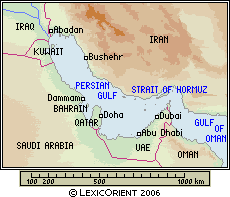
A Gulf oil industry source said the charters suggested there would be high naval activity, possibly including a demonstration to Iran that the U.S. Navy will protect the Strait of Hormuz oil shipping route during tensions over Tehran's nuclear programme.
The U.S. Navy's Military Sealift Command (MSC) has tendered for four tankers in November to move at least one million barrels of jet and ship fuel between Gulf ports, from Asia to the Gulf and to the Diego Garcia base, tenders seen by Reuters show.
It usually tenders for one or two tankers a month to supply Gulf operations, which include missions in Iraq.
The MSC, asked for comment, confirmed the tenders and said there was nothing abnormal about current requirements in the Gulf, where it has a large military presence and which is home to the U.S. Navy's Fifth Fleet.
A fifth hire request was recently cancelled, it said.
Fuels specified to be moved between Gulf ports include JP5, high flashpoint jet fuel, used to power F18 fighters aboard aircraft carriers.
"They have been very active," said a ship industry source, familiar with the MSC tender process, who asked not to be named.
"Out of the multiple charter requirements they issue, they usually do maybe one or two (tankers) a month in the Gulf. They were quiet over the summer months," he said.
Is this Cheney and his drive to attack Iran before his term is out? What is going on?
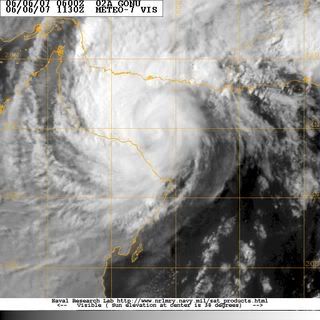
Weather obs from Musqat showed that pressure went down to 993mb and stayed there for three hours, and winds have been steady at around 30mph with gusts to 50mph.
The AP reported, 'Oman's eastern provinces were cut off, with heavy rains making the roads unusable and communication lines severed. "We have no communication with them, nothing," said a senior police officer.'
GulfNews notes: 'Azhar Al Kindi, a member of Oman's National Committee for Civil Defence, said the government was working to restore power to the region.
He added: “There is extensive damage to properties in most towns in the eastern region including Sur and Ras Al Hadd.'
Gonu has weakened and is moving parallel to the Oman coast, but enough offshore that there will be very little in the effects of wind -- however surge and waves will still be a problem, and possibly rain.
Oman’s economy is heavily reliant on oil revenues, which account for about 75 percent of the country’s export earnings and 40 percent of its gross domestic product (GDP). During 2006, Oman’s real GDP grew at an estimated rate of 4.2 percent, down from 5.7 percent in 2005. The slowdown in economic growth occurred largely as a result of declining oil production in Oman. To help offset these declines, the government has devoted considerable resources to new exploration and production activities, enhanced oil recovery projects, and introduced policies aimed at diversifying the country’s economy away from the oil sector. The development of natural gas reserves in Oman is a central part of this effort, and natural gas production is likely to expand considerably during the next several years.
All of Oman’s domestic energy consumption is supplied by natural gas and oil, reflecting the country’s relative abundance of oil and natural gas reserves.
And don't forget the nine warships we have bobbing about in the Persian Gulf.....
Are they refusing to attack Iran? What is going on? Who is replacing these commanders?
For the sixth time in as many weeks, the lead officer of a Navy ship has been suddenly relieved of command, DANGER ROOM pal Andy Scutro reports for Navy Times.
So what if it's right on off the coast of Iran? The Persian Gulf is a small place! With all the warships and subs we have here, there might just be an acci... OMG!! Did you see that? One of our ships had a collision!! Bomb Iran! Bomb it now!! Bom... oh. Just us. Jeez, tell the admiral to stop making the ship do wheelies.
Carry on:
THE US today threatened new UN sanctions to punish Iran's nuclear drive as it ratcheted up tensions with the biggest display of naval power in the Gulf in years.
A bristling US armada led by two aircraft carriers steamed into waters near Iran for exercises, hours before UN watchdogs said Iran was expanding its uranium enrichment program in defiance of international sanctions.
[snip]
The US Navy said the Gulf exercises were not directed at Iran but Mustafa Alani, senior analyst with the UAE-based Gulf Research Centre, said it was no coincidence the powerful flotilla arrived on the day of the IAEA report.
"The aim of this step, which coincides entirely with the end of the UN deadline (to suspend enrichment), is to send a clear message to Iran that a military option is available to Washington," Mr Alani said.
The carriers USS John Stennis and USS Nimitz sailed through the Strait of Hormuz into the Gulf along with a helicopter carrier and amphibious assault ships carrying an estimated 2200 marines.
And here:
WASHINGTON - As the United States and Iran prepare to hold talks on stabilizing Iraq, tensions between Tehran and Washington are ratcheting up again.
The U.S. Navy on Wednesday began its largest war games off the Iranian coast since the 2003 U.S.-led invasion of Iraq, with two nuclear-powered aircraft carriers leading a flotilla of nine ships, dozens of combat aircraft and more than 2,100 Marines.
As the air and sea exercises commenced, the U.N. nuclear watchdog agency reported that Iran is expanding its nuclear program - which U.S. officials charge is aimed at developing nuclear weapons - in defiance of U.N. Security Council demands that it suspend uranium enrichment.
Iran also has stepped up arms shipments to insurgents battling American troops and the U.S.-backed governments in Iraq and Afghanistan, U.S. officials said. For the first time, Iran has begun supplying the Taliban in Afghanistan with explosively formed projectile bombs, which have been used to destroy U.S. armored vehicles in Iraq, the officials said.
These developments are part of a wider pattern of tit-for-tat actions and reactions that some members of Congress, U.S. officials and Arab governments worry could escalate into an armed confrontation.
Another example of the back-and-forth: As U.S. forces in Iraq continue to hold five Iranians it seized from a diplomatic facility in Irbil in the Kurdish zone, Iran has detained three Iranian-Americans, among them Haleh Esfandiari, a leading Middle East expert at the at the Woodrow Wilson International Center for Scholars in Washington, D.C.
Let me just repost what I put up February 12 of this year:
U.S. Navy nuclear submarines maintaining vigil off the coast of Iran indicate that the Pentagon’s military plans include not only control over navigation in the Persian Gulf but also strikes against Iranian targets, a former commander of the Russian Black Sea Fleet, Admiral Eduard Baltin has told the Interfax news agency.
“The presence of U.S. nuclear submarines in the Persian Gulf region means that the Pentagon has not abandoned plans for surprise strikes against nuclear targets in Iran. With this aim a group of multi-purpose submarines ready to accomplish the task is located in the area,” Admiral Baltin said.
He made the comments after reports that a U.S. submarine collided with a Japanese tanker in the Strait of Hormuz.
“American patience is not unlimited,” he said. “The submarine commanders go up to the periscope depth and forget about navigation rules and safety measures,” the admiral said.
Currently there is a group of up to four submarines in the Persian Gulf area, he said. So far they only control navigation in the Persian Gulf, the Gulf of Oman, and in the Arabian Sea, he said. They might receive different orders in future: to block off the Gulf of Oman, that is the Iranian coast, and, if need be, launch missile strikes against ground targets in Iran, he said.
We've packed so many warships and subs into the area, 'accidents' are bound to happen:
The Straits of Hormuz carry a vast quntity of the worlds oil in a huge number of ships. Traffic is very heavy there. There is a “Traffic Separation Scheme” in place that separates opposing shipping traffic to reduce the possibility of collision in this vital, and narrow, passage.
The USS Newport News and the Mogamigawa were travelling in the same direction so the “Traffic Separation Scheme” did not offer any protection to them. Since the USS Newport News was fully submerged the Mogamigawa was not even aware of her presence and could not take action to avoid the collision.
Somehow I always thought it would be other guys who would sink a tanker in the Strait of Hormuz to block the Persian Gulf. I reckoned without the peculiar incompetence of this administration and the bad luck our military has had in the region.
Update: And Francis Townsend (a White House 'Counter Terror' Official) sounds just a little bit too excited to tell us that Bush is keeping all options on the table (starts at 1:13):
But actually safely on an aircraft carrier out at sea in the Gulf, Cheney points at Iran and yells," You're next!"
“Vice President Dick Cheney used the deck of an American aircraft carrier just 150 miles off Iran’s coast as the backdrop today to warn the country that the United States was prepared to use its naval power to keep Tehran from disrupting off oil routes or ‘gaining nuclear weapons and dominating this region.’
He really is a one-trick pony, isn't he?
Main Entry: one-trick pony Function: noun : one that is skilled in only one area; also: one that has success only once
Or maybe that's a no-trick pony.....
(update: fixed grammar which is always questionable and interestingly flexible.)
Today, the Nimitz is rapidly approaching the Persian Gulf, where it will join two other U.S. aircraft carriers and the French carrier Charles De Gaulle in the largest concentration of naval firepower in the region since the launching of the U.S. invasion of Iraq four years ago.
Why this concentration now? Officially, the Nimitz is on its way to the Gulf to replace the USS Dwight D. Eisenhower, which is due to return to the United States for crew leave and ship maintenance after months on station. But the U.S. Central Command (Centcom), which exercises command authority over all U.S. forces in the Persian Gulf area, refuses to say when the Eisenhower will actually depart—or even when the Nimitz will arrive.
For a time, at least, the United States will have three carrier battle groups in the region. The USS John C. Stennis is the third. Each carrier is accompanied by a small flotilla of cruisers, destroyers, submarines, and support vessels, many equipped with Tomahawk land-attack cruise missiles (TLAMs). Minimally, this gives modern meaning to the classic imperial term "gunboat diplomacy," which makes it all the stranger that the deployment of the Nimitz is covered in our media, if at all, as the most minor of news stories. And when the Nimitz sailed off into the Pacific last month on its way to the Gulf, it simply disappeared off media radar screens like some classic "lost patrol."
Rest assured, unlike us, the Iranians have noticed. After all, with the arrival of the Nimitz battle group, the Bush administration will be—for an unknown period of time—in an optimal position to strike Iran with a punishing array of bombs and missiles should the President decide to carry out his oft-repeated threat to eliminate Iran's nuclear program through military action. "All options," as the administration loves to say, remain ominously "on the table."
The US navy has begun its largest demonstration of force in the Gulf since the invasion of Iraq in 2003.
The exercises, just off the coast of Iran, involve more than 10,000 US personnel.
Kevin Aandahl, a US navy commander, declined to say when plans for the exercises had been drawn up.
The manoeuvres bring together two strike groups of US warships and more than 100 aircraft to conduct simulated air warfare in and above the crowded Gulf shipping lanes.
[snip]
Overall, the exercises involve more than 10,000 US personnel on warships and aircraft making simulated attacks on enemy shipping with aircraft and ships, hunting enemy submarines and finding mines.
So.... what happens when we're just stretching, our fist just happens to land on Iran's nose....?
BERLIN (Reuters) - Iran said on Sunday it was considering charging 15 British sailors and marines with illegally entering its waters, but added it may give consular access to them after an investigation.
Prime Minister Tony Blair denied the navy personnel had been in Iranian waters and said Tehran should be under no illusion how seriously Britain considers the detentions.
The incident raised tensions that were already high with the West over Tehran's nuclear programme. The U.N. Security Council imposed new sanctions on Iran on Saturday. London and Washington have also accused Tehran of fomenting violence in Iraq.
"This is a very serious situation and there is no doubt at all that these people were taken from a boat in Iraqi waters," Blair told reporters at a European Union summit in Berlin.
And then, during this highly touchy situation which demands finesse and diplomacy, a Lt. Commander of ours speaks up: (my bold)
A senior American commander in the Gulf has said his men would have fired on the Iranian Republican Guard rather than let themselves be taken hostage.
In a dramatic illustration of the different postures adopted by British and US forces working together in Iraq, Lt-Cdr Erik Horner - who has been working alongside the task force to which the 15 captured Britons belonged - said he was "surprised" the British marines and sailors had not been more aggressive.
Asked by The Independent whether the men under his command would have fired on the Iranians, he said: "Agreed. Yes. I don't want to second-guess the British after the fact but our rules of engagement allow a little more latitude. Our boarding team's training is a little bit more towards self-preservation."
The executive officer - second-in-command on USS Underwood, the frigate working in the British-controlled task force with HMS Cornwall - said: "The unique US Navy rules of engagement say we not only have a right to self-defence but also an obligation to self-defence. They [the British] had every right in my mind and every justification to defend themselves rather than allow themselves to be taken. Our reaction was, 'Why didn't your guys defend themselves?'"
His comments came as it was reported British intelligence had been warned by the CIA that Iran would seek revenge for the detention of five suspected Iranian intelligence officers in Iraq two months ago but refused to raise threat levels in line with their US counterparts. The capture of the eight sailors and seven marines - including one young mother - will undoubtedly renew accusations that Britain's determination to maintain a friendly face in the region has left its troops frequently under protected.
Yes, we would have started a new war just to show how tough we were... even though the detention of five of their diplomats was something we did deliberately. If this had been U.S. soldiers, Georgie would have declared war in two minutes....
DUBAI, United Arab Emirates — Iranian naval vessels on Friday seized 15 British sailors and marines who had boarded a merchant ship in Iraqi waters of the Persian Gulf, British and U.S. officials said. Britain immediately protested the detentions, which come at a time of high tension between the West and Iran.
In London, the British government summoned the Iranian ambassador to the Foreign Office: "He was left in no doubt that we want them back," Britain's Foreign Secretary Margaret Beckett said after the meeting.
A spokesman for the U.S. Navy, which operates off the Iraqi coast along with British forces, said Iran's Revolutionary Guard naval forces were responsible.
Cmdr. Kevin Aandahl of the U.S. Navy's Fifth Fleet said the Iranian Revolutionary Guards had radioed a British warship explaining that no harm had come to the 15 Britons and that they were seized because they were in Iranian waters. The British Defense Ministry said the Iranians took custody of the sailors and marines in Iraqi waters.
Via NewsHog, this interview by our Navy Admiral in the Persian Gulf:
"Although our presence in the Arabian Gulf is for defensive and not offensive purposes, the US will take military action if ships are attacked or if countries in the region are targeted or US troops come under direct attack," Patrick Walsh yesterday told journalists in Bahrain.
The three-star vice admiral said that there was increasing concern about the intention of Iran in the region.
"The question is not what the US is planning, but rather what Iran is planning for the region," he said.
"When you look at the exercises conducted by Iran in the last nine months, you see the open display of suggestions. They are using mines in their exercises and, very importantly, they are conducting sea manoeuvres in the proximity of the Strait of Hormuz. Why would Iran conduct them in that region when they have so much space elsewhere?" About 40 per cent of all the world's traded oil passes through the strategic waterway, and last month, an Iranian newspaper warned that retaliation by Tehran could include stopping oil traffic through the Strait.
'Why would Iran conduct them in that region when they have so much space elsewhere?' Could it be because...you know... it's their coastline and their waters? Just because we've packed our warships into the Gulf and have been mooning Iran in hopes of creating a convenient international incident doesn't mean Iran can't play wargames, too.
(Stupid, yes. But with all our nyah nyahing outside on his lawn, he feels he has the right to turn on the sprinklers..... It just means the next step is we get to burn down his house...)
U.S. Navy nuclear submarines maintaining vigil off the coast of Iran indicate that the Pentagon’s military plans include not only control over navigation in the Persian Gulf but also strikes against Iranian targets, a former commander of the Russian Black Sea Fleet, Admiral Eduard Baltin has told the Interfax news agency.
“The presence of U.S. nuclear submarines in the Persian Gulf region means that the Pentagon has not abandoned plans for surprise strikes against nuclear targets in Iran. With this aim a group of multi-purpose submarines ready to accomplish the task is located in the area,” Admiral Baltin said.
He made the comments after reports that a U.S. submarine collided with a Japanese tanker in the Strait of Hormuz.
“American patience is not unlimited,” he said. “The submarine commanders go up to the periscope depth and forget about navigation rules and safety measures,” the admiral said.
Currently there is a group of up to four submarines in the Persian Gulf area, he said. So far they only control navigation in the Persian Gulf, the Gulf of Oman, and in the Arabian Sea, he said. They might receive different orders in future: to block off the Gulf of Oman, that is the Iranian coast, and, if need be, launch missile strikes against ground targets in Iran, he said.
We've packed so many warships and subs into the area, 'accidents' are bound to happen:
The Straits of Hormuz carry a vast quntity of the worlds oil in a huge number of ships. Traffic is very heavy there. There is a “Traffic Separation Scheme” in place that separates opposing shipping traffic to reduce the possibility of collision in this vital, and narrow, passage.
The USS Newport News and the Mogamigawa were travelling in the same direction so the “Traffic Separation Scheme” did not offer any protection to them. Since the USS Newport News was fully submerged the Mogamigawa was not even aware of her presence and could not take action to avoid the collision.
Somehow I always thought it would be other guys who would sink a tanker in the Strait of Hormuz to block the Persian Gulf. I reckoned without the peculiar incompetence of this administration and the bad luck our military has had in the region.
TEHRAN, Feb. 7 Iran's Islamic Revolutionary Guards Corps began two days of air and naval military exercises Wednesday in the Persian Gulf and the Sea of Oman.
The naval exercise was named Thunder, while the air operation was named Thunderbolt, the state-run IRNA news agency reported.
The military said both operations focus on defensive and operational capabilities, the Alalam TV network reported. Last month, the military conducted five days of ground exercises to test its missile abilities, and last year, Iran also held three large-scale military exercises involving ballistic missile tests, the FARS news agency reported.
“Everything the advocates of war said would happen hasn’t happened,” says the president of Americans for Tax Reform, Grover Norquist, an influential conservative who backed the Iraq invasion. “And all the things the critics said would happen have happened. [The president’s neoconservative advisers] are effectively saying, ‘Invade Iran. Then everyone will see how smart we are.’
Tonight on Hardball, Sen. Jim Webb (D-VA) said that during his time as Navy Secretary under President Reagan — and “until very recently” — the U.S. “never operated” aircraft carriers within the Gulf because it risked confrontation. “The chance of accidentally bumping into something that would start a diplomatic situation was pretty high,” Webb explained. “With the tensions as high as they are, I’m very worried that we might accidentally set something off in there and we need, as a Congress, to get ahead of the ballgame here.”