This article:
Mahmoud Ahmadinejad, the Iranian president, has marked the 28th anniversary of Iran's revolution by pledging to maintain the country's nuclear programme, but adding that he wanted to remain within international rules.
"We are ready for talks, but will not suspend our activities," he said in a speech broadcast on state television on Sunday.
Along with this article:
Vladimir Putin, the Russian president, has arrived in Saudi Arabia on the first leg of a three-day tour of the Middle East aimed at building energy and military ties with traditional US allies.
The tour began a day after Iran asked Putin to block any UN resolutions passed against it when a deadline to halt nuclear work expires on February 21.
Along with this article:
MUNICH, Feb. 10 -- Russian President Vladimir Putin, in some of his harshest criticism of the United States since he took office seven years ago, said Saturday that Washington's unilateral, militaristic approach had made the world a more dangerous place than at any time during the Cold War.
"The United States has overstepped its national borders in every way," he said in an address at an annual international security conference here. "Nobody feels secure anymore, because nobody can take safety behind the stone wall of international law."
Although the US brushed off the criticism:
But Washington has clearly decided to politely brush aside Mr Putin's remarks rather than to escalate tensions with Russia.
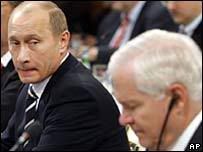
Making his first appearance at the conference as the new US Defence Secretary, Robert Gates tried to deflate President Putin's attack by poking a bit of fun at their past careers as spies.
"As an old Cold Warrior," he said, "one of yesterday's speakers almost filled me with nostalgia for a less complex time. Almost.
" Many of you have backgrounds in diplomacy or politics. I have, like your second speaker yesterday, a starkly different background - a career in the spy business.
"And, I guess, old spies have a habit of blunt speaking"
Mr Gates bluntly said there was no new Cold War and that the US certainly did not want one.
We know that the PNAC neocons remember fondly the good old days when the USSR was the evil empire, defense spending unquestioned, and the world chess board game was easier to play than fighting stateless terrorism. Condi's 'strength' was purportedly the Soviet Union. Could they thinking 'wouldn't it be nice to go back to the 1960s'?
Or are they still working on the old plan to piss everyone in the world off?
Update: This is interesting: (my bold)
It is seldom that the Russian president is publicly contradicted by officials in Moscow. But in the Russian reaction to Tehran's proposal for formal cooperation among the major gas-producing countries, it happened.
Supreme Leader Ali Khamenei conveyed the Iranian suggestion to the visiting secretary general of Russia's National Security Council, Igor Ivanov, in Tehran on January 28. The next day, Russia's Gazprom reacted in Moscow that "establishing a gas OPEC [Organization of Petroleum Exporting Countries] is impossible because of different structuring of the oil and gas business".
A spokesman of the Russian Economic Development and Trade Ministry also reacted sharply: "I do not understand why Russia would need to create a gas cartel - I do not see any sense in it. The more so as Iran is now coming under serious external pressure." The official asked: "Why should we undertake commitments to synchronize our actions, why force ourselves into regulatory frameworks which could boil down to setting quotas?"
Then came a structured Russian position when Ivanov put the Iranian proposal in perspective at a press briefing in Moscow this Tuesday. He said the Iranian side mentioned the idea "not as a question or proposal for discussion, but as a general idea that natural-gas producers should seek such forms of cooperation, which fully supports their interests. As far as I know, no talks on setting up a cartel are under way."
But two days later, at a press conference in Moscow, President Vladimir Putin took a giant leap forward. He said, "A gas OPEC is an interesting idea, and we will think about it. In this initial stage we will agree with the Iranian specialists, with our Iranian partners and with some of the other countries that are large suppliers of fossil fuels, above all gas, to world markets, and we are already trying to coordinate our activities on the markets of third countries. We plan to continue doing so in future."
Putin added, "We have no plans to create some kind of a cartel, but I think it would be a good idea to coordinate our activities, especially in the context of achieving our main aim of ensuring a certain and reliable supply of energy resources for our main consumers."
However, five days later, Russian Energy Minister Viktor Khristenko was still at Square 1. "Fantasies about cartels and 'gas OPECs' are products of a sick imagination," he said.
So what's the problem? First, Moscow wanted to see that alarm bells didn't ring in Western capitals, especially when a top-level European Union delegation was due to visit Moscow. In the West, sweat breaks out at the very mention of "cartel", invoking images of production quotas, price rigging, and so on. Second, Moscow knows that a "gas OPEC" is still a decade away from realization, given the regional structure of the market, absence of a floating gas price (gas is mostly price-indexed to petroleum), double dependency resulting from the transportation through pipelines (gas-carrier ships are nowhere near meeting the needs of transportation) and the prevalence of long-term contracts between the supplier and the consumer, and, of course, the absence of a developed gas-liquefaction infrastructure.
Third, a masterly stroke in ambiguity doesn't do Russian interests any harm. The North Atlantic Treaty Organization has visualized that it is a matter of time before a "gas OPEC" takes shape. On the sidelines of the last NATO summit, in Latvia in November, there were calls for the formation of a "gas NATO" that is geared to safeguarding the energy security of Western consumer countries.
Thanks to Russian ingenuity, between the illusion and the reality of a "gas OPEC" a gray zone has appeared, with no certainty that this zone will not incrementally become the reality itself.
[snip]
Clearly, Tehran has sized up the growing assertiveness in Russian regional policies and is keen to harness it geopolitically. But more important, Tehran has signaled to European capitals that they may have to pay a heavy price for any further identification with the US policy toward Iran. The fact that the
Iranian proposal on the "gas OPEC" as made by spiritual leader Khamenei should leave Western capitals in no doubt that Tehran is not scoring a propaganda point. They must now rethink before imposing unilateral sanctions on Iran.
Iran is the "last frontier" for European countries seeking to access natural gas from the Middle East. By 2015-20, Europe will face serious gas shortages, even if Russia augments its supplies via the Northern European pipeline. Tehran knows it is a "special case" for European countries. Tehran was hoping all along that it could normalize relations with the European Union, and that it would receive serious economic and political carte blanche.
NTodd at Dohiyi Mir notes the similarities between Bush and Putin, both of them 'vile, anti-democratic creatures'.