(My bold) WASHINGTON — What's likely to happen if the world does nothing to combat global warming? The answer from the Nobel Prize-winning Intergovernmental Panel on Climate Change was jaw-dropping: more than 40 percent of known plant and animal species could become extinct by the end of this century.
Many scientists who've been studying climate change say extinctions aren't inevitable if the world greatly reduces its dependence on oil, coal and natural gas. As daunting as the warning signs and projections are, there's still time to fend off the worst, they say. But they also warn that "business as usual" would bring devastating changes in the decades ahead.
"We're locked into a different planet, but we can still make it a planet similar to what we have known," said Lara Hansen, an ecologist who's the chief climate-change scientist at the World Wildlife Fund. The Arctic Ocean will be ice free in the summer in a few years, "but we're not locked into the Arctic being ice-free year round, or Greenland melting."
[snip]
Some paleontologists have suggested that the world already is witnessing a sixth mass extinction, after five others known from the fossil record. The fifth was the end of the dinosaurs and some 70 percent of other species 65 million years ago. Some of the projections of a do-nothing trend on global warming suggest that 70 percent of all living things could become extinct again.
[snip]The World Conservation Union says that the rapid loss of species today is 1,000 to 10,000 times higher than the natural rate of species loss over the past millions of years. The causes of the current threat go back through human history: habitat destruction for development and agriculture, overexploitation, diseases and invasions of alien species. Climate change adds to the pressure on vulnerable species.
The group's "Red List" comprises 16,306 plant and animal species that the group says are threatened with extinction. It also says that there's evidence from the effects of climate change on species around the world that rising temperatures will be "catastrophic for many species."
Biologist Camille Parmesan of the University of Texas at Austin, who participated on the Intergovernmental Panel on Climate Change, said that some 40 scientific studies found that the risk at higher temperature increases, 7 to 9 degrees Fahrenheit, could range from an extinction rate of more than 40 percent to more than 70 percent.
[snip]
Earth's average temperature has increased by about 1 degree Fahrenheit since 1890, and roughly another degree is expected from the greenhouse gases that already have been released, because of a lag in the climate system and because carbon dioxide, the main greenhouse gas, stays in the atmosphere for hundreds of years.
Many scientists say that the world would be in trouble with any warming of more than 2 degrees Celsius — about 3.5 degrees Fahrenheit — above 19th-century levels. At that temperature, the panel's report said, up to 30 percent of species would be at increasing risk of extinction and most corals would be bleached.
The report found that temperatures could be kept below that level by reducing greenhouse gas emissions by about 80 percent by 2050, or about 2 percent per year. They're now increasing by about 3 percent per year.
Thomas Lovejoy, a conservation biologist who heads the Heinz Center for Science, Economics and the Environment, said he thought that the world would see serious disruptions in ecosystems before global warming hit 3.5 degrees. But he said that the high level of extinction the panel projected wasn't inevitable if society greatly reduced fossil fuel pollution and invested more in wildlife protection.
Lovejoy, Parmesan and some 600 other scientists sent a letter last month urging Congress to pass legislation to curb U.S. global-warming pollution and invest more in protecting wildlife and habitats.
The National Wildlife Federation sent a similar appeal this week from 670 hunting and fishing organizations in all the states.
Tuesday, February 19, 2008
Global warming can kill

Wednesday, November 28, 2007
Why aren't we on this list?

Initiative by the Green Belt Movement, the Prince of Monaco, UNEP and ICRAF to Catalyze the Planting of one Billion Trees Reaches Goal in Advance of Next Climate Convention Conference.
[snip]
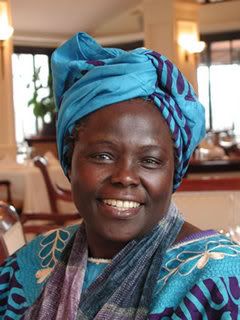
Nobel Peace Prize winner Wangari Maathai, the Kenyan Green Belt Movement founder and Patron of the campaign, said: "I am elated beyond words at the global interest and action that was motivated by the Billion Tree Campaign. I knew we had it within us as a human family to rise up! We called you to action almost exactly a year ago and you responded beyond our dreams. Thank you very much! Now we must keep the pressure on and continue the good work for the planet. Plant another tree today in celebration!"
The enthusiasm of individuals to make a difference is underlined by figures collected by UNEP which indicate that half of all those who planted are often private citizens or households planting one to three trees. Significantly, another 13 per cent have been planted by the private sector, which participated actively in the initiative.
ICRAF Director General Dennis Garrity said: "The World Agroforestry Centre is very proud that the ambitious goal of the Billion Tree Campaign has been attained. This milestone shows clearly that the global community has the spirit and the substance to unite in achieving ambitious targets to create a better environment for all. We look forward to working with UNEP and so many other organizations in setting and achieving even greater stretch goals for a more 'bountreeful' world in the coming years."
The news comes as thousands of delegates across the world are ready to arrive on the Indonesian island of Bali for the next and most crucial round of global warming negotiations under the UN Framework Convention on Climate Change (UNFCCC).
The Intergovernmental Panel on Climate Change, jointly established by UNEP and the World Meteorological Organization, has in 2007 concluded that climate change is happening; the global impacts are likely to be in many cases devastating but cost effective solutions are available now to counter the worst.
[snip]
The totals of trees planted are still being collated with the numbers rising almost daily. But the top-ranking countries appear to be Ethiopia, over 700 million trees planted; Mexico, 217 million trees; Turkey, 150 million; Kenya, 100 million; Cuba, 96.5 million; Rwanda, 50 million; Republic of Korea, 43 million; Tunisia, 21 million; Morocco, 20 million; Myanmar, 20 million and Brazil, 16 million. The Green Belt Movement alone planted 4.7 million trees, double the number of trees it had initially pledged.
Thank you, Nobel Peace laureate Prof Wangari Maathai for your good work!
Monday, November 19, 2007
Bangladesh's cyclone aftermath
Relief Web has this:BARGUNA, Bangladesh (AP) -- The death toll from Thursday's cyclone in Bangladesh is now more than 3,100, and officials say that number could reach 10,000 once rescuers get to outlying islands. Rescuers are struggling to reach thousands of survivors, and relief items have been slow to reach many. Survivors grieved and buried their loved ones Monday as they waited for aid to arrive.
The death toll from the Thursday cyclone reached 3,113 after reports finally reached Dhaka from storm-ravaged areas which had been largely cut off because of washed-out roads and downed telephone lines, said Lt. Col. Main Ullah Chowdhury, a spokesman of the army coordinating the relief and rescue work.
As of 18th November, the disaster management control room reported death of 2,300 people in 23 districts due to the Cyclone Sidr. It is also reported from different sources that nearly 4,000 people are seriously injured. Thousands are still missing and it is unofficially forecasted that the dead and missing will be over 5,000. It is estimated that the cyclone has affected 887,000 families of 103 upazilas, killed 242,000 livestock and destroyed crops on 23,000 acres of land and flattened nearly three million houses.And:
DHAKA (AFP) — Experts said Sunday they feared for the wildlife and ecology of the world's biggest mangrove forest after a deadly cyclone tore through the Sunderbans -- home to the endangered Royal Bengal tiger.
Zunayed Kabir Chowdhury, a Dhaka-based mangrove expert, said he feared thousands of deer as well as many tigers and wild boar had been swept away by the massive tidal wave triggered by cyclone Sidr last Thursday.
"The eye of the cyclone hit the part of the Sunderbans which is known to be the most important habitat of the tigers and other wildlife," he said.
The nests of many birds would also have been destroyed, he added.
"Wildlife is vulnerable to this sort of natural disaster and much would have been washed away by the strong surge," said Shanti Ranjan Das of the government's livestock department.
"The cyclone has inflicted an ecological disaster," he added.
This is just the beginning of constant news about inundations along the coastlines, about huge losses of life. Too many people trying to find areas to live in are forced into danger zones.
Nice to think there are still people who deny global warming and insist that birth control is evil....
Update:
The Intergovernmental Panel on Climate Change (IPCC) said in its report that evidence of climate change is "unequivocal."
It said the trend could lead to "abrupt" changes to the planet, cause human suffering and threaten some species with extinction.