April 26, 2024 2:27 p.m. By Talking Points Memo editor Josh Marshall (talkingpointsmemo.com)
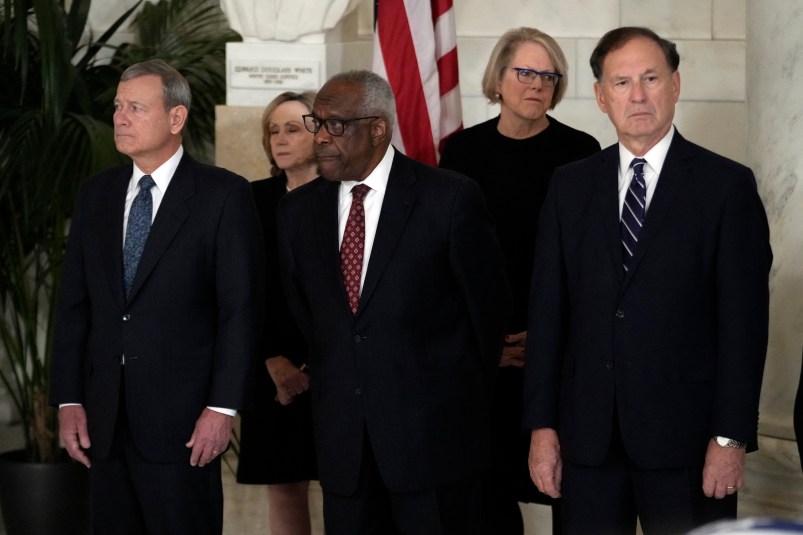
Chief
Justice of the United States John Roberts, Justice Clarence Thomas and
Justice Samuel Alito attend a private ceremony for retired Supreme Court
Justice Sandra Day O'Connor before public repose in the Great Hall...There were so many things that happened yesterday in the Supreme
Court’s hearing on presidential immunity that it’s hard to know where to
start. But one part that captured it for me was Sam Alito’s line of
argument that presidential immunity might be necessary to make it
possible for presidents to leave office voluntarily, or that not having
some broad grant of immunity would make refusal to leave office more
likely. Here’s one of the quotes: “If an incumbent who loses a very
close, hotly contested election knows that a real possibility after
leaving office is not that the president is gonna be able to go off to a
peaceful retirement, but that the president may be criminally
prosecuted by a bitter political opponent, will that not lead us into a
cycle that destabilizes the functioning of our country as a democracy?
And we can look around the world and find countries where we have seen
this process, where the loser gets thrown in jail.”I think it’s safe to say that as a policy matter this is a very bad
way to approach presidential accountability, the rule of law or the
peaceful transfer of power. But that really isn’t the big point to me.
It’s that the subtext of so much of yesterday’s discussion and — often
the explicit statements from the justices during it — was that this is a
new question that the Supreme Court is now tasked with crafting a
policy to address. Neither is the case.I am not naive enough to think that judicial interpretations and
rulings don’t have policy implications. Of course they do. What’s more,
the policy implications of judicial interpretations frequently are a
reasonable part of the prudential analysis that goes into judges’ work:
if we think the law and the Constitution say something, we need to have
open eyes about what that something actually means in practice. What was
so striking about yesterday’s performances, if not at all surprising,
were that there was little effort to even keep up these pretenses. It
was almost like these were de novo questions. Even down to the
point where multiple justices waived off dealing with the actual case
and facts before them, arguing that they’re being called upon to set up
the big rules for posterity.Listening to Sam Alito, but really Kavanaugh and Roberts too, you get
the sense that if they decided that presidents need to be immune from
possible prosecution forever for whatever policy reason they think makes
sense … well, elections have consequences and it’s up to them to make
that choice. But that’s not how any of this works. If you really want to
get into history to make this ruling, it is the plainest thing in all
the discussions around the authorship and ratification of the federal
Constitution that presidents remain citizens. The core dynamic in the
process of creating the Constitution was the belief that the country
needed a more unified and powerful executive authority without making
that person above the law, which is to say, a king. Presidents are not
above the law. When they leave office they give up all their powers. The
text itself gives not the slightest hint that presidents have immunity
from the law.You can play devil’s advocate and say: well how is it then that the
Justice Department and pretty much the whole legal and political class
has decided that a president can’t be prosecuted while in office?
There’s an answer to that. There are numerous principles in the common
law that say that you can’t be a judge in your own case. The president
is the officer who enforces the laws. He can’t prosecute himself. It’s a
contradiction in terms. Well, is there a defect in the Constitution?
Did they leave something out? No. It turns out that the Constitution
creates a process to resolve this contradiction. The document invests
the political process with a means to deal with a law-breaking
president: Impeachment. The Congress can remove the president. Now
someone else is charged with enforcing the laws, and the contradiction
is resolved. Some people disagree with this logic. But this is the
proper process of looking at the document — resolving seeming
contradictions or problems by looking at the whole document and trying
to see what it prescribes, how it charges us to resolve seeming
contradictions within it.The display we saw yesterday was a vivid illustration of how the
Court has gone thoroughly rogue, cutting itself off from even the
appearances of the processes that give it legitimacy. That is the core
of the current Court’s corruption. If we assume that there might be some
limited ways that official acts can’t be reinterpreted as crimes, it
seems to go without saying that refusing to honor the results of an
election can’t be one of them. Trying to overthrow the government can’t
be one of those official acts. If that’s the case — this hypothetical,
narrow kind of immunity — then the Court’s proper path is clear. You say
that there may be some cases where a very narrow kind of immunity
applies. But what we have before us now certainly isn’t one of those
cases. End of story.But that’s not what we got.It’s certainly the case that justices aren’t bound by things they say
in the process of airing an issue. So perhaps this was all just the
equivalent of the preposterous hypotheticals that a law professor raises
in a class on constitutional interpretation. But lets be real. We know
who these people are. They’re telling us.It’s a rogue court, a thoroughly corrupt one, one that is so far gone
in its corruption that it feels free even from the practical obligation
to clothe its corruption for the sake of appearances.
I think there’s a decent chance Mitch McConnell suckered President Trump into canceling stimulus bill negotiations. The GOP looks to be shifting into bust out mode. McConnell and other party leaders likely see that Trump is finished and that the Senate majority probably is too. The cynical play is straightforward: pocket the Court seat and leave an incoming Biden administration in as deep a hole as possible. It even cues Republicans up to switch seamlessly back into austerity/fiscal scold mode in 2021, without their fingerprints on any more stimulus spending. Little discussed here is Trump’s assertion that leaving stimulus negotiations until after the election will clear the calendar to focus on confirming Amy Coney Barrett. Of course it will. That seems to be the point.
Normally it would be reasonable to ask whether anyone really thinks that cynically about governance. With Mitch McConnell not only do we know he thinks that cynically he actually acted this cynically under Barack Obama. We have a track record.
President Trump’s defeat already looks increasingly likely. Not only foreclosing the possibility of any additional relief but owning that decision publicly is the political equivalent of taking a hammer to your own head. Trump campaign advisors who spoke to reporters off the record last night were apoplectic. The stock market tanked. This is likely why by mid-evening Trump was back on Twitter demanding Nancy Pelosi agree to more deals and more spending.
It is no accident that we haven’t seen the President speak live on camera since his COVID diagnosis. It is hard to distinguish the President’s current state of mind from his baseline antic, mercurial nature. But much of what has happened over the last three days resembles a fairly typical manic episode and mania is a relatively common side effect of the steroid medication he was given as part of his COVID treatment. His Twitter feed is increasingly difficult to distinguish from Kanye West’s. Whatever the clinical effects of these medications, it is likely and would be unsurprising that the events of the last week – the failed debate, a life-threatening medical diagnosis and difficulty breathing – affected the President’s mental state. How could it not?
But don’t take your eyes off this broader calculus – one separate from Trump, his state of mind, one that is above all rational. Yes, everyone should give their 110%. Everybody get out to vote. The stakes for a second Trump term are too high to take anything for granted. But for those gaming out their own moves and post-January realities, Trump’s defeat is starting to look very likely. Under normal circumstances that would lead congressional Republicans to cut Trump loose and pitch their reelection as a check on the power of a Democratic President. That would be a great card to play for a number of endangered Republican Senators at the moment. But it’s all but impossible since loyalty to Trump is now the centerpiece of Republican identity. And any move away from him would trigger a fatal backlash.
So look for more signs of this bust out scenario. Steal what you can and burn the rest down on the way out.
Perhaps the White House had planned all along for Attorney General Jeff Sessions to make an appearance at today's press briefing to rail against sanctuary cities. But the timing is consistent with what I've long feared will be the impulse for the Trump administration: When the going gets rough (failed Obamacare repeal, low poll numbers, etc), it will fall back on appeals to racism and xenophobia to regain political footing.
With so much incompetence taking root, it's not difficult to envision a scenario where those base appeals must become more amped up, extreme, and scurrilous to be "effective." It threatens to turn into a vicious cycle the likes of which we've never seen in this country.