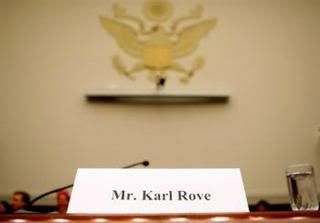
Tell Attorney General Holder: Karl Rove must testify.Sign the petition.On February 23, Karl Rove was supposed to testify before the House Judiciary Committee in accordance with a Congressional subpoena. But Rove didn't show up. Again.
Rove didn't show up last year when he was ordered to testify, because his old friend President Bush said that Rove's testimony was protected by executive privilege. Now that Bush is no longer in office, we may finally have an opportunity to learn the truth about his alleged misdeeds, from authorizing voter suppression tactics to orchestrating the arrest of Alabama Governor Don Siegelman.
But even though we have a new president, Karl Rove is still acting like he's entitled to all the privileges that came with his old job. So far, the Obama administration has let him get away with it.
The Obama administration has the power to clarify that Rove no longer has access to the "executive privilege" line of defense - since the executive in question is no longer in office. If that happened, a judge would have a lot more power to compel Rove to comply with the subpoena, and we might finally begin to learn the truth about his activities.
Sign this petition today to tell Attorney General Eric Holder take swift action to compel Karl Rove to comply with Congressional subpoenas. The American people deserve better than smoke and mirrors - we deserve the truth.
Saturday, February 28, 2009
Karl Rove needs to be told he's mortal like the rest of us.

Saturday, September 06, 2008
Just ... hold ... it ... back ...
Washington, D.C. (AHN) - The U.S. Court of Appeals for the District of Columbia has temporarily stayed a ruling requiring top White House aides to comply with a subpoena issued by Congress about allegedly politically-motivated dismissals of federal attorneys.
The Justice Department has been trying to delay a court decision ordering presidential chief of staff Josh Bolten to provide documents, and former White House counsel Harriet Miers to testify before lawmakers about the firings of nine prosecutors in 2006. Both officials refused to comply with subpoenas, citing executive privilege.
Sunday, July 13, 2008
Karl Rove to the nation:

Rove skips congressional inquiry. Steve Bates of Yellow Doggerel Something has the facts.
Hipparchia of Over The Cliff, Onto The Rocks has a message from Rep. Wexler about Rove, Cheney and Bush and discussing inherent contempt and impeachment.
Tuesday, February 05, 2008
Mukasey goes after the last standing stronghold of a free people,
Glenn Greenwald:
.... before his nomination was formally announced, the White House chose Bill Kristol to announce his selection and, in a lengthy article, to vouch to conservatives for what a fine AG Mukasey would make.Right. No free press, no real journalism, no ability for checks and balances over the worst administration ever. Thanks.Mukasey was a long-time supporter of the neocons' favorite candidate, Rudy Giuliani and, prior to becoming Attorney General, was part of the Giuliani campaign. And it was Dianne Feinstein and Chuck Schumer -- both with neoconservative leanings (war supporters both, among other things) -- who jointly enabled Mukasey's confirmation by becoming the only Democrats on the Senate Judiciary Committee to vote in his favor.
Although there are still facts missing -- such as whether this Subpoena was actually approved by Mukasey rather than Gonzales -- it's hard to avoid the conclusion that the Grand Jury Subpoena was done at least with Mukasey's assent. It seems rather clearly to signify the intent of his Justice Department to more aggressively pursue reporters who disclose information embarrassing to the President.
It's hard to overstate how threatening this behavior is. The Bush administration has erected an unprecedented wall of secrecy around everything it does. Beyond illegal spying, if one looks at the instances where we learned of lawbreaking and other forms of lawless radicalism -- CIA black sites, rendition programs, torture, Abu Ghraib, pre-war distortion of intelligence, destruction of CIA torture videos -- it is, in every case, the by-product of two forces: government whistleblowers and reporters willing to expose it.
Grand Jury Subpoenas such as the one issued to Risen have as their principal purpose shutting off that avenue of learning about government wrongdoing -- the sole remaining avenue for a country plagued by a supine, slothful, vapid press and an indescribably submissive Congress. Mukasey has quickly demonstrated that he has no interest in investigating and pursuing lawbreaking by high government officials, but now, he (or at least the DOJ he leads) seems to be demonstrating something even worse: a burgeoning interest in investigating and pursuing those who expose such governmental lawbreaking and turning those whistleblowers and investigative journalists into criminals.
And tell us again how waterboarding is not torture, Mukasey. That one is always good for a laugh.
Update: Glenn Greenwald links to Spencer Ackerman of the Washington Independent:
The Justice Department is going after New York Times reporter Jim Risen for the non-crime of revealing President Bush’s illegal domestic surveillance program. It’s pathetic and unsurprising—a fixture of Bush Justice—that the activity DOJ pursues isn’t the blatant illegality of Bush violating the Foreign Intelligence Surveillance Act, but instead the fact that government sources blew the whistle to a great investigative reporter. The right response from the press, and the public, is to put one arm around Risen and, with the other arm, extend a single finger in the direction of the Justice Department.
Tuesday, September 18, 2007
Does that mean we all can ignore subpoenas?
This is over the Duke Cunningham's briber Brent Wilkes:
In addition to Issa, Blunt, R-Mo., and Hastert, R-Ill., Wilkes' attorneys are seeking testimony from:
_House Intelligence Committee Chairman Silvestre Reyes, D-Texas.
_House Armed Services Committee Chairman Ike Skelton, D-Mo.
_House Appropriations defense subcommittee chairman John Murtha, D-Pa.
_California Republican Reps. Duncan Hunter, John Doolittle, and Jerry Lewis. Hunter chaired the Armed Services Committee and Lewis chaired the Appropriations Committee in the last Congress.
_Republicans Reps. Peter Hoekstra and Joe Knollenberg of Michigan. Hoekstra chaired the House Intelligence Committee in the last Congress.
_Democratic Rep. Norm Dicks of Washington.
The subpoenas from U.S. District Court for the Southern District of California were read on the House floor late Monday in accordance with House rules requiring lawmakers to inform the House speaker if they've been subpoenaed.
All the lawmakers said in notifications to House Speaker Nancy Pelosi that after consulting with House attorneys they had decided not to comply with the subpoenas.
Good to know that we don't have to take these thing seriously....
Update: Steve Bates of Yellow Doggerel Democrat reminds me in comments what it says in the Constitution:
Members of Congress probably do have a leg to stand on in this case. U.S. Constitution, Article I, Section 6, first paragraph:
"The Senators and Representatives shall receive a Compensation for their Services, to be ascertained by Law, and paid out of the Treasury of the United States. They shall in all Cases, except Treason, Felony and Breach of the Peace, be privileged from Arrest during their Attendance at the Session of their respective Houses, and in going to and returning from the same; and for any Speech or Debate in either House, they shall not be questioned in any other Place."
Emphasis mine. This may not apply directly, but the principle that one cannot interfere with members' activities while Congress is in session is pretty clear.
Standard reminder: I am not a lawyer, nor do I even play one on the web.
Wednesday, August 01, 2007
He still has the tapes from the NSA warrantless wiretapping too...
Karl Rove, President Bush's political lieutenant, told a closed-door meeting of 2008 Republican House candidates and their aides Tuesday that it was less the war in Iraq than corruption in Congress that caused their party's defeat in the 2006 elections.Thers explains:
When these guys are gone (if they go...) how many politicians will come forward to say they were being blackmailed? Anybody? Nobody?So what's up? I've never thought Rove was quite the Wizard he was made out to be. His entire success, such as it is, is due to the fact that he is a total asshole who is willing to act like a total asshole. Period. But he's not stupid ... indeed, it was rather a clever insight that you could get quite far by acting like an absolute asshole. Too bad about the unforeseen "having to actually govern" difficulty, but still. Well done, man.
... So I'm going to go with, "here, Rove is being a total asshole, and not stupid." I don't think he expected any of these "insiders"to actually believe him about this "2008 will not be about the war" nonsense.
No. What he wanted them to do was not give an inch to the Democratic Congress.
Why?
Because the motherfucker has just been subpoenaed -- which everyone knew was coming.
What was he saying? About "corruption"?
He was saying, "I know where all the corruption is, and there's a lot of it, and if you value your phony-baloney jobs you will help us stonewall the Democratic Congress for the next year and a half."
Tell me I'm wrong.
It's all about power and hanging with the cool kids, isn't it?
Sunday, July 22, 2007
Contempt of Congress
SubpoenasCongressional rules empower all its standing committees with the authority to compel witnesses to produce testimony and documents for subjects under its jurisdiction. Committee rules may provide for the full Committee to issue a subpoena, or permit subcommittees or the Chairman (acting alone or with the ranking member) to issue subpoenas.
As announced in Wilkinson v. United States, 365 U.S. 399 (1961), the Congressional committee must meet three requirements for its subpoenas to be "legally sufficient." First, the committee investigation of the broad subject area must be authorized by its Chamber; second, the investigation must pursue "a valid legislative purpose" but does not need to involve legislation and does not need to specify the ultimate intent of Congress; and third, the specific inquiries must be pertinent to the subject matter area which have been authorized for investigation.
The Court held in Eastland v. United States Servicemen's Fund, 421 U.S. 491 (1975) that Congressional subpoenas are within the scope of the Speech and Debate clause which provides "an absolute bar to judicial interference" with such compulsory process. Under that ruling, Courts generally do not hear motions to quash Congressional subpoenas; even when executive branch officials refuse to comply, the Courts tend to rule that such matters are "political questions" unsuitable for judicial remedy.
Procedures
Following the refusal of a witness to produce documents or to testify, the Committee is entitled to report a resolution of contempt to its parent chamber. A Committee may also cite a person for contempt but not immediately report the resolution to the floor. In the case of subcommittees, they report the resolution of contempt to the full Committee, which then has the option of rejecting it, accepting it but not reporting it to the floor, or accepting it and reporting it to the floor of the chamber for action. On the floor of the House or the Senate, the reported resolution is considered privileged and, if the resolution of contempt is passed, the chamber has several options to enforce its mandate.
Inherent contempt
Under this process, the procedure for holding a person in contempt involves only the chamber concerned. Following a contempt citation, the person cited for contempt is arrested by the Sergeant-at-Arms for the House or Senate, brought to the floor of the chamber, held to answer charges by the presiding officer, and then subject to punishment that the House may dictate (usually imprisonment for punishment reasons, imprisonment for coercive effect, or release from the contempt citation.)
Concerned with the time-consuming nature of a contempt proceeding and the inability to extend punishment further than the session of the Congress concerned (under Supreme Court rulings), Congress created a statutory process in 1857. While Congress retains its "inherent contempt" authority and may exercise it at any time, this inherent contempt process was last used by the Senate in 1934, in a Senate investigation of airlines and the U.S. Postmaster. After a one-week trial on the Senate floor (presided by the Vice-President of the United States, acting as Senate President), a lawyer who had allowed clients to rip up subpoenaed documents, William P. MacCracken, a lawyer and former Assistant Secretary of Commerce for Aeronautics, was found guilty and sentenced to 10 days imprisonment. [1]
MacCracken had filed a petition of Habeas Corpus in federal courts to overturn his arrest, but after litigation, the US Supreme Court ruled that Congress had acted constitutionally, and denied the petition in the case Jurney v. MacCracken, 294 U.S. 125 (1935). [2][3]
Presidential pardons appear not apply to civil contempt procedures like the above, since it is not an "offense against the United States" or an offense against "the dignity of public authority." [4]
And from Answers.com:
Contempt of Congress is any improper attempt to obstruct the legislative process, usually by a refusal to provide information that Congress has requested. The contempt power is critical to Congress's ability to investigate the activities of the executive branch or any issue about which it is considering enacting legislation. Congress can use contempt citations against witnesses who refuse to testify or to produce required evidence. Those found guilty of contempt of Congress may go to prison.And Capitol Questions:
There are three methods of prosecuting for contempt of Congress. First, Congress can try contempt cases itself. In 1848 and 1871 the Senate did just that, imprisoning newspaper reporters in the Capitol for not revealing the source of the Senate secrets they had published. Congress can also turn contempt cases over to the Department of Justice for criminal prosecution. However, juries have often acquitted individuals charged with contempt, especially if it appears that the congressional committee abused its power. For example, between 1950 and 1966 the House Un-American Activities Committee issued 133 contempt citations, but only nine people were convicted. Finally, the Senate or House can also file civil charges of contempt. Using this procedure, a federal judge determines whether a question asked by Congress was legitimate. If the judge orders a witness to answer and the witness refuses, then the witness would be in contempt of court and could be fined or imprisoned.
Contempt of Congress is initiated by a resolution reported from the affected congressional committee which can cite any individual for contempt. The resolution must then be adopted by the House or Senate. If the relevant chamber adopts the contempt resolution recommended by one of its committees, the matter is referred to a U.S. Attorney for prosecution. The U.S. Attorney may call in a grand jury to decide whether or not to indict and prosecute. If prosecuted by the courts and found guilty of contempt, the punishment is presently set at up to one year in prison and/or up to $1,000 in fines.Okay! We're waiting!
[snip]Contempt resolutions have most often been issued in two categories: (1) for reasons of refusing to testify or failing to provide Congress with requested documents or answers, and (2) bribing or libeling a Member of Congress. Contempt citations are limited to matters which relate to legislative purposes and which fall within the affected committee's established jurisdiction.
Several Supreme Court decisions have upheld the contempt authority of Congress, most notably Anderson v. Dunn, decided in 1821. Congress sets the procedures and punishment for contempt by statute. The current contempt statute (2 USC 192) was adopted in 1857, and has been amended several times over the years. This statute also limits the issuance of contempt citations to matters which relate to legislative purposes and which fall within the affected committee's established jurisdiction as delegated to it by the full House or Senate.
Wednesday, July 18, 2007
What do you mean: may?
In a letter sent to House Judiciary Committee chairman John Conyers (D-MI), George Manning, the attorney for former White House Counsel Harriet Miers, said that because of President Bush’s claim of executive privilege, “Ms. Miers will not appear before the Committee or otherwise produce documents or provide testimony as set forth in the Committee’s subpoena.” The Committee has previously warned that if Miers does not comply with the subpoena, she may face contempt of Congress.Will the Democrats follow through? They cannot let this contempt of Congress stand without challenge. If they don't they have shown Congress is not an equal branch of government with the Executive.
Read the Constitution, Congress, if you haven't yet.
Monday, July 16, 2007
Helping us realize what is at stake
By not responding to the subpoena, the President and Ms. Miers all but invited the House Judiciary Committee and, in turn, the House of Representatives to vote to deem her in contempt of Congress. It was a defiant, in-your-face insult to Congress. No president would do this unless he was quite confident of the outcome. Clearly, Bush's White House and Justice Department lawyers believe that the solidly conservative federal judiciary will grant them a favorable ruling, and that, in the process, they will greatly weaken congressional oversight powers, to the advantage of the White House.Update 7/17: Steve Bates of The Yellow Doggerel Democrat catches another viewpoint which is less scary:
In short, the Bush White House is not bluffing with this act of defiance. Rather, the White House truly wants to test, and attempt to expand, presidential power. Bush's White House is ready, willing, and able to play hardball. Indeed, the White House may actually be trying to bait the House Judiciary Committee and the House of Representatives into voting to deem Ms. Miers in contempt of congress.
[snip]
As a result of Miers's "no show," the full House Judiciary Committee will no doubt support the subcommittee, and vote to deem Miers in contempt. One can only hope - but probably this hope is in vain -- that Republicans may realize this is not a partisan issue, but an institutional matter, and thus will either abstain or vote to support the dignity of the committee on which they serve. Republicans should remember that they will one day be back in control, and may then be confronted by a Democratic president defying their subpoenas - and relying on this very precedent to do so. Realistically, however, there is zero chance that Republicans will place their constitutional interest ahead of their partisan interests.The House Judiciary Committee itself cannot hold Miers in contempt; rather, the Committee can only report its request that this be done to the full House, which must then vote to deem her in contempt. Before the full House turns to this question, however, its members should not only carefully consider what they are doing, but also consider what they are not doing. At this stage, it is unclear how far this conflict will progress. The White House appears to have given this matter much more thought than Congressional leaders have thus far.
Long ago, Congress should have oiled up its most powerful tool to require Executive cooperation. No one who follows these matters is surprised that Bush is again pushing the envelope of presidential powers. But it continues to mystify me why Congress does not get its act together, and remind the White House that they are constitutional co-equals.
The always essential Crooks and Liars supplies video of Keith Olbermann's interview with constitutional law professor Jonathan Turley, who sees matters quite differently: reminding us that Congress has the power to try individuals for contempt directly, bringing them before Congress rather than the courts, Turley sees the Bush administration's approach as extremely foolish. Maybe no one told Gonzo or John Yoo or even Dick Cheney about that congressional power?
When you make a threat
Chairman of the House Judiciary Committee John Conyers (D-MI) warned Harriet Miers' attorney today that the former White House counsel will risk contempt proceedings unless she complies with a committee-issued subpoena for testimony.As a lawyer and a momentary Supreme Court nominee, I would have thought Miers would have had more respect for ... you know... the law.
Miers was supposed to testify before a Judiciary subcommittee yesterday on the US attorney firings, but she did not appear after a White House attorney instructed her to stay home. The White House claims that executive privilege cloaks Miers from testifying
Thursday, June 28, 2007
Nyah!
Nyah nyah nyah, says Georgie:President Bush, moving toward a constitutional showdown with Congress, asserted executive privilege Thursday and rejected lawmakers' demands for documents that could shed light on the firings of federal prosecutors.
Bush's attorney told Congress the White House would not turn over subpoenaed documents for former presidential counsel Harriet Miers and former political director Sara Taylor. Congressional panels want the documents for their investigations of Attorney General Alberto Gonzales' stewardship of the Justice Department, including complaints of undue political influence.
The Democratic chairmen of the two committees seeking the documents accused Bush of stonewalling and disdain for the law, and said they would press forward with enforcing the subpoenas.

Wednesday, June 13, 2007
This should be interesting
WASHINGTON -- Two former senior White House officials were subpoenaed by congressional committees today in an escalation of the investigation into the firing of eight U.S. attorneys last year.Just think of the fun we're missing because she didn't get to be on the Supreme Court...
The House Judiciary Committee issued a subpoena to former White House Counsel Harriet E. Miers, and the Senate Judiciary Committee subpoenaed Sara Taylor, who formerly was the White House political affairs director. The subpoena to Taylor directs her to appear for questioning July 11; Miers' testimony is being sought on July 12.
Wednesday, March 21, 2007
I don't think this is steely resolve
WASHINGTON (CNN) -- House Democrats voted Wednesday to give their leaders the authority to force White House officials to testify on the firings of U.S. attorneys.
The House Judiciary subcommittee vote was to authorize subpoenas. It does not mean that subpoenas will be issued; only that they could be if the four White House officials Democrats want to question do not voluntarily testify under oath.
But the act puts congressional Democrats on a collision course with President Bush. He said Tuesday that the four -- top political adviser Karl Rove, former White House counsel Harriet Miers, and their two deputies -- could be interviewed in the matter, but no oath could be administered and no transcript would be taken.
Monday, December 11, 2006
What you should do when the subpoena from Waxman comes in the mail
"1) Panic. Hire your expensive representation now (a piece of advice we've highlighted before). Birnbaum quotes a PR consultant who advises that companies which "even suspect they're in jeopardy should take precautions." His short list: "oil and drug companies, contractors to the Pentagon and the Homeland Security Department, hedge funds and any firm that produces anything that contributes to global warming, including electric utilities and auto manufacturers."
2) Panic. Batten down the hatches. These investigators want to nail you, and what's worse, "these investigations are stalking horses for the Justice Department," one lawyer warns. If you don't absolutely have to give it up, don't. It might come back to haunt you.
3) Panic. If you've got something damning, get it out ASAP. "If you do have some bad news or bad information, get it out yourself, on your own terms and explain it," counsels Barbara Comstock, a star GOP crisis manager.
4) Act humble. As another lawyer puts it to Birnbaum: "You are not a big-time, hot-shot CEO of a multibillion-dollar corporation. You are an American citizen, under oath and with limited rights, providing information to the U.S. Congress under their roof, rules and procedures."
5) Keep a distance. You are "working with" your investigators, not "cooperating." Don't let them walk all over you.
6) Be boring. More media means more scrutiny, and the media love defiant tycoons. Be as colorless and unmemorable as possible.
So there you have it. Now, get panicky!"
Update: Waxman is already at work over Blackwater:
"The California congressman said that Blackwater's services were not just pricey, but prohibited, because the Army never authorized Blackwater or any other Halliburton subcontractors to guard convoys or carry weapons. Houston-based Halliburton has been paid at least $16 billion to provide food, lodging and other support for troops in Iraq, and $2.4 billion to work on Iraqi oil infrastructure.
Waxman demanded "whether and how the Army intends to recover taxpayer funds paid to Halliburton and Blackwater for services prohibited under [Halliburton's] contract.""