Showing posts with label Islamic Militias. Show all posts

Friday, September 07, 2007

That's not Osama

His nose is too big:

Photo Sharing and Video Hosting at Photobucket

And what are we to make of this?
Web sites shut down
Soon after Washington announced it had the video, all the Islamic militant Web sites that usually carry statements from al-Qaida went down and were inaccessible, in an unprecedented shutdown.

The reason for the shutdown was not immediately known. Evan Kohlmann, an NBC News terrorism expert, said he suspected it was the work of al-Qaida itself, trying to find how the video leaked to U.S. officials.

"For them this is totally disruptive that the U.S. government could have a copy before their targeted audience does," he said. "They could be concerned and trying to plug the leak quickly."

Another possibility is that the U.S. government shut down the sites, but that was unlikely, he said.

"I don't think they would have the legal or technical capability to do so, to collectively shut all these sites at the same time. Also, I don't think the U.S. government is necessarily interested in shutting these sites down, unless there is something so provocative and dangerous in what bin Laden is saying."

"It's pretty remote that the content of his speech is so incendiary that they would shut down all the sites. The idea that they (U.S. government) could totally prevent this from coming out on the Internet is ludicrous," he said.
Ludicrous? I don't think so.

It's hard to catapult the propaganda if the peasants aren't afraid enough.

Update: BooMan thinks this might not be Osama, too.

Update 9/10: JJ of Unrepentant Old Hippie also is suspicious.

Tuesday, July 17, 2007

Repeat after Bush...

There is no civil war in Iraq! There is no civil war in Iraq! There is no... crap!!

Photo Sharing and Video Hosting at Photobucket
The Sunni insurgency in Iraq is splitting, with loyalists to the old Baathist regime now fighting al-Qaida-backed Islamists. Could it be a turning point in the country's civil war?

There are two very different opinions about what happened. "One of our men was going around in the city painting over enemy graffiti," is the al-Qaida version of events. "The Islamic Army shot him and that started the battle."

The Islamic Army tells a different story. "We went to the Maluki mosque to take al-Qaida to task," they say. "It is no longer acceptable what these people are doing to our Sunni neighborhoods: They're ghost towns where nobody can live. That's why it came to a fight."

The battle in Amiriyah, currently Baghdad's most dangerous district, lasted two days. Afterwards, the dead littered the streets and even the last inhabitants of the Maluki mosque had fled. No one counted the actual number of casualties, since the Iraqi police, army and US military no longer come to this part of Amiriyah. Here terror, insurgency, murder and violence are left to fester undisturbed.

Still, the carnage in Amiriyah is a cause of hope for some. Until recently, the Iraqi branch of the global terrorist network al-Qaida had good ties to the Islamic Army, a homegrown radical Sunni outfit taking part in the country's insurgency. The two groups used to congratulate each other on their respective Web sites whenever they managed to blow up a US Humvee or a group of Iraqi police recruits.

(my bold.)

Update: massacre of Shiite villagers in Diyala by Sunni gunmen.

Tuesday, July 03, 2007

Things that could go boom on the 4th

Pakistan on the edge:
Pakistan's president, Gen Pervez Musharraf, faced a violent challenge to his authority last night after nine people were killed in clashes between security forces and radical Islamist students.

After six months of deadlock, gun battles flared between police and students from a religious seminary in the heart of the capital, Islamabad. More than 140 were injured in the shooting.

Friday, June 15, 2007

One bomb after another, they are slowly setting a trap in Baghdad for our military

The insurgents / Islamic militias /Iraqi freedom fighters / al-Qaeda / Sunnis / Shia / secular fighters are containing our soldiers and helpless Iraqi citizens by taking out important bridges in the city of Baghdad.

Larry C. Johnson from No Quarter
:
...The bombed bridges of Baghdad are [snip] a warning sign of potential disaster for U.S. forces in Iraq. The ongoing attacks on bridges in and around Baghdad creates significant risks and logistical obstacles for U.S. forces in Iraq. In my opinion these attacks are part of deliberate strategy to create ambush chokepoints, degrade the capability of U.S. Quick Reaction Forces, and enhance the ability of insurgent forces to cut the U.S. lines of communication.

Juan Cole summarizes the latest activity:

Guerrillas blew up another bridge in Iraq on Monday, this time over the Euphrates in Diyala province. Its destruction will make drivers from northeastern Diyala who want to go to Baghdad take a route through Baquba, among the more violent cities in Iraq. Guerrillas are attempting to cause Iraqi society and government to collapse by hitting the infrastructure, and the bridge demolitions are part of that strategy. Late on Sunday, an overpass leading to a bridge south of Baghdad was destroyed, and 3 American soldiers were killed and 6 wounded.

These attacks continue a trend that started in April, with the attack on the Sarafiya Bridge in central Baghdad (see U.S. Policy in the Drink). The loss of these bridges represent more than increased inconvenience for commuters and travelers.

Traffic will be re-routed, which means there will be more traffic in a concentrated area. This is a boon for insurgents who can in turn concentrate their limited resources and simplify their planning for successful attacks. It also creates logistical nightmares for the United States forces. Most of the basic necessities required to sustain U.S. forces in Iraq are carried in truck convoys. The destruction of these bridges will further increase the transportation time for drivers and the maintenance requirements just to keep the vehicles on the road.
I just pray we won't have an horrific incident and be able to point to this warning. Are we being caged in? What are the War Czar and Commander Guy doing about this? Or are they just leaving it to the Generals on the Ground Commission?

Tuesday, June 12, 2007

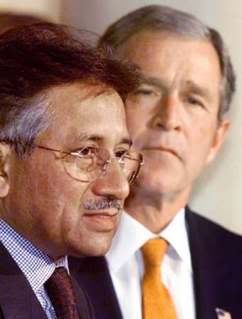
Pervez Musharraf, on the way out?

And we're relying on the Pakistani military to prevent a meltdown, in every sense of the word.

Since September 11, 2001, the U.S.'s Pakistan policy can be summed up in two words: Pervez Musharraf. But within the U.S. intelligence community, and in Pakistan, there's a growing belief that the U.S.-friendly military dictator's days are drawing to a close -- and possibly within the next few months. It may be time for the U.S. to face what it's long feared in the nuclear state: the prospect of chaos, rising Islamism or anti-Americanism that follows Musharraf.

But the hope -- among Pakistani military officers and politicians, to say nothing of U.S. diplomats -- is that the increasingly inept and unpopular Musharraf can be eased out of power while the U.S. slowly distances itself from him, allowing for as smooth a transition as is possible in the turbulent South Asian country. Some see the Pakistani Army remaining powerful enough to prevent a chaotic transition or an Islamist takeover.

[snip]

Within three months, Musharraf has grown steadily weaker in the eyes of the security services, the Islamists, and the general public, compounding the doubts that some in the U.S. have over his commitment to taking on al-Qaeda. The mistakes expose a regime "imploding" under the weight of its contradictions, according to Grere, and unable to mollify the multifaceted discontent that has taken root since Musharraf seized power in a 1999 coup.

Neither Richer nor Grare believes that there's an obvious candidate to succeed Musharraf, the ex-Pakistani official cited two prominent generals who could emerge as successors if the Army opts to retain formal rule, or alternatively, serve as crucial behind-the-scenes power brokers. The two are Ehsan Saleem Hayat, the army's vice chief of staff, and Ehsan ul-Haq, the chairman of the joint chiefs and a former head of Pakistan's powerful intelligence apparatus, known as the ISI. According to the ex-Pakistani official, both men were recently in Washington, sounding out senior officials: "They didn't come to Washington for a Burger King meal." A State Department official confirms that ul-Haq met in May with Deputy Secretary of State John Negroponte, but could not say the same for Hayat.


Photo Sharing and Video Hosting at Photobucket

Thursday, May 17, 2007

I'm sure Bush will demand that this man be fired

He's too intelligent, educated and he said the no-no word: civil war:
SPIEGEL ONLINE: Mr. Biddle, you just returned from a four week stay in Baghdad where you had been asked to advise General Petraeus, the commander of American forces in Iraq. Did you come back with a sense that he has a workable idea on how to improve the situation in Iraq?

Stephen Biddle: I am very impressed with the general's ability. I think he is an extremely able public servant. If anyone is able to make the best of this, it's him.

SPIEGEL ONLINE: General Petraeus is known to be an expert in counter insurgency. In fact the entire administration seems to think that this should be the focus. You on the other hand have argued that counter insurgency is not what is needed in Iraq. Why?

Biddle: A classical ideological insurgency is a war of ideas in which a sub-national group is challenging the ideas by which the government runs the country. In this kind of war of ideas, you can in principle win by changing people's ideas. Given that, the classical strategy for waging counter insurgency is oriented around winning hearts and minds. You engage in a process of political reform in which you introduce democracy to make the government's ideas legitimate. You engage in a campaign of economic development assistance. And you try and train an indigenous military to wage the war. All those strategies are what the Bush Administration's approach to Iraq has been. They make some sense, if the problem you are trying to solve is a classical ideological insurgency. Except, Iraq is not.

SPIEGEL ONLINE: What is then?

Biddle: It's a communal civil war in which the war is not fought over a set of ideas. Rather, it is about the survival and self interest of communal groups within the nominal state. Sunnis are not fighting for an idea of what's best for all Iraqis; they are not trying to persuade Shiites that a Sunni government would be good for them. They are fighting for the self interest of Sunnis against the self interest of Shiites -- and vice versa. Because it is not a war of ideas you cannot expect to win it by changing people's minds. It's a war of identity. Identities can't change in the way minds can.

He doesn't see leaving Iraq anytime soon, though, on moral grounds. In his mind, we have to stay and police the cease-fire. With the delicate balance of power between Shia and Sunni, an overbalance in anything could mean extermination:
With respect to the power sharing compromise, the problem is that the stakes for each side are literally existential. They are afraid that if the other side gets control of the state the result might be genocide. The kind of compromise the playbook calls for by definition implies ceding power -- thus compromising with people who you think are threatening you with genocide. If you miscalculate and give up too much power, the result is extermination. So the downside risk is cosmic. By contrast, refusing to compromise means to have an ongoing, chronic low level bloodletting, which isn't great -- but probably looks a lot better than genocide. So we have a recipe for stalemate.
Stalemate = ongoing, chronic low level bloodletting = quagmire. Lovely.

Wednesday, May 09, 2007

The Fort Dix Islamopizza attackers

Were not even close to being real jihadists:

"Unlike other cases we've done, there was no clear ringleader," U.S. Attorney Christopher J. Christie said in an interview. "They all seemed to feed off each other. They were clearly guys turning to this element for inspiration. They wanted to be jihadists."

At the same time, a 26-page indictment unsealed Tuesday indicates that the group had no rigorous military training and did not appear close to being able to pull off an attack. The arrests in the case began Monday night after two defendants arrived at a local home to buy assault weapons, which had been supplied and disabled by the FBI, officials said.

[snip]

The FBI first got wind of the alleged plot in January 2006, after an unidentified store clerk alerted police to a video that showed the men firing assault weapons, calling for jihad and yelling "God is great" in Arabic, officials said. The men had submitted the video file to the store so that it could be copied onto a DVD, authorities said.

Could it be that this conveniently distracting capture was helped along by this nice old man?

Photo Sharing and Video Hosting at Photobucket

Update 5/11: Josh Marshall notes:
There also seems to be more than a hint of entrapment in the role the government informant played in helping arrange the planned attack. Back in November one of the plotters called a Philly police officer and told him that he'd been approached by someone [i.e., the government informant] "who was pressuring him to obtain a map of Fort Dix, and that he feared the incident was terrorist-related."


How ... conveeeeeennient....

Friday, April 13, 2007

Iraqi group splits off from al Qaeda, indicates desire to talk to Congress

Different ideals, different goals: (my bold)

One of Iraq's main armed groups has confirmed a split with al-Qaeda, according to a spokesman for the dissenting organisation.

Ibrahim al-Shammari told Al Jazeera on Thursday that the Islamic Army in Iraq had decided to disunite from al-Qaeda in Iraq after its members were threatened.

"In the beginning, we were dealing with Tawhid and Jihad organisation, which turned into al-Qaeda in Iraq," he said, his identity obscured for security reasons.

[snip]

The Islamic Army in Iraq is one of several nationalist groups which opposes hitting Iraqi civilians, but it has carried out high-profile attacks against multinational forces.

Al-Shammari said they would be willing to deal with the Americans if certain conditions are met.

"We, the Islamic Army in Iraq, are ready to negotiate, but only with the US congress.

"They are the representatives of the American people, and the Iraqi resistance represents the Iraqi people. We are ready to establish a dialogue with them, not with the arrogant US administration."

Where do you go for food when the bullets start flying?

“This is our seventh day inside our house and the kids are starving,” Jalal Jumaa Hadi, a 33-year-old taxi driver and father of two boys, told IRIN in a phone interview from his house “I can't go out to work and we can’t venture out to buy anything for the kids. We’re just baking bread and feeding our kids.”
A humanitarian crisis is occuring in Dinwaniyah, Iraq:

BAGHDAD, 11 April 2007 (IRIN) - A week of fierce clashes between US-Iraqi forces and Shia militiamen in Diwaniyah has brought the city to the brink of a “real humanitarian catastrophe”, health workers said on Wednesday. Aid agencies and doctors are demanding they be given access to a desperate population who have become prisoners in their own homes.

“We can’t send our ambulances in to collect dead bodies or the wounded from the streets. And we are running out of essential medical items such as pain killer tablets, IV fluids, anaesthesia, stitches, antiseptics and things like bandages and cotton," said Dr Kamal Hussein of the city’s general hospital.

“In addition, we don't have enough fuel to operate our generators so we only have four to six hours of electricity a day,” Hussein added. “The government and US forces must allow medicines into this city otherwise there will be a real humanitarian catastrophe.”

The predominantly Shia city of Diwaniyah, about 130km south of the capital, Baghdad, has a population of between 400,000 and half a million.

The focus of the US offensive in Diwaniyah is The Mahdi Army, run by radical Shia leader Muqtada al-Sadr, who had ordered Baghdad militiamen to lay down their weapons during a month-long US-led security crackdown in the capital.

Many of the Diwaniyah fighters are thought to have come from Baghdad and are using the US preoccupation with the capital to cement their hold on parts of the southern city.

Sunday, April 08, 2007

Since we always invade countries that we sell arms to...

Does this mean we will be invading Ethiopia next because of their WMDs?:

WASHINGTON, April 7 — Three months after the United States successfully pressed the United Nations to impose strict sanctions on North Korea because of the country’s nuclear test, Bush administration officials allowed Ethiopia to complete a secret arms purchase from the North, in what appears to be a violation of the restrictions, according to senior American officials.

The United States allowed the arms delivery to go through in January in part because Ethiopia was in the midst of a military offensive against Islamic militias inside Somalia, a campaign that aided the American policy of combating religious extremists in the Horn of Africa.

American officials said that they were still encouraging Ethiopia to wean itself from its longstanding reliance on North Korea for cheap Soviet-era military equipment to supply its armed forces and that Ethiopian officials appeared receptive. But the arms deal is an example of the compromises that result from the clash of two foreign policy absolutes: the Bush administration’s commitment to fighting Islamic radicalism and its effort to starve the North Korean government of money it could use to build up its nuclear weapons program.

I'm warning all tinpot dictators again. If we sell you weapons, be prepared to be invaded later. Have oil? Be prepared to be invaded sooner. .....

Wait a minute. Does Ethiopia have oil?

Oh my goodness, yes it does. And the Chinese are interested.