So what exactly were we claiming as we sailed our warships through them?:
Tension spiked markedly last week when Iranian Revolutionary Guards Corps (IRGC) speedboats were involved in an "incident" with three US Navy vessels, which claimed they were international waters.The article goes on to discuss the 1982 UN Convention on the Law of the Sea, (UNCLOS) and makes this point:
Yet there is no "international water" in the Strait of Hormuz, straddled between the territorial waters of Iran and Oman. The US government claimed, through a Pentagon spokesperson, Bryan Whitman, that the three US ships "transiting through the Strait of Hormuz" were provocatively harassed by the speedboats.
However, irrespective of how Congress acts on the pending legislation on UNCLOS, the fact is that the US cannot have its cake and eat it. That is, rely on it to defend its navigational rights in the Strait of Hormuz and, simultaneously, disregard the various limitations on those rights imposed by the UNCLOS - and favoring Iran.Thus:
In other words, US warships transiting through Hormuz must, in effect, act as non-war ships, "temporarily depriving themselves of their armed might". And any "warning shots" fired by US ships at Iranian boats, inspecting the US ships under customary international laws, must be considered an infringement on Iran's rights. This technically warrants a legal backlash in the form of the Iranians temporary suspending the US warships' right of passage. Again, the US could be technically prosecuted by Iran in international forums for conducting questionable activities while in Iranian territorial waters.Now take a look at the Strait:
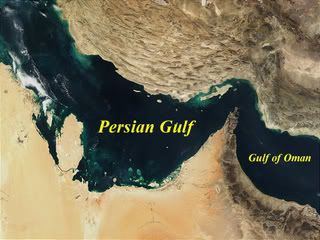
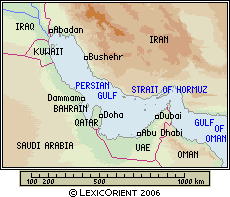
And tell me which one is doing the harassing?
