Have they really thought through what they are doing? What will happen when nobody in the United States can afford their product? When the middle class has been strangled to death? That they are literally putting themselves out of work?
Via whig at Cannablog:
Showing posts with label Foreign Workers. Show all posts
Showing posts with label Foreign Workers. Show all posts
Saturday, June 23, 2007

Sunday, April 08, 2007
Guess who supports Chinese sweatshops and low pay?
We do. (My bold): (updated: forgot link)
In a historically unprecedented visit, influential Chinese scholar and labor-law expert Liu Cheng arrived in Washington, DC, to garner support from US legislators and labor leaders for a law that is pending not before the US Congress but before the National People's Congress (NPC) in China. Liu Cheng has been a key adviser to the drafters on a labor-law reform bill currently working its way through the Chinese legislative process.[snip]
His visit is part of a behind-the-scenes battle that is raging worldwide over reforms in China's labor law. On the one side are Wal-Mart, Google, General Electric (GE) and other global corporations that have been aggressively lobbying to limit new rights for Chinese workers. On the other side are pro-worker-rights forces in China, backed by labor, human rights, and political forces in the US and around the world.
Liu Cheng's visit to Washington was part of that international support campaign. He warned in an interview that support for the new law within China is not enough. "Some National People's Congress representatives are influenced by the employer lobby. Although the principles of the amendments are secure, there may be concessions on the details, so we call for help."
On December 8, shortly after last year's elections, Democrats Lynn Woolsey, Barbara Lee, George Miller, Barney Frank and 28 other members of the House of Representatives introduced legislation calling on Bush to express public support for the workers' rights and protection provisions in China's draft labor law and repudiate efforts by some US corporations and their representatives in China to limit new rights for workers.Want to fight back? Scare the corporate world with these words: Want less, buy less, use up, recycle, repair.
This legislation properly places the focus on the actual role of US corporations in China. Their action is part of the broader effort by a Democratic-controlled Congress to take the policymaking initiative away from the Bush administration.
The exposure of corporate opposition to expanded labor rights for Chinese workers has also generated outrage among labor organizations and their allies around the world. Inside China, leaders of the ACFTU have been fighting efforts by companies to restrict unions' role in setting new employer policies.
Thursday, March 22, 2007
Remembering the Confederacy
With fondness:
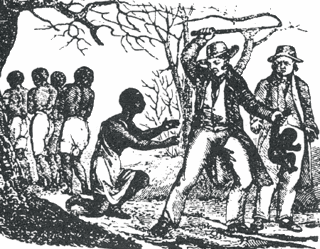
The report — Close to Slavery: Guestworker Programs in the United States — comes as Congress is about to begin debating immigration legislation that could greatly expand guestworker programs to cover hundreds of thousands, if not millions, of new temporary foreign workers.
"Congress should reform our broken immigration system, but reform should not rely on creating a vast new guestworker program," said Mary Bauer, director of the SPLC's Immigrant Justice Project and author of the report. "The current program is shamefully abusive in practice, and there is almost no enforcement of worker rights."
The 48-page report, based on interviews with thousands of guestworkers and dozens of legal cases, describes the systematic abuse of workers under what is known as the H-2 system administered by the U.S. Department of Labor. The program was created in 1943 to allow the sugar cane industry to bring in temporary workers and was revised by Congress in 1986 to include non-agricultural workers.
Subscribe to:
Posts (Atom)