Showing posts with label Commercial Fishing. Show all posts

Tuesday, August 12, 2014

Piles and piles of bones, artifacts, fish

Piles of prehistoric bones!

Piles of 'artifacts spanning more than 15 centuries of Etruscan, Roman and medieval civilization in Tuscany'.

Piles of dead sea creatures.  Stop ghost fishing.
Shocking Statistics
Up to 30% of all fish are caught in ghost nets.
Roughly 10%, or 640,000 tons of all marine debris are caught in ghost nets.
As of right now, and still counting, there has been thousands of seabirds, 20,000 northern fur seals, and 500,000 octopi caught in ghost nets.
Over a 23 week period, there has been 11 harbor seals, 450 salmon, 1,300 spiny dogfish, 1,800 birds, and 16,900 crabs caught in just one net.
In the wreck of the MV Infidel off the coast of Santa Catalina Island alone, 4.5 tons of netting sank to the ocean floor.

Saturday, July 28, 2012

The whole world is Fukushima'd.....

Fukishima nuclear disaster update.

Fukushima Medical Care Provider: Hospital president says people will be healthier after radiation exposure from triple meltdowns — “There is no argument allowed”

Post-Fukushima, Japan’s irradiated fish worry B.C. experts
The numbers show that far from dissipating with time, as government officials and scientists in Canada and elsewhere claimed they would, levels of radiation from Fukushima have stayed stubbornly high in fish. In June 2012, the average contaminated fish catch had 65 becquerels of cesium per kilo. That’s much higher than the average of five Bq/kg found in the days after the accident back in March 2011, before cesium from Fukushima had spread widely through the region’s food chain. In some species, radiation levels are actually higher this year than last.

Asahi: Fukushima nuclear disaster is affecting every region of the world – Japanese Professor

Tuesday, May 29, 2012

Pre-oiled? Or glow in the dark?

Tuna contaminated with Fukushima radiation found in California:
Bluefin tuna contaminated with radiation believed to be from Fukushima Daiichi turned up off the coast of California just five months after the Japanese nuclear plant suffered meltdown last March, US scientists said. Tiny amounts of caesium-137 and caesium-134 were detected in 15 bluefin caught near San Diego in August last year, according to a study published on Monday in the Proceedings of the National Academy of Sciences journal. The levels were 10 times higher than those found in tuna in the same area in previous years, but still well below those that the Japanese and US governments consider a risk to health. Japan recently introduced a new safety limit of 100 becquerels per kilogram in food. The timing of the discovery suggests that the fish, a prized but dangerously overfished delicacy in Japan, had carried the radioactive materials across the Pacific ocean faster than those conveyed by wind or water.
If you don't want that tuna, have some fish without eyes.

 Going vegan makes more and more sense....

Thursday, October 13, 2011

It adds a certain piquant flavor...

One reason I have cut back on seafood... the choices are pre-cooked radioactive fish from the Pacific or pre-oiled polluted and toxic seafood from the Gulf
New Study Says FDA Underestimated Seafood Contamination Risk After BP Oil Spill

Saturday, February 19, 2011

Eating our oceans empty

Fewer big fish in the sea, say scientists
WASHINGTON (AFP) – Fewer big, predatory fish are swimming in the world's oceans because of overfishing by humans, leaving smaller fish to thrive and double in force over the past 100 years, scientists said Friday.
Big fish such as cod, tuna, and groupers have declined worldwide by two-thirds while the number of anchovies, sardines and capelin has surged in their absence, said University of British Columbia researchers.
Meanwhile, people around the world are fishing harder and coming up with the same or fewer numbers in their catch, indicating that humans may have maxed out the ocean's capacity to provide us with food.
The UK Independent has a plan:
Out with tuna, in with sardines – a recipe for saving the seas

Thursday, August 20, 2009

California: once the bread basket of the world

Now a basket case.

The Los Angeles Times:
If San Joaquin Valley farmers such as Locke are fearful, so are the agricultural scientists who support California's $10-billion annual fruit and nut crop, the largest in the nation. A new study from UC Davis, to be published today, found that the number of winter chilling hours, essential to the flowering of orchards, has declined as much as 30% since 1950 in large swaths of the Central Valley, where most of the tree crops are grown.

Only 4% of the Central Valley is now suitable for apples, cherries and pears, all high-chill fruits that could once be grown in half the valley, according to the study. By the end of the century, it says, "areas where safe winter chill exists for growing walnuts, pistachios, peaches, apricots, plums and cherries are likely to almost completely disappear."
And:
Along California's central and northern coasts, salmon season has been closed for the second straight year because, in large part, water conditions have become so mucked up in the Sacramento-San Joaquin River Delta that baby fish can't survive before heading to sea.

Commercial fishermen and their crews can't work. Recreational anglers can't fish, hurting charter boat owners.

"The delta is a black hole" for salmon, legislators were told by Zeke Grader, executive director of the Pacific Coast Federation of Fishermen's Assns.

The Sacramento-San Joaquin river system -- encompassing California's Central Valley -- historically has been the second-largest salmon producer on the West Coast, second only to the Columbia River. And Columbia salmon tend to migrate north to British Columbia and Alaska. Salmon that make it through the delta and out the Golden Gate have supplied 90% of the catch off California, and 50% off Oregon.

The delta also is the largest estuary on the West Coast of America, north and south, Grader said in an interview.

"Estuaries are places where salmon gain strength before going to sea," he continued. "We've been seeing salmon actually losing weight in the delta. They become weakened, get lost because of [reverse river] flows, become entrained in pumps or wind up in forebays where they're easy prey to predator fish."

What Grader describes is pretty much the fault of water management in the delta during the past half-century -- something all sides currently are trying to fix.
And here's this nice graphic that shows how the Central Valley will dry up.

Add in the economic collapse and budget disaster and California will be good and truly Californicated.

Sunday, June 28, 2009

When climate change affects the weather patterns

People die. We're going to see lots of articles like these as the water wars start, the oceans' rising temperatures make fish die off or stop breeding....:
"No one will call us for work and the children will have to go hungry. We won't have anything to eat."

Devi is among roughly 600 million people in India who make a living off the land. That is about 60 percent of India's population of 1.1 billion.

Most of the country is suffering from a rain deficit. The Monsoon has been delayed in some parts of the country. Usually the season begins around the first of June.

In developed countries, irrigation is common and electricity readily available, but both are a luxury for most Indian farmers.

Rainwater is key to crop survival and the livelihoods of those who work the farms.

Devinder Sharma is a food and trade policy analyst. He says "65 percent of farmers in India rely on rainwater."
Fish will become harder and harder to find:
French fishermen hit back at stars' bid to save bluefin tuna

[snip]

It has been a long few weeks for captain Jean-Louis Donnarel and the crew of the Provence-Côte d'Azur II. Long, rough and not very profitable. After sailing a total of 6,600 nautical miles - first to Cyprus, then the length of the Egyptian coast, to Malta, around the Balearics and then home - the Provence-Côte d'Azur II returned with 84 tonnes of bluefin tuna, a catch that will barely cover the costs of the voyage.

"We found fish on the last day," Donnarel said last week. "Without that, we would have been finished. Someone has to take a decision. Do they want us to fish or not? If not, they should put us out of our misery."

Donnarel and his crew are at the sharp end of an increasingly bitter row: one that links globally known restaurants, top celebrities, huge international conglomerates, sushi shops and supermarkets across half the world to the livelihoods of a few thousand fishermen.

At stake is the survival of the bluefin tuna, a single specimen of which can be sold for tens of thousands of dollars - a price that has seen stocks decline in some areas by up to 90%.

It apparently hasn't dawned on the fishermen that if there are no more fish, there WILL BE no more jobs....

Update:
A severe heatwave has claimed the lives of nearly 100 people across India, reports say.

The eastern Indian state of Orissa appears to be the worst affected with 58 people dying from heat stroke, according to local officials.

Unofficial figures in the Orissa media put the number of dead closer to 200.

Sunday, February 22, 2009

Get used to more articles like this

Photobucket

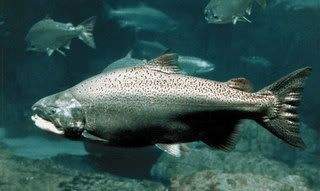
Salmon fishing was banned along the West Coast for the first time in 160 years Thursday, a decision that is expected to have a devastating economic impact on fishermen, dozens of businesses, tourism and boating.

Commerce Secretary Carlos Gutierrez immediately declared a commercial fishery disaster, opening the door for Congress to appropriate money for anyone who will be economically harmed.

The closure of commercial and recreational fishing for chinook salmon in the ocean off California and most of Oregon was announced by the National Marine Fishery Service.

It followed the recommendation last month of the Pacific Fishery Management Council after the catastrophic disappearance of California's fabled fall run of the pink fish popularly known as king salmon.

It is the first total closure since commercial fishing started in the Bay Area in 1848.

Truly, it can't have taken people by surprise, right? You know... People fish something completely to extinction in one area and then are astonished the the natural fisheries collapse? What? The concept that you must leave some fish to make other fish is unknown?

Thursday, February 05, 2009

No fish for you

The oceans are acidifying as they heat up, and the fish are disappearing:
Feb. 5 (Bloomberg) -- The risk of fisheries collapsing in Peru, the world’s largest fishmeal producer, and developing nations such as Senegal that depend on fish for both food and jobs means economic hardship as climate change threatens fishing grounds.

About 33 countries in Latin America, Africa and Asia are “highly vulnerable” to rising ocean temperatures, changes in river flows and less precipitation, said Allison Perry of the World Fish Center, who co-wrote a study that looked at the economic risks to fisheries in countries affected by changing weather.

The world’s poorest countries are less able to adapt to these changes because they lack the financial resources to replace a food source and an industry that contributes more to economic activity than in wealthier nations. “Many of these countries are simply not in a position to adapt and implement measures,” Perry said.

One more thing that global warming is going to cause: starvation.

Thursday, August 14, 2008

Fish wars

Photobucket

As predicted, when the catch gets low, anger rises, the sense of injustice grows, the irritation at fellow fisherman increases:
Norwegian government coastguards filmed the crew of the Prolific, a Shetland-based trawler, openly discarding more than 5,000 kg of cod and other dead white fish, or nearly 80% of its catch.

According to the coastguard, the boat had previously been inspected in Norwegian waters and declared legal, before crossing into UK waters where it dumped its load. The incident took place on 2 August but the video only came to light in Britain yesterday.

It is illegal to discard fish in Norwegian waters, but boats are forced to do so in European Union waters if they have caught the wrong species of fish or fish that are too small. Last year the EU estimated that between 40% and 60% of all fish caught by trawlers in the North sea is discarded. The practice of dumping is widely recognised as unsustainable but inevitable given the present EU quota system.

Yesterday, Norwegian minister for fisheries and coastal affairs Helga Pedersen, speaking to angry fishing communities in northern Norway who had seen the film, said she would press for review of the EU fishing policy and wanted to ban any boat discarding fish that were caught in Norwegian waters.
Check the link to see the video of what five tons of fish looks like. What a waste.

Friday, July 11, 2008

Why is the concept so hard to understand?

Photobucket

If you catch all the fish in the sea, there will be no more:
While Spanish, French and Italian fishermen clamour for a resumption of bluefin tuna fishing - knowing that if they are allowed to fish now this will be the last season ever - around the UK it has begun to dawn on some fishermen that there might be an association between the survival of the fish and the survival of the fishing.

Prompted by Young's seafood and some of the supermarkets, who in turn have been harried by environmental groups, some of the biggest British fisheries have applied for eco-labels from the Marine Stewardship Council, which sets standards for how fish are caught. Fishermen around the UK also seem to be taking the law more seriously, and at last to be showing some interest in obscure issues such as spawning grounds and juvenile fish (which, believe it or not, turn out to have a connection to future fish stocks). By ensuring that far too many boats, and far too many desperate fishermen, stay on the water, and that the remaining quotas are stretched too thinly, the EU will slow down or even reverse the greening of the industry.

Why is this issue so hard to resolve? Why does every representative of a fishing region believe he must defend his constituents' right to ensure that their children have nothing to inherit? Why do the leaders of the fishermen's associations feel the need always to denounce the scientists who say that fish stocks decline if they are hit too hard? If this is a microcosm of how human beings engage with the environment, the prospect for humanity is not a happy one.
The fish are disappearing. Will we realize that we can actually empty the ocean of edible fish? Will we be able to stop ourselves?
Is anyone not aware that wild fish are in deep trouble? That three-quarters of commercially caught species are over-exploited or exploited to their maximum? Do they not know that industrial fishing is so inefficient that a third of the catch, some 32 million tonnes a year, is thrown away? For every ocean prawn you eat, fish weighing 10-20 times as much have been thrown overboard. These figures all come from the United Nations Food and Agriculture Organisation (FAO), which also claims that, of all the world's natural resources, fish are being depleted the fastest. With even the most abundant commercial species, we eat smaller and smaller fish every year - we eat the babies before they can breed.

Callum Roberts, professor of marine conservation at York University, predicts that by 2050 we will only be able to meet the fish protein needs of half the world population: all that will be left for the unlucky half may be, as he puts it, 'jellyfish and slime'. Ninety years of industrial-scale exploitation of fish has, he and most scientists agree, led to 'ecological meltdown'. Whole biological food chains have been destroyed.
At the end of the article a solution is offered:
Roberts has one solution: marine reserves. Protecting up to 40 per cent of the world's oceans in permanent refuges would enable the recovery of fish stocks and help replenish surrounding fisheries. 'The cost, according to a 2004 survey, would be between £7bn and £8.2bn a year, after set-up. But put that against the £17.6bn a year we currently spend on harmful subsidies that encourage overfishing.'

Reserves must not be ruled by politicians, says Roberts. 'The model of industry-political control for regulatory bodies just doesn't work. It's like central banks - put them under politicians' control and they make dangerous, short-term decisions that result in economic instability. Put them under independent control, and they make better-judged, more strategic decisions.'

The Newfoundland cod fishery, for 500 years the world's greatest, was exhausted and closed in 1992, and there's still no evidence of any return of the fish. Once stocks dip below a certain critical level, the scientists believe, they can never recover because the entire eco-system has changed. The question is whether, after 50 years of vacillation and denial, there's any prospect of the politicians acting decisively now. 'It is awful and we are on the road to disaster,' says Tudela. 'But the collapse - in some, not all the situations - is still reversible. And it's worth trying.'
What with the wars over oil, water, and politics, fish will be last on the list of things to fix. But as with everything else, we no longer have very much time to rectify our mistakes before we lose everything.

crossposted at American Street

Saturday, April 12, 2008

Eaten into extinction

Photobucket

We should be so proud of ourselves:

Culver City, CA (AHN) - After much deliberation, federal officials have decided to cancel the salmon fishing season this Friday. Due to dwindling numbers of salmon in rivers, commercial and recreational fishing of salmon has been outlawed, and the governor has declared a state of emergency for fisherman.

Experts say the number of salmon has reached a critically low amount, with only 68,000 in the Sacramento river and its tributaries. This is down from 800,000, just six years before, a record low in the population.

The price of Salmon is expected skyrocket. Salmon is already going for $30-$40 dollars a pound in some markets, in anticipation of the shortage.

This could very well be the death of the industry in California. "We're looking at the end of it right now," Hedley Prince told the San Francisco Chronicle. He is the harbormaster at San Francisco's Fisherman's Wharf. He used to have hundreds of fishing boats based out of San Francisco - now, there is only a handful.

Some commercial fishermen are worried about their futures saying they have been fishing all their lives and have no other marketable skills.

[snip]

The salmon season was expected to start on May 1. At least 400 commercial fishermen could stand to lose 80 percent of their annual income, should the ban remain in force. In addition, California's economy stands to take about a $20 million dollar hit from this ban.
We're going to see more and more of this as we go. Our world is changing before our very eyes.

Monday, November 19, 2007

I don't think he's lost

I think he's hiding:
A 5.5m long minke whale has been spotted more than 1600km (994 miles) from the Atlantic Ocean, deep inside the Amazon rain forest. The whale ran aground earlier this week but after being freed with the help of vets and biologists it disappeared shortly afterwards.
Because of this:
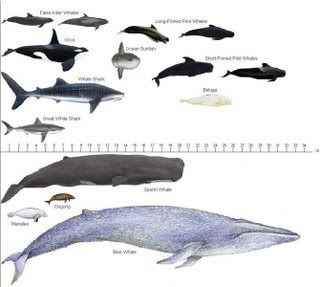
The UK, Australia and New Zealand have sharply criticised Japan for the launch of its largest ever whaling expedition. The hunting fleet has instructions to kill up to 1,000 whales. Humpback whales will be hunted for the first time in over 40 years.
Swim for your lives! You're food!

Photo Sharing and Video Hosting at Photobucket

Update 11/20: P.Z. Myers of Pharyngula has the last word.