Showing posts with label Colombia. Show all posts

Saturday, December 04, 2010

Aliens!! Rat bomb sniffers! Sugar beets! Evil cuteness!

It must be aliens or a super secret spy mission for Bond. James Bond:
LOS ANGELES — The U.S. military's secretive X-37B unmanned spaceplane slipped out of orbit and landed itself in early morning darkness Friday at a California airbase after a successful maiden flight that lasted more than seven months, the Air Force said.
And then there's the rodents...
Reporting from Bogota, Colombia — Rats may soon become heroic figures in this nation's struggle to detect and dispose of land mines.

Early next year, anti-narcotics police will begin deploying squads of rats to sniff out land mines in remote areas of Colombia where leftist rebels and drug traffickers have planted hundreds of thousands of the deadly devices. It's an unconventional initiative in a country that is second only to Afghanistan in the number of land mine victims.

Using a project in Tanzania as a model, Colombian scientists have taught rats to detect mines buried as deep as 3 feet. The rats are conditioned to search and burrow down for explosives in exchange for the reward of sugar.
Monsanto!
DES MOINES, Iowa – A federal judge in California has ordered the removal from the ground of plants grown to produce seeds for genetically modified sugar beets, citing the potential for environmental harm.
The ruling by U.S. District Judge Jeffrey White has again raised questions about the use of genetically modified crops and what will happen if growers aren't allowed to plant GMO seeds.
About 95 percent of the sugar beet crop has been genetically modified to resist the weed killer Roundup. The crop provides roughly half of the nation's sugar supply.
In his decision, White cited, "a significant risk of environmental harm."
Dangerous cute animals like the platypus. Be afraid!

Monday, March 03, 2008

What the world needs now

A war to start in South America:
Ecuador has cut diplomatic ties with Colombia in a deepening crisis over a cross-border raid by Colombian troops.

Venezuela also said it was expelling all Colombian diplomats in the wake of the raid, which killed senior Farc rebel Raul Reyes and 16 others.

Venezuela and Ecuador have deployed troops to their borders amid calls for restraint led by the head of the UN.

[snip]

As the crisis deepened, UN Secretary General Ban Ki-moon added his voice, expressing concern about "increased tensions and heightened rhetoric" in the region.

In Washington, a state department spokesman backed Colombia's right to defend itself while urging dialogue.

Meanwhile, Colombia accused Ecuador and Venezuela of having ties with the Farc and said the rebels had tried to buy uranium.

The Colombian authorities said the information had come from documents found during Saturday's raid on the rebel camp in Ecuador.

"When they mention negotiations for 50 kilos of uranium, this means that the Farc are taking big steps in the world of terrorism to become a global aggressor. We're not talking of domestic guerrilla but transnational terrorism," said Colombian national police chief Oscar Naranjo at a news conference in Bogota.

Other documents showed that President Chavez had provided $300m (£151m) to the Farc, and had received funds from them many years earlier, he said.

And there was also evidence of links between the Farc and representatives of the Ecuadorean government, Gen Naranjo claimed.

But Venezuela and Ecuador poured scorn on the Colombian claims.

And from The Guardian:
Venezuela and Colombia were locked in a tense stand-off yesterday, with explosive accusations levelled against Venezuelan president Hugo Chávez a day after he ordered tanks and troops to the border.

There was no sign of imminent conflict but the war of words escalated when Colombia accused Chávez of bankrolling the Revolutionary Armed Forces of Colombia (Farc), Marxist rebels categorised around the world as terrorists.

Colombia's police commander, General Oscar Naranjo, told a media conference that Bogotá had evidence that Chávez paid $300m (£151m) to the organisation, an allegation which complicated efforts to cool a serious regional crisis.

Colombia triggered the dispute last Saturday by bombing a Farc camp a mile inside Ecuador, killing 17 rebels, including Raúl Reyes, a senior commander. In response, Ecuador and Venezuela yesterday severed diplomatic ties. Quito sent 3,200 troops to its border and Chávez, from the other end of the Andes, ordered the mobilisation of 10 armoured battalions and warplanes to deter what he called Colombian aggression.

Thursday, March 08, 2007

They love Bush in Brazil

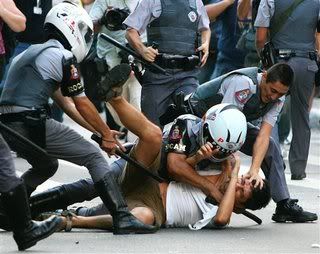
They welcomed him very... enthusiastically:

Photo Sharing and Video Hosting at Photobucket

US President George W Bush has arrived in Brazil's largest city, Sao Paulo, as a massive march in protest at his visit turned violent.

At least 20 people were hurt in clashes between demonstrators and riot police.

The US president is due to meet Brazil's Luis Inacio Lula da Silva to sign an ethanol energy alliance.

[snip]

Many of the demonstrators are angry at the war in Iraq and the proposed ethanol deal, which they say is an attempt to control the country's production of the bio-fuel which powers eight out of 10 new cars in Brazil.

Together with Colombia, Brazil produces about 70% of the world's ethanol, a bio-fuel made from sugar cane or corn.

The proposed accord would make ethanol an internationally traded commodity and promote its production in Central America and the Caribbean.

But activists claim that sugar cane cultivation is water intensive and responsible for stripping the Amazon rainforest.

They also say that the ethanol production process is concentrated in the hands of a few powerful families or corporations.

As Mr Bush left Washington to begin his tour, hundreds of protesters occupied the Cevasa sugar and ethanol-processing plant in Sao Paulo state that was recently sold to a US company.

Update: Others say Bush's visit is to try and destroy the influence Hugo Chavez has:

According to a former Brazilian ambassador in Washington, Rubens Barbosa, the tour is a belated attempt by Mr Bush to regain ground lost to Mr Chavez as a result of the US administration's neglect of Latin America. According to a former Brazilian ambassador in Washington, Rubens Barbosa, the tour is a belated attempt by Mr Bush to regain ground lost to Mr Chavez as a result of the US administration's neglect of Latin America.
Bush got to speechify before he flew down:
My trip is an opportunity to remind the folks in our neighborhood that the United States has a robust policy toward empowering individuals to realize their full potential.
NTodd notes Godwin's law.

Update 3/9: Compare and contrast Clinton's visit to Bush's visit.