Thursday, March 12, 2026

Sunday, March 01, 2026

Tuesday, February 24, 2026

Thursday, February 19, 2026

Tuesday, February 17, 2026
Not since 1783. So why would we want one now?
The legal establishment of the United States as a sovereign nation was finalized with the signing of the Treaty of Paris on September 3, 1783. This agreement officially ended the Revolutionary War. In the treaty, Great Britain formally acknowledged that the United States was a group of free and independent states. The British government gave up all its claims to the territory and the government of the new nation.

Friday, February 13, 2026
Monday, February 02, 2026
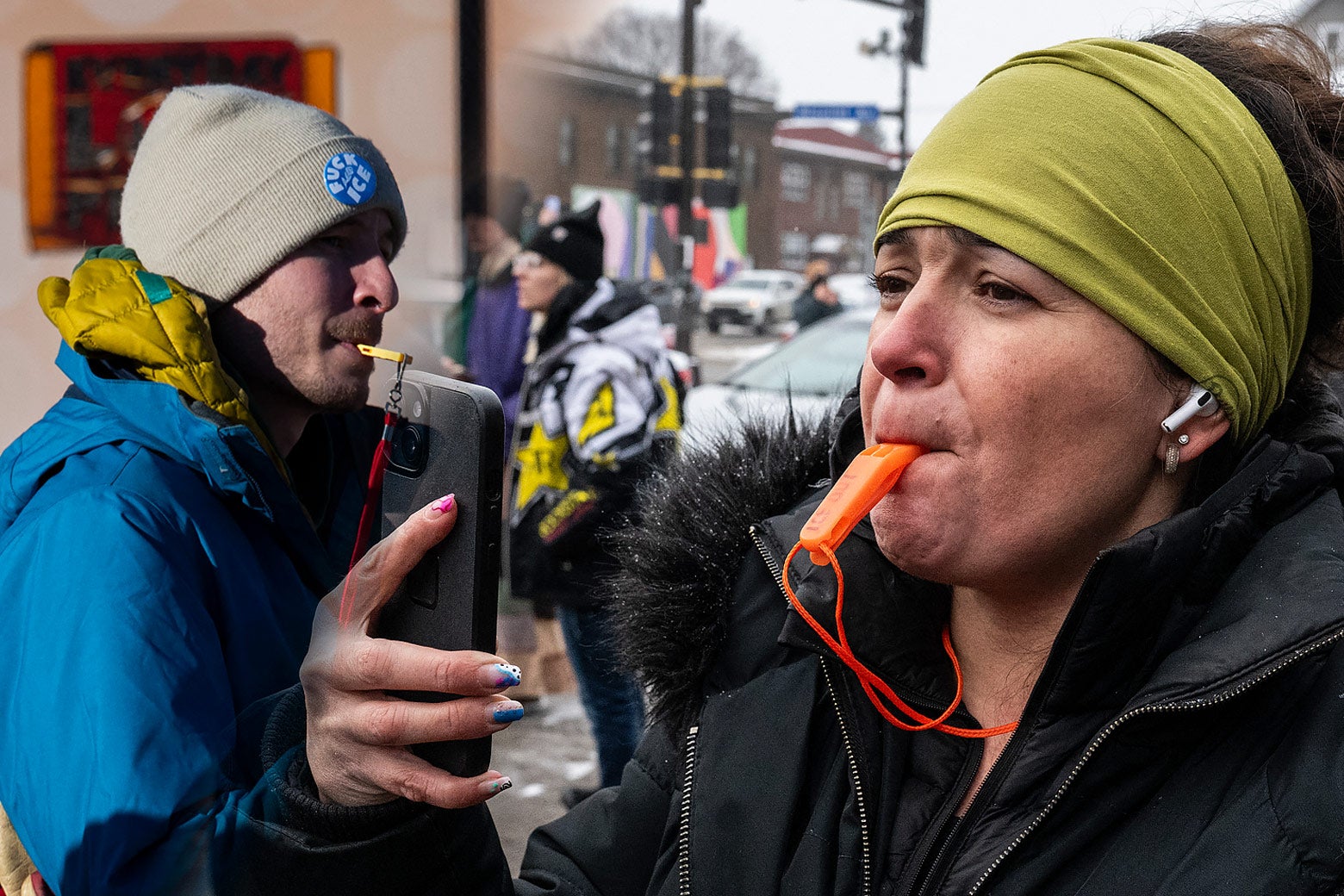
Give a little whistle
The idea behind the whistle is simple: If you see ICE agents, you let out three short tweets to alert people in the area of the presence of federal agents. If you see ICE agents detaining someone, you let out three prolonged tweets to call witnesses to the scene. Witnesses are legally permitted to document arrests; this evidence can be used later in court or to find detainees after arrest.
Tuesday, January 27, 2026
Heather Cox Richardson
Every night, while the rest of us spiral through news feeds, one woman sits in a fishing village and does something radical—she reminds us that history's endings aren't written yet.
Her name is Heather Cox Richardson.
She's a Boston College history professor who lives in a tiny Maine coastal town. While most of us refresh headlines until anxiety becomes our second language, she sits at her desk and does something extraordinary.
She transforms panic into perspective.
Every single night, she writes. She connects today's chaos to yesterday's patterns. And tens of thousands of people wait for her words like a lifeline.
Because Richardson has spent decades studying something most of us can't bear to think about: the moments when democracies failed.
And the moments when they didn't.
THE HAUNTING GIFT OF HINDSIGHT
Here's what she sees that we don't:
Imagine you're living in America in 1859.
To us, looking back through history textbooks, the Civil War feels inevitable. We see the timeline. We know how it ends. The battles have names. The dates are memorized by schoolchildren.
But to the actual people living in 1859?
Nothing was written.
They were just ordinary people watching their neighbors stop talking to each other. Watching the language get harsher. Watching institutions strain.
Hoping someone else would step in and fix it.
They saw warning signs everywhere. And step by step, day by day, they walked straight into catastrophe.
This is the terrible curse of studying history—seeing exactly where the exit ramps were and exactly when people drove right past them.
Richardson has spent her career watching people miss those exits.
BUT HERE'S WHERE EVERYTHING CHANGES
The past is locked. The ink is permanent. Those choices are fossilized.
But the future?
The future is still blank pages.
This is Richardson's radical message: We are not stumbling in the dark like previous generations.
The lights are on.
We know what happens when institutions erode. We know what happens when we stop seeing each other as human. We know what the edge of the cliff looks like.
That knowledge—that hard-won, sometimes terrifying knowledge—is our superpower.
THE TRUTH ABOUT HOW DEMOCRACIES DIE
Democracy rarely explodes in one dramatic moment.
It dies by a thousand small shrugs.
It dies when good people decide politics is too messy to touch.
It dies when we forget that "the system" isn't some distant machine—the system is us.
Every single one of us.
But here's the flip side Richardson teaches:
History also shows us the opposite story.
The 19th Amendment didn't pass because politicians woke up feeling generous one morning. Women marched for decades. They were arrested. They went on hunger strikes. Tired, ordinary people who could have stayed home chose to show up anyway.
The Civil Rights Movement didn't succeed because victory was guaranteed. Every single gain came from scared people deciding to stand up when standing up felt impossible.
Those victories looked hopeless at the time.
But people showed up.
They wrote their chapter.
WE'RE STANDING AT OUR OWN CROSSROADS
Right now, we're living in blank pages.
The next chapter is terrifyingly unwritten.
Every single day is a choice.
How we treat the person who disagrees with us. Whether we engage or check out. Whether we let momentum carry us—or we pick up the pen ourselves.
Richardson doesn't live in the past, even though she studies it every day.
She lives in the hope of the present.
Because here's the secret she's learned from a lifetime with ghosts:
The terrible inevitability only applies to yesterday.
Tomorrow is still wet cement.
It's waiting for our fingerprints.
THE WOMAN IN THE FISHING VILLAGE
While we doomscroll, Heather Cox Richardson sits at her desk in Maine.
She looks at the chaos. She sees the patterns. She knows how bad it can get.
And every single night, she writes the same message in different words:
We are not powerless.
We are not passengers.
History is not something that happens to us—it's something we make.
The people in 1859 didn't know how their story would end.
We don't know how ours will end either.
But we know something they didn't: we've seen this movie before. We know where the exits are.
The question isn't whether the future is written.
The question is: who's holding the pen?
Monday, January 26, 2026
It is time.
This is the part they seldom write about in the history books—
the moment before the tide turns,
when the air is thick with fear and knowing.
It will not be easy...
And still—
You must stand.
Remember Selma,
when the bridge was more than iron and asphalt—
it was a test,
a dare,
a line that said no further.
Remember the Warsaw streets
where whispers became resistance,
where bread was smuggled
with the same care as the truth.
Remember the women, and children, in the mills,
the coal miners in the dark,
the students in Tiananmen Square
facing steel with nothing but their bodies
and the weight of enough.
They do not expect you to rise.
They are counting on your silence,
on your patience,
on your desire to play by the rules
when the rules have already been rewritten
against you.
Waiting on due process
is a luxury they have stolen from your table.
The time for petitions
and polite applause
is over.
Meet them with might.
Meet them with numbers.
Meet them in every street,
every square,
every place they swore you would never gather.
Yes—
it will get uglier before it gets better.
Yes—
there will be bruises,
losses,
names carved into the stone of memory.
But the power—
your power—
has never been theirs to give.
It has always lived in your joined hands,
your locked arms,
your voices swelling together
until the walls tremble.
And crumble.
Organize.
Rise.
The past is watching.
The future is calling.
It. Is. Time.
 Tara Shannon, 2025
Saturday, January 03, 2026
Subscribe to:
Comments (Atom)